

Months seven and eight hit different. I don’t know how else to say it. Because up until now development has been about construction — building the pieces, forming the organs, establishing the systems. But the third trimester is about something else entirely. It’s about finishing. Filling out. Getting ready.
Your baby is going from looking like a baby to being ready to be a baby. And the speed at which that happens in these two months is genuinely staggering.
If you’ve been following along with the full journey of fetal development you know how much has already happened to get here. But months seven and eight might be the most visually dramatic of the entire pregnancy — for you and for your baby.
Let’s break it down week by week.
Week 28: Welcome to the third trimester
Week twenty-eight is the official start of the third trimester and it opens with a bang developmentally. Your baby now weighs about one kilogram. Their eyes are open and blinking. They have eyelashes. They’re dreaming — REM sleep has been documented in fetuses from around this point.
Let that sit for a second. Your baby is dreaming.
The brain is also undergoing rapid gyrification — those folds and grooves that allow for complex thought are deepening and multiplying. A 28-week brain looks dramatically different from a 24-week brain. More complex. More capable. More ready.
Survival rates for babies born at 28 weeks with modern neonatal care exceed 90 percent at most advanced centers. The margin for error is still significant but the trajectory has shifted enormously.
Week 29 and 30: Fat is the priority now
From week twenty-nine onward your baby’s body is focused on one major task above all others: building fat. Subcutaneous fat — the layer just beneath the skin — is accumulating steadily. This fat serves multiple purposes. It regulates body temperature after birth. It provides energy reserves. It gives that newborn roundness that makes every parent completely lose their mind.
At week thirty your baby weighs roughly 1.3 kilograms and measures about 40 centimeters. The skin that looked thin and translucent just weeks ago is now smoother and more opaque as the fat fills in beneath it.
Bone marrow has fully taken over the job of producing red blood cells — a role previously shared with the liver and spleen. The immune system continues to mature as antibodies transfer from you through the placenta.
Week 31 and 32: Brain development hits another gear
The brain growth happening between weeks thirty-one and thirty-two is some of the most significant of the entire pregnancy. The cerebral cortex is developing at a pace that won’t be matched again until early childhood. Neural connections are forming by the billions. The regions responsible for processing the five senses are becoming increasingly sophisticated.
Your baby can now distinguish between light and dark. They’ll turn toward a light source pressed against your belly. Their hearing is sharp enough that they’re not just detecting sound — they’re processing it. Familiar voices and music are being stored as recognizable patterns.
At 32 weeks most babies have also settled into a head-down position in preparation for birth. Not all — some take until 36 weeks to turn — but the majority are already orienting themselves. You might feel this shift as a change in where you feel kicks and pressure.
Week thirty-two is also a significant milestone in terms of lung development. A baby born at 32 weeks will almost certainly need respiratory support but their lungs are capable enough that serious long-term complications become much less likely.
Week 33 and 34: Bones, reflexes and practice breathing
Something interesting happens around week thirty-three. Your baby starts making breathing movements — their chest rises and falls rhythmically even though there’s no air in the lungs. They’re inhaling and exhaling amniotic fluid in a kind of practice run for the real thing.
These breathing movements are a sign of neurological maturity. Doctors sometimes use them as an indicator of fetal wellbeing on biophysical profile scans.
Bones are hardening significantly during these weeks. The skull remains intentionally soft and flexible — the plates don’t fully fuse until childhood — but the long bones of the arms and legs are becoming increasingly dense.
Your baby’s reflexes are sharp. Startle reflex. Grasp reflex. If you could touch their palm right now they’d curl their fingers around yours. These reflexes are hardwired and present at birth — they’re already being rehearsed.
At week thirty-four a baby born prematurely has an excellent prognosis. Most will spend time in the NICU for feeding and temperature regulation but serious long-term complications are uncommon.
Week 35: Space is getting tight
By week thirty-five your baby weighs about 2.4 kilograms. The uterus that once felt like a spacious swimming pool is now genuinely crowded. Movements change in character — less rolling and somersaulting, more pushing and shifting. You’ll feel elbows and knees pressing from the inside in ways that are unmistakable.
The vernix caseosa — that white waxy coating that’s been protecting your baby’s skin — is starting to shed into the amniotic fluid. Lanugo, the fine body hair that covered the skin in the second trimester, is mostly gone now.
Brain and nervous system development continues at a rapid pace. Studies have shown that a baby’s brain at 35 weeks is only about two-thirds the weight it will be at 39 to 40 weeks. Those final weeks matter enormously for neurological development — which is one reason why elective early delivery without medical indication is discouraged.
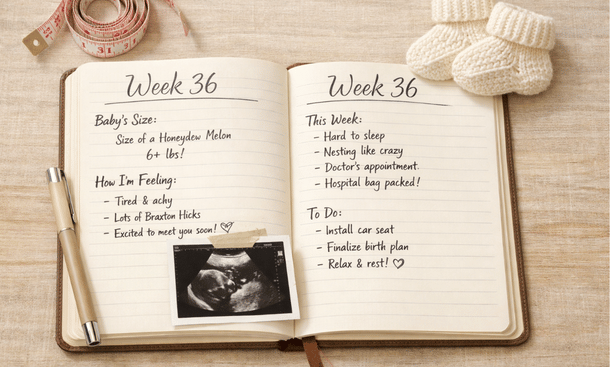
Week 36: One month out
Thirty-six weeks. One month to go if everything stays on track.
Your baby is now considered late preterm — between 34 and 36 weeks — which means a birth at this point carries relatively low risk but still warrants monitoring. Feeding can be challenging for late preterm babies because the coordination of sucking, swallowing and breathing takes time to fully develop.
Lung maturity is close but not complete for every baby at 36 weeks. Your provider may discuss an amniocentesis to test lung maturity if early delivery is being considered for medical reasons.
Fat accumulation is continuing. Your baby is gaining roughly 200 to 250 grams per week through this period. Cheeks are filling out. The body is rounding. They’re starting to look like the baby you’re going to meet.
What months 7 and 8 mean for your body
While your baby is putting on weight and finishing development your body is doing its own preparation work. The hormone relaxin is loosening your ligaments and joints in preparation for labor. Your center of gravity has shifted. Sleep is harder. Heartburn is real. The pressure in your pelvis is increasing as the baby descends.
Braxton Hicks contractions — practice contractions — become more frequent and sometimes more intense. They’re irregular and don’t indicate labor but they’re your uterus rehearsing for what’s coming.
Your blood volume has increased by about 50 percent over the course of the pregnancy. Your heart is working harder than it ever has. Everything your body is doing right now is oriented toward one outcome.
Months seven and eight are where the pregnancy becomes undeniable — to your body, to everyone around you and to your baby who is now dreaming, practicing breathing and storing up the fat and brain development they’ll need for the world outside.
The third trimester growth surge is extraordinary. And it sets up the final chapter — month nine — which is its own kind of milestone. Your baby is going to spend those last weeks putting finishing touches on everything, getting into position and preparing for the moment you finally meet them. All of that is in baby development at 9 months: the final countdown.
And if you want the full map of how every single month connects — from that very first cell division all the way to birth — the complete month-by-month fetal development guide lays it all out in one place.

As an author at Felyro.com, I create actionable content on pregnancy tracking, offering practical tools, tips, and insights that empower mothers-to-be to stay informed and confident throughout their pregnancy.
Hi, everything is going well here and ofcourse every one is sharing information, that’s truly excellent, keep up writing.