

Nine months. You’re here. And honestly it doesn’t quite feel real does it. You’ve been doing this long enough that pregnancy has become your normal and now the end is actually in sight and your brain doesn’t know what to do with that information.
I’ve written about every stage of fetal development and month nine is the one that always gets me the most. Not because the changes are the most dramatic — month two takes that trophy — but because of what they mean. Every single thing happening inside you right now is oriented toward one moment. Your baby is getting ready to meet you.
Let’s talk about what’s actually going on in these final weeks.
Week 37: Full term — but what does that actually mean
Here’s something worth knowing. The definition of full term changed in 2013. Before that 37 weeks was considered full term. Now the medical community distinguishes between early term (37 to 38 weeks) full term (39 to 40 weeks) and late term (41 weeks). This matters because research showed that babies born at 37 and 38 weeks — while generally healthy — have slightly higher rates of feeding difficulties, temperature regulation issues and brief NICU stays compared to babies born at 39 weeks and beyond.
So 37 weeks is not a finish line. It’s more like the doorway to the final room.
At week thirty-seven your baby weighs roughly 2.9 kilograms. The lungs are considered mature for most babies at this point. The brain however is still actively developing and will continue to do so for years after birth.
Week 37 and 38: The finishing touches
These two weeks are about refinement. The vernix — that white protective coating — is mostly shed now. Lanugo is gone. Your baby’s skin has the color and texture it will have at birth.
Fat accumulation continues. About 15 percent of your baby’s body weight is now fat — a number that will feel very real when you’re holding a solid, heavy newborn for the first time.
The digestive system has been practicing for months — swallowing amniotic fluid, processing it, producing meconium in the intestines. Meconium is the dark, sticky first bowel movement your baby will have after birth. It’s been building up in the intestines since the second trimester and is made up of everything your baby has swallowed and processed in the womb — amniotic fluid, lanugo, skin cells.
Week 38: Dropping and engaging
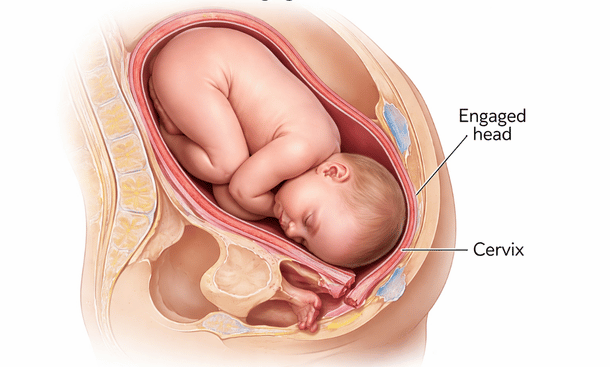
At some point in the final weeks — for first-time mothers often around week 36 to 38, for those who’ve been pregnant before sometimes not until labor begins — your baby drops. This is called lightening or engagement. The baby’s head descends into the pelvis in preparation for birth.
You’ll notice it. The pressure in your upper abdomen eases. Heartburn might improve. Breathing feels easier because your lungs have more room. But the pressure in your pelvis intensifies and walking becomes its own adventure.
This positioning is the baby getting into place. The head pressing against the cervix from the inside is part of what eventually triggers labor — along with a complex cascade of hormones that scientists are still working to fully understand.
Week 39: The brain is still working overtime
This is the week that matters most for neurological development in the final stretch. Between weeks 37 and 40 the brain grows by roughly 35 percent in volume. The connections being made right now — between neurons, between brain regions — are foundational for everything from breathing regulation to feeding reflexes to early sensory processing.
This is the clearest argument against elective early delivery without medical reason. Those final weeks of brain development are not optional extras. They’re essential.
At week thirty-nine your baby weighs somewhere between 3.1 and 3.4 kilograms on average. They’re running out of room. Movements feel different now — more deliberate, more pushing, less rolling. You might feel a foot lodged firmly under your ribs for what feels like days at a time.

Late Pregnancy Glow
Week 40: Due date — and what it really means
The due date is not a deadline. Only about 5 percent of babies are born on their actual due date. It’s an estimate based on a 28-day cycle and a 40-week pregnancy — two averages that don’t apply to everyone.
At forty weeks your baby is considered full term in every sense. Lungs are mature. Brain development has hit its prenatal peak. Fat stores are solid. They’re ready.
But your body might not have gotten the memo yet and that’s okay. Labor starting on its own between 39 and 41 weeks is completely normal. Your provider will monitor you closely if you go past 40 weeks and will discuss induction timing usually around 41 to 42 weeks depending on your individual circumstances.
What your baby is doing at week forty is mostly waiting. Their heart rate patterns have matured. Their movement patterns are established. They have a personality — sleep habits, active periods, favorite positions — that you’ve already learned over months of paying attention.
Week 41: If you go past your due date
Going past 40 weeks is more common than most people realize. About 10 percent of pregnancies reach 42 weeks naturally. The risks associated with post-term pregnancy — placental aging, decreased amniotic fluid, meconium in the fluid — are real but they’re also monitored carefully.
Your provider will likely recommend non-stress tests and biophysical profiles to check on your baby’s wellbeing if you go past 40 weeks. These tests look at heart rate patterns, movement, breathing movements, muscle tone and fluid levels.
Induction is typically discussed around 41 weeks and recommended by 42 weeks. The conversation will be specific to you — your cervix, your baby’s position, your history and your preferences all factor in.

The signs labor is starting
Your baby doesn’t send a calendar invite. Labor announces itself in different ways for different people and sometimes it’s obvious and sometimes it genuinely isn’t.
Bloody show — mucus tinged with blood from the cervical mucus plug — can appear days before labor or hours before. The mucus plug itself can come out in one piece or gradually over days.
Contractions that are irregular and go away when you move around are Braxton Hicks. Contractions that stay consistent, get closer together and intensify regardless of what you do — those are the real thing. The general guidance is 5-1-1: contractions five minutes apart lasting one minute each for one hour. That’s when most providers want you to come in.
Water breaking happens before labor begins for only about 15 percent of people. For most the membranes rupture during active labor. If your water breaks before contractions start call your provider regardless of the time.
What your body has done
I want to take a second here because I think it deserves saying clearly. What your body has done over these nine months is extraordinary. Starting from a single fertilized cell it has built a complete human being — every organ, every nerve, every fingerprint, every eyelash. It has sustained two heartbeats simultaneously. It has restructured its own chemistry, blood volume, organ positioning and hormonal landscape to make this possible.
And now it’s going to do one more enormous thing.
Month nine is the final chapter and it carries everything the previous eight months built toward. Every developmental leap, every milestone, every week of growth has led here — to a baby who is ready, positioned, and waiting to breathe actual air for the first time.
The journey from that first positive test to this moment is one of the most remarkable things human biology does. And if you want to go all the way back to the beginning — back to week one, that first heartbeat, the neural tube forming in the dark — first trimester fetal development week by week is where the whole story starts.
And for the complete picture of every month from conception to birth — all in one place — the complete month-by-month fetal development guide walks you through the entire journey from beginning to end.

As an author at Felyro.com, I create actionable content on pregnancy tracking, offering practical tools, tips, and insights that empower mothers-to-be to stay informed and confident throughout their pregnancy.
you are truly a just right webmaster. The site loading velocity
is amazing. It kind of feels that you are doing any distinctive
trick. Moreover, The contents are masterwork.
you’ve done a fantastic job in this subject!