

Table of Contents
- Why your schedule is everything
- How many times should you pump at work
- Building your schedule around your actual workday
- Sample pumping schedules by work shift
- What to do when sessions get cut short
- Tools that make sticking to your schedule easier
- When your schedule is working — and when it is not
You figured out the nursing rhythm at home. Then you went back to work and that rhythm got completely blown up. Now you are trying to squeeze pump sessions between meetings, wondering if you are doing enough, and second-guessing every decision you make before noon.
The truth is, most pumping advice out there is built around ideal conditions — a quiet room, a flexible schedule, a supportive workplace. Real life looks different. This is about building something that works in the real world, around the job you actually have.
Why your schedule is everything
Your body does not care about your calendar. It cares about consistency. Milk production responds to pattern — the more predictable your pump sessions are, the more reliably your body prepares for them.
Think of it like this: your body starts prepping for a feeding before it even happens. When sessions are random or frequently skipped, your supply system stays in a kind of reactive mode, always playing catch-up. When sessions are consistent, your body anticipates them and produces accordingly.
This is why a mediocre pump used on a reliable schedule will often outperform an expensive pump used sporadically. The schedule matters more than most moms realize.

How many times should you pump at work
The general guidance from most lactation consultants is to pump once for every feeding your baby would have had while you are apart. For a baby under six months who feeds every two to three hours, that usually means two to three pump sessions during a standard eight-hour workday.
Here is a simple breakdown by baby’s age:
Under 3 months: aim for three sessions during an eight-hour shift. Your supply is still being established and consistency is critical at this stage.
3 to 6 months: two to three sessions is typically enough, depending on how well your supply is established and how your body responds to the pump.
6 months and older: if your baby has started solids, two sessions may be sufficient — but watch your output closely before dropping one.
These are starting points, not rules. Your body will tell you if you need to adjust.
Building your schedule around your actual workday
Before you build anything, map out your day honestly. When do you have recurring meetings? When is your lunch? When do things tend to go sideways? Look at a realistic week, not a perfect one.
Then block your pump sessions the same way you block meetings — on your calendar, with a reminder, and treated as non-negotiable. Here is what actually works:
Morning session: aim for within the first two to three hours of arriving at work. If you nursed before leaving home, this session usually falls around the two-hour mark naturally.
Midday session: around the middle of your shift. If you get a lunch break, use part of it. Most moms can pump and eat at the same time.
Afternoon session: about two to three hours before you plan to head home and nurse again. This session is easy to skip when the afternoon gets busy — protect it.
If you can only get two sessions in, space them as evenly as possible across your shift. An eight-hour day with sessions at hour two and hour six is better than both sessions crammed into the first half of the day.
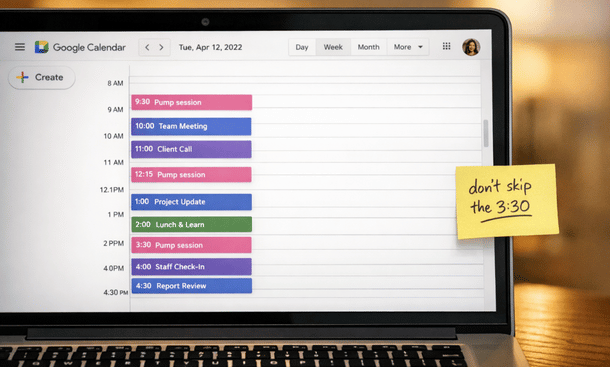
Sample pumping schedules by work shift
Standard 9-to-5 schedule
| Time | Activity |
|---|---|
| 7:00am | Nurse baby before leaving home |
| 9:30am | First pump session at work |
| 12:15pm | Second pump session during lunch |
| 3:30pm | Third pump session |
| 6:00pm | Nurse baby after returning home |
Early shift (6am–2pm)
| Time | Activity |
|---|---|
| 5:30am | Nurse or pump before leaving |
| 8:00am | First pump session |
| 10:30am | Second pump session |
| 1:00pm | Third pump session |
| 2:30pm | Nurse after returning home |
Late shift (2pm–10pm)
| Time | Activity |
|---|---|
| 1:00pm | Nurse before leaving |
| 4:00pm | First pump session |
| 7:00pm | Second pump session |
| 9:30pm | Third pump session |
| 10:30pm | Nurse after returning home |
These are templates. Move sessions by 15 to 30 minutes as needed to fit your reality — the spacing matters more than the exact time.
What to do when sessions get cut short
It is going to happen. A meeting runs long, a call comes in, someone needs you. Here is how to handle it without spiraling.
If you only get ten minutes instead of twenty, pump anyway. A shorter session is always better than a skipped one. Even partial emptying sends the right signal to your body.
If you miss a session entirely, do not try to make it up by pumping longer at the next one. Just resume your normal schedule. One missed session will not derail your supply. A pattern of missed sessions will.
If your workplace makes it consistently difficult to step away, that is a conversation worth having with HR or your manager. In the United States, the PUMP for Nursing Mothers Act requires employers to provide reasonable break time and a private space. You are not asking for a favor. You are exercising a legal right.
Tools that make sticking to your schedule easier
A few practical things that help moms stay consistent:
A pumping timer app. Apps like Baby Tracker or Huckleberry let you log sessions and set reminders. Seeing the gap since your last session on screen makes it harder to justify skipping.
A hands-free pumping bra. It lets you pump and actually do something else at the same time — eat, answer emails, review notes. It turns twenty minutes from dead time into productive time.
A small cooler or dedicated space in the office fridge. Knowing your storage situation is handled removes one mental obstacle from the process.
A backup set of pump parts at work. Forgetting a flange or valve at home can derail your whole day. A second set lives in your pump bag permanently.

When your schedule is working — and when it is not
Give any schedule at least five to seven days before judging it. Supply fluctuates naturally, and your body needs time to adjust to a new pattern.
Signs your schedule is working: your output per session stays roughly consistent, you are not feeling engorged between sessions, and your baby seems satisfied when nursing.
Signs you need to adjust: your output is dropping session by session over multiple days, you are regularly feeling painfully full before a session, or your baby is fussing more at the breast in the evenings. Those signals mean something in the schedule needs to shift — usually adding a session or tightening the spacing.
A good pumping schedule is one of the most powerful things you can do for your supply — but it works best when you also have the right equipment backing it up. If you are not sure whether your current pump is actually doing its job, the guide on choosing the best breast pump for your life as a working mom walks you through exactly what to look for before you invest.
And if you want to see how the schedule fits into the bigger picture — from nutrition to travel strategies — the complete guide to maintaining your milk supply while working and traveling puts it all together in one place.
You are not behind. You are building something that works for your actual life. That takes a little time, and it is worth it.

As a Felyro.com content author, I develop actionable content on breastfeeding, translating research-backed information into practical advice for mothers. My goal is to help families establish healthy feeding habits, improve maternal confidence, and support infant development.