

When you’re tracking a pregnancy and something feels off, the first thing most people do is look at their numbers. And hCG — human chorionic gonadotropin — is the number that tells the whole story in those early weeks. It’s what makes a pregnancy test turn positive. It’s what your tracking app is monitoring when it flags something unusual. And in a chemical pregnancy, it’s the clearest signal that something didn’t go as expected.
The problem is that most of the information out there about hCG levels is either too clinical to be useful or too vague to actually help you understand what you’re looking at. So let’s fix that.
If you’re coming from a broader look at what a chemical pregnancy involves from start to finish, this page goes deeper into the hormone side of things — what the numbers look like, what the timeline is, and how to make sense of what your tracker is telling you.
What hCG actually is and why it matters
HCG is a hormone produced by the cells that will eventually form the placenta. Your body starts making it shortly after a fertilized egg implants in the uterine lining. It’s what pregnancy tests detect — both home tests and blood draws.
In a healthy early pregnancy, hCG rises steadily. The general rule of thumb is that levels double roughly every 48 to 72 hours in the first weeks. That doubling pattern is what tracking apps and fertility clinics use to assess whether a pregnancy is progressing normally.
In a chemical pregnancy, that pattern breaks down. Levels rise briefly — sometimes just enough to trigger a positive test — and then stall or drop before the five-week mark.
What hCG numbers look like in a chemical pregnancy
This is where people want specifics, so here they are.
In a chemical pregnancy, hCG levels typically peak somewhere between 10 and 200 mIU/mL. For context, a healthy pregnancy at five weeks might show levels anywhere from 200 to over 7,000 mIU/mL depending on the individual. The numbers in a chemical pregnancy are low relative to gestational age and they don’t follow the expected doubling pattern.
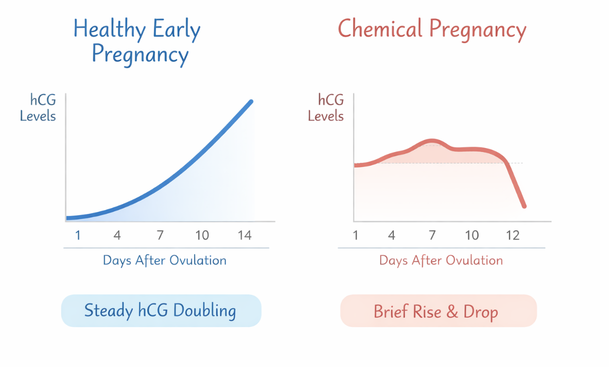
What this looks like in practice: you test at 10 days past ovulation and get a faint positive. You test again at 12 days past ovulation and it looks the same or lighter. By 14 days past ovulation the line is gone or the test is negative. Meanwhile your blood draw shows an hCG that rose to maybe 50 or 80 mIU/mL and is now dropping.
That pattern — a brief, low rise followed by a decline — is the hallmark of a chemical pregnancy from a hormonal standpoint.
Beta hCG testing — what it is and when it helps
A beta hCG test is a blood test that measures the exact amount of hCG in your system. Unlike a home urine test which just gives you a positive or negative (or a line that you spend twenty minutes analyzing in different lighting), a beta draw gives you a precise number.
When doctors want to assess whether an early pregnancy is progressing, they typically order two beta draws 48 hours apart and compare the results. If hCG is doubling or close to it, that’s a reassuring sign. If it’s rising slowly, plateauing, or dropping, that raises concern.
For people who have already experienced a chemical pregnancy or are being monitored for early pregnancy loss, serial beta draws are a standard tool. If you’re actively trying to conceive and have a history of early losses, it’s worth asking your provider about early monitoring.
How home pregnancy tests reflect hCG changes
Most people aren’t getting daily blood draws — they’re using home tests. And the good news is that if you’re testing consistently with the same brand, your test progression can tell you a lot.
The darkness of the line on a pregnancy test is directly related to your hCG level. As hCG rises, the line gets darker. As it drops, the line fades. This is why people who test daily or every other day during a chemical pregnancy often notice that their positive line never really got strong before it started fading.
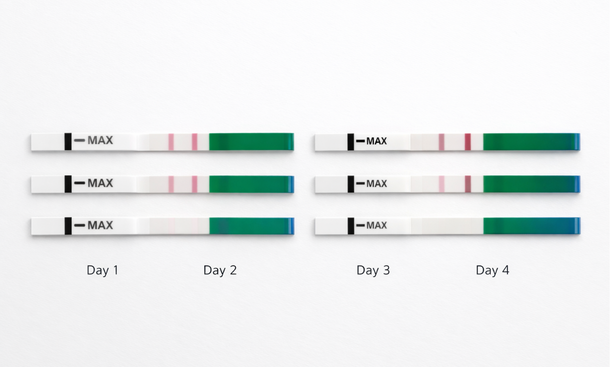
Testing with first morning urine gives you the most concentrated sample and the most reliable line progression. If you’re trying to track hCG trends through home tests, consistency matters — same brand, same time of day, same collection method.
What your tracking app is doing with this data
If you’re using a cycle or pregnancy tracking app, it may be pulling in your test results, your logged symptoms, or even direct data from Bluetooth-enabled test readers. Some apps ask you to photograph your tests and use the image to estimate line darkness over time.
What the app is essentially doing is looking for that doubling pattern. When the data doesn’t show expected progression, a good tracking app will flag it — either with a note about hCG trends or by adjusting your pregnancy timeline.
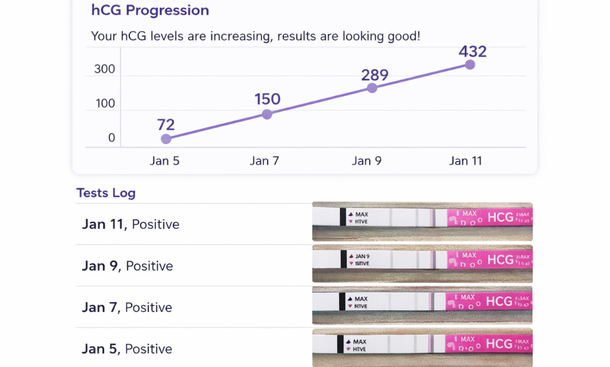
The limitation is that most apps are designed around healthy pregnancy progressions. They aren’t always built to interpret a chemical pregnancy pattern in real time. Knowing what the numbers mean yourself — not just relying on what the app tells you — puts you in a much better position to have an informed conversation with your doctor.
When hCG returns to zero
After a chemical pregnancy, hCG levels drop back to zero. For most people this happens within one to two weeks of the loss. Once hCG is at zero, your body can begin preparing for the next ovulation cycle.
This is clinically significant because hCG needs to be undetectable before a new pregnancy can be accurately assessed. If you were to conceive again before hCG fully cleared, residual levels could complicate interpretation of new test results.
Most providers recommend confirming that hCG has returned to zero before trying to conceive again — not because there’s necessarily a health risk in trying sooner, but because it helps ensure clean baseline data for your next cycle.
When the numbers should prompt a call to your doctor
If your hCG is not dropping as expected after a chemical pregnancy — meaning levels stay elevated or drop very slowly — that warrants medical attention. In rare cases, a persistently elevated hCG can indicate a molar pregnancy, which is a different condition that requires specific management.
One-sided pain combined with low or slowly rising hCG also needs evaluation to rule out an ectopic pregnancy. These situations are uncommon but important to know about.
For the vast majority of chemical pregnancies, hCG drops on its own, bleeding resolves, and no intervention is needed. But knowing when to make the call is part of being an informed patient.
What comes next
Understanding your hCG numbers is one piece of the larger picture. Once those levels return to zero and your body resets, the question most people are sitting with is: what now? When is it safe to try again, what does recovery actually look like, and what should you be monitoring in the next cycle?
All of that is covered in trying again after a chemical pregnancy — the timeline, the fertility piece, and what to watch for going into your next cycle.

As an author at Felyro.com, I create actionable content on pregnancy tracking, offering practical tools, tips, and insights that empower mothers-to-be to stay informed and confident throughout their pregnancy.