

Nobody prepares you for the moment you have to figure out which kind of loss you just went through. You’re already dealing with the emotional weight of it, and now there’s medical terminology being thrown at you — chemical pregnancy, early miscarriage, early pregnancy loss — and it’s not always clear what any of it actually means for your situation.
This page is here to clear that up. Not with a wall of clinical language, but with a real explanation of where the line is drawn, why it matters, and what it means for your tracking, your records, and your next steps.
If you’re still getting grounded in the basics, the full breakdown of what a chemical pregnancy is covers the foundation. Here we’re building on that and getting into the comparison directly.
They’re both early pregnancy losses — so what’s different
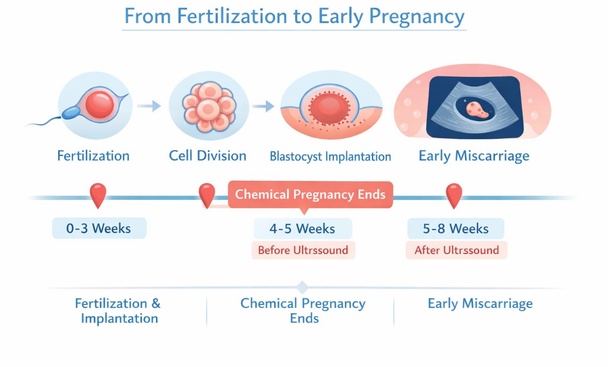
Both a chemical pregnancy and an early miscarriage involve a pregnancy that ends before it’s viable. That part is the same. The difference is mostly about when it happens and what can be seen at the time of the loss.
A chemical pregnancy ends before five weeks of gestation — before anything is visible on an ultrasound. The only evidence that a pregnancy existed at all is a positive hCG test. Once that drops and bleeding begins, there is nothing to see on imaging.
An early miscarriage — sometimes called a clinical miscarriage — happens after the pregnancy has been confirmed on ultrasound. That usually means after five to six weeks, when a gestational sac and sometimes a fetal pole or heartbeat can be detected. When that pregnancy ends, there is clinical evidence beyond just a blood test.
That distinction — ultrasound visibility — is essentially the dividing line between the two terms.
Why the medical world uses different words
The terminology exists for clinical reasons. When a pregnancy has been confirmed on ultrasound, there is a different set of management options, follow-up protocols, and documentation involved. A chemical pregnancy, by contrast, often resolves on its own with no medical intervention needed and may not even appear in some medical records if it was never confirmed beyond a home test.
This is not about one loss being more valid than the other. It is purely a clinical classification. The emotional weight of either experience is real regardless of what it gets called on a chart.
HCG levels tell the story
One of the clearest ways to understand the difference is through hCG levels. In a chemical pregnancy, hCG rises briefly — often peaking somewhere below 100 to 200 mIU/mL — and then drops before the five-week mark. In an early miscarriage, hCG had time to rise higher, development had begun, and the loss happens at a later stage.
If you were getting serial hCG draws during that window, the numbers would tell you a lot about which category you fall into. A pattern of low, stalling, or declining hCG before five weeks points to a chemical pregnancy. Rising levels that then fall after ultrasound confirmation points to an early miscarriage.
This is one of the reasons cycle trackers and fertility-focused individuals often have more clarity on what happened — they’re already monitoring their numbers closely enough to see the pattern.
The emotional difference is real too
Here is something the clinical definitions don’t fully capture: for many people, the emotional experience of a chemical pregnancy and an early miscarriage feel very similar. You had a positive test. You let yourself feel something. And then it was gone.
The fact that a chemical pregnancy ends before ultrasound confirmation does not make the loss smaller. People grieve chemical pregnancies. People feel confused, disappointed, and sometimes devastated by them — and that response is completely legitimate.
What the distinction can affect is how much support or follow-up you receive from the medical system. Chemical pregnancies are often not counted in formal miscarriage recurrence tracking, which can be frustrating for someone who has had multiple early losses and is trying to get answers.

If you feel like your experience is being minimized because it was “just” a chemical pregnancy, you are allowed to push back on that with your provider. Your loss counts.
How your tracking data helps clarify things
If you’re using a pregnancy tracking app or monitoring hCG at home with tracking strips, you may actually have more data about your loss than you realize. The pattern of your test progression — how dark the lines got, when they started fading, when bleeding began — gives you a timeline that can help both you and your doctor understand what happened.
This is one of the real advantages of tracking closely. It turns what might have looked like a late period into documented information about an early pregnancy. That documentation matters if you ever need to discuss your history with a reproductive specialist.
Does the distinction affect future pregnancy planning
For a single loss, probably not much. One chemical pregnancy does not typically trigger medical investigation, and neither does one early miscarriage. The general threshold for further workup is two or more consecutive losses.
Where the distinction matters more is in counting. If you’ve had two chemical pregnancies and one early miscarriage, some providers will count those differently depending on how they were documented. Being clear with your doctor about what happened — including any home test evidence you have — helps ensure your history is recorded accurately.
If recurrent loss is part of your picture, getting clarity on whether those losses were chemical pregnancies or clinical miscarriages can help direct which tests get ordered and what the investigation focuses on.
A quick reference
To keep it straightforward:
Chemical pregnancy ends before five weeks, before ultrasound visibility, hCG rises briefly then drops, resolves without intervention in most cases, may not appear in formal medical records.
Early miscarriage happens after ultrasound confirmation, typically after five to six weeks, involves higher hCG levels that then fall, may require medical management depending on how it progresses, is formally documented as a pregnancy loss.
Both are real. Both matter. And both deserve appropriate follow-up if they happen more than once.
What to read next
Now that the difference between these two types of loss is clear, the next logical piece of the puzzle is understanding the hormone behind all of it. HCG is what confirms a pregnancy, what tracks its progress, and what tells you when something has gone wrong.
The specifics of how hCG behaves during a chemical pregnancy — what the numbers look like, what the timeline is, and how to interpret what your tracker is showing you — are all covered in reading your hCG levels during a chemical pregnancy.

As an author at Felyro.com, I create actionable content on pregnancy tracking, offering practical tools, tips, and insights that empower mothers-to-be to stay informed and confident throughout their pregnancy.