

You know that moment when you’re just sitting there — maybe watching TV, maybe zoning out — and then you feel it. This little flutter. Like a fish tail moving underwater. And you freeze. Was that the baby?
Yeah. That was the baby.
Months four and five are when pregnancy starts feeling less abstract and more real in the most physical way possible. The nausea is mostly gone. Your energy is back. And your baby is in there moving, hearing, growing at a pace that’s honestly hard to keep up with.
I’ve written about fetal development for a long time and the second trimester still gets me. Because this is when a baby stops being a concept and starts being a person.
Week 14: The second trimester officially begins
Week fourteen marks the start of the second trimester and things are moving fast. Your baby is about 8.5 centimeters long — roughly the size of a lemon. The facial muscles are developed enough that they can squint and frown. They’re already making expressions even though no one can see them yet.
The thyroid gland is now producing hormones. Lanugo — a fine layer of soft hair — is starting to cover the body. It acts as insulation and helps regulate temperature in the womb. Most of it sheds before birth but some babies are born with patches of it still present, especially if they arrive early.
Sucking and swallowing reflexes are kicking in. Your baby is already practicing.
Week 15: Bones are hardening
Cartilage is being replaced by actual bone throughout the skeleton. The process is called ossification and it continues well past birth. At week fifteen you can see detailed bone structure on an ultrasound — the femur, the spine, the tiny bones of the hands.
Your baby is also moving their eyes behind those fused eyelids. They can’t see yet but the eye muscles are getting their workout.

Week 16: The anatomy is getting detailed
At sixteen weeks your baby weighs about 100 grams and measures around 11.5 centimeters. The ears are now in their final position on the sides of the head. This matters because your baby can start detecting sound — low frequency sounds first, like the rumble of your voice and your heartbeat.
They’ve been floating in amniotic fluid this whole time and now they’re actively swallowing it. The kidneys are filtering it and producing urine. It’s a closed loop that keeps the fluid levels balanced.
This is also when some parents find out the sex of their baby if they’re looking. The genitals are developed enough to be visible on ultrasound depending on positioning.
Week 17 and 18: Fat is building up
For the first time your baby is starting to accumulate body fat. This is called adipose tissue and it’s going to become increasingly important as birth approaches — fat helps regulate body temperature and stores energy.
The nervous system is maturing rapidly. Myelin — the protective coating around nerve fibers that speeds up signal transmission — is beginning to form. This process continues for years after birth but it starts now.
Week eighteen is also when a lot of people feel the first definitive movements. Not everyone feels it this early. First-time mothers often feel it later than those who’ve been pregnant before because they don’t yet know what they’re looking for. But if you feel something that’s not gas — something rhythmic, something directed — that’s probably your baby.
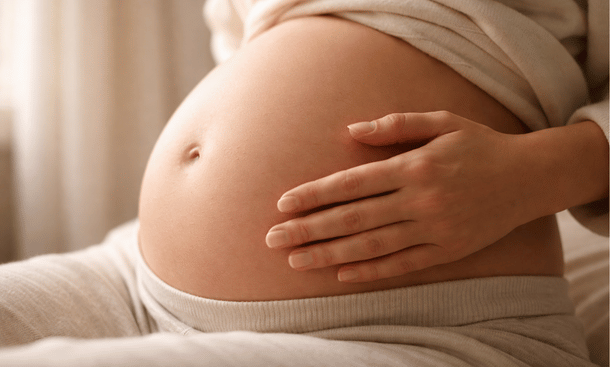
Week 19: The anatomy scan
This is one of the most important appointments of the entire pregnancy. The anatomy scan at around 18 to 20 weeks checks every major organ system — brain, heart, spine, kidneys, limbs. It measures growth. It looks at the placenta position. It can detect a wide range of structural differences.
For a lot of parents this is also the appointment where the sex of the baby is confirmed if they want to know.
Your baby at week nineteen is about 15 centimeters and weighs around 240 grams. The brain is developing distinct regions. The senses are becoming more sophisticated by the day.
Week 20: Halfway there
The halfway mark. Twenty weeks.
Your baby now has eyebrows and eyelashes. Their skin is covered in vernix caseosa — a white waxy coating that protects the skin from the amniotic fluid. You might see traces of it when your baby is born.
Movement is becoming more frequent and more obvious. Some people describe it as popcorn popping. Others say bubbles. Some feel actual kicks and jabs that are unmistakable.
Your uterus is now at the level of your belly button. That’s called fundal height and your doctor will measure it at every appointment from here.
Week 21 and 22: Your baby can hear you
By week twenty-one your baby’s hearing is well enough developed that they’re responding to external sounds. Loud noises might startle them. Your voice — which travels through your body directly — is one of the most familiar sounds they know.
There’s research showing that newborns recognize their mother’s voice from birth. That recognition starts here in the womb during these weeks. So yes, talking to your belly is doing something.
Week twenty-two also brings something interesting: your baby now has a sleep-wake cycle. They’re not awake all the time. They have periods of activity and periods of rest. You might start to notice patterns — maybe they’re more active after you eat, or in the evenings when you’re sitting still.

The quickening: what first movement really feels like
“Quickening” is the old-fashioned term for those first fetal movements and I love it because it’s accurate. It’s this moment when something quickens — comes alive — in a way you can actually feel.
For first-time moms it usually happens between weeks 18 and 22. For people who’ve been pregnant before it can be as early as 16 weeks because they know what to look for.
It starts subtle. Flutters. Bubbles. Then over the following weeks it becomes unmistakable — rolls, jabs, the occasional foot in your ribs at 2am.
Tracking movement becomes an important health indicator later in pregnancy. Your provider will eventually talk to you about kick counts — monitoring your baby’s movement patterns to make sure everything is okay. The habits you build now of tuning in to those movements matter.
Months four and five are the chapter of pregnancy where everything starts feeling tangible. The bump is visible. The movements are real. Your baby is hearing your voice and already knowing it. That’s not nothing — that’s everything.
The second trimester gives you this window of connection that’s hard to describe until you’re in it. And understanding what’s happening developmentally — why the movements feel the way they do, what the anatomy scan is actually looking for, why your baby startles at loud sounds — makes that connection deeper.
From here the pregnancy enters another critical phase. Month six brings one of the most significant milestones of the entire journey — the point of viability — and it comes with some of the most impressive developmental leaps yet. All of that is in fetal viability at 24 weeks: what month 6 really means.
And if you want the full picture of how every month connects from the very beginning, the complete month-by-month fetal development guide walks you through the whole journey in one place.

As an author at Felyro.com, I create actionable content on pregnancy tracking, offering practical tools, tips, and insights that empower mothers-to-be to stay informed and confident throughout their pregnancy.
Have you ever thought about writing an e-book or guest authoring
on other websites? I have a blog based upon on the same
topics you discuss and would love to have you share some stories/information. I know my visitors would enjoy
your work. If you are even remotely interested, feel free to send me an email.