

Month three. You made it. For a lot of people this feels like crossing a finish line — except the race is just getting started. The nausea might be easing up. You might be telling people. And that 12-week scan is either coming up or just happened and you’re still processing that tiny shape on the screen.
But here’s what I want you to actually understand: month three is not just a milestone you survive. It’s one of the most sophisticated developmental periods of the entire pregnancy. Your baby is wrapping up the most complex phase of organ formation and stepping into something new. Less construction. More refinement.
Let me walk you through what’s really going on.
Week 9: From embryo to fetus
This is a word you’ll start hearing more — fetus. At week nine your baby officially transitions from embryo to fetus. It’s not just a label change. It marks a real shift in development. The most critical organ-building phase is wrapping up and growth is about to accelerate.
The tail that was present in earlier weeks has disappeared. The head is still large relative to the body — taking up about half the total length — but facial features are becoming more defined. Eyelids have formed and are fused shut. They won’t open again until around week 26.
Fingers and toes are separating. No more webbing. Tiny individual digits.
Week 10: Organs are functional (sort of)
By week ten the major organs are all present. Heart, brain, lungs, kidneys, liver — they’re there. Most aren’t fully functional yet but they’re starting to do their jobs in early ways.
The kidneys are beginning to produce urine. The liver is making blood cells. The brain is sending signals. None of this is something you’d feel but it’s happening constantly.
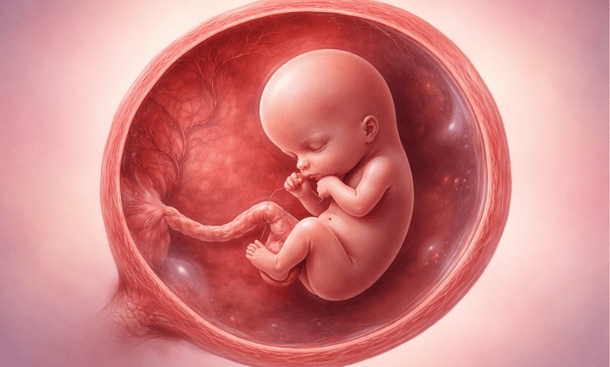
The heart is now beating between 160 and 180 times per minute — almost twice the speed of an adult heart. If you’ve had a Doppler scan you might have heard it for the first time this week. That sound tends to stay with you.
Week 11: Reflexes kick in
Week eleven is when things start getting a little more… active. Your baby is developing reflexes. They’ll open and close their mouth. They’ll respond to touch if the uterine wall is pressed — though you won’t feel any of this yet.
Fingernails are starting to grow. Tooth buds are forming beneath the gums. The intestines, which were temporarily outside the body in a pouch of the umbilical cord, are now moving back inside the abdomen as the body grows large enough to contain them.
That detail right there — the intestines migrating back inside — is one of those things that makes first trimester development feel almost science fiction. The body is solving problems you didn’t even know needed solving.
Week 12: The 12-week scan and a major milestone
This is the big one. The scan most people have been counting down to.
At 12 weeks your baby is about 5.5 centimeters long — roughly the size of a lime. The spine is visible. You can see the profile clearly. Arms and legs are moving even if you can’t feel it. And here’s the detail that gets me every time: your baby already has unique fingerprints.
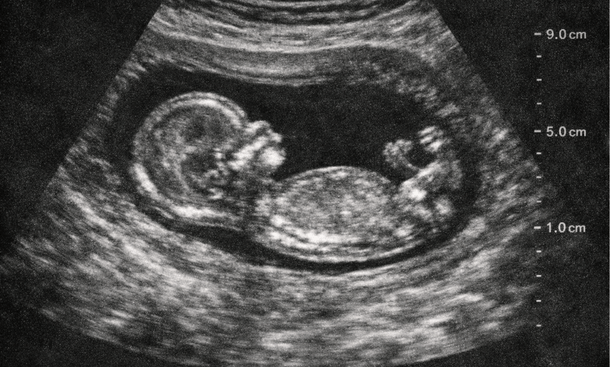
Ultrasound Fetal Profile
The 12-week scan also screens for chromosomal conditions like Down syndrome through nuchal translucency measurement. It’s a lot of information to take in during one appointment. A lot of parents describe it as emotional in ways they didn’t fully expect.
Week 13: Officially into the second trimester
Week 13 is the final week of the first trimester depending on which calendar your doctor uses. Your baby is now producing its own hormones. The vocal cords are forming. Bone is starting to replace cartilage throughout the skeleton.
The placenta has taken over hormone production from the corpus luteum — which is partly why nausea often improves around this time. Your HCG levels start to level off and your body gets a little break.

What “end of first trimester” actually means for your body
For the baby it means the most structurally critical phase is complete. For you it often means a noticeable shift. Energy comes back for a lot of people. Nausea fades. The risk of miscarriage drops significantly after 12 weeks — which is why so many people wait until now to share their news.
Your uterus is moving up out of the pelvis and into the abdomen. You might start to show. Or you might not — and both are completely normal.
The connection to everything else
Month three doesn’t exist in isolation. Every fingernail, every reflex, every heartbeat you’re marveling at right now was set in motion during months one and two when the neural tube formed and the heart first started beating. If you want to go back and understand how all of that happened, first trimester fetal development week by week covers the full picture of those earliest weeks.
Month three is a milestone that deserves real recognition. Not just because the risk numbers change or because you finally get to tell people — but because your baby has genuinely completed one of the most complex developmental phases in human biology. In thirteen weeks they went from a single fertilized cell to a fetus with fingerprints, reflexes and a racing heartbeat.
That’s not small. That’s extraordinary.
And it’s just the beginning. Because next comes the part that a lot of mamas say is their favorite — the second trimester. The bump. The movement. The moment you feel your baby for the very first time. All of that is covered in fetal movement in the second trimester: months 4 & 5.
And if you want the full map of how every month connects — from that first positive test all the way to birth — the complete month-by-month fetal development guide has everything in one place.

As an author at Felyro.com, I create actionable content on pregnancy tracking, offering practical tools, tips, and insights that empower mothers-to-be to stay informed and confident throughout their pregnancy.