
Table of Contents
- Why the wrong pump costs you more than money
- The three main types of breast pumps
- Wearable pumps: freedom with trade-offs
- Electric double pumps: the reliable workhorse
- Hospital-grade pumps: when you actually need one
- What specs actually matter
- Insurance, cost, and what to do before you buy
You are standing in a baby store or scrolling through Amazon at midnight, looking at seventeen different breast pumps with seventeen different claims on the box. Every single one says it is the best. None of them tell you which one works for a woman with back-to-back Zoom calls, a forty-minute commute, and a baby who cluster feeds every evening.
Choosing a pump is not really about features. It is about your life. And once you understand the actual differences between your options, the decision gets a lot simpler.
Why the wrong pump costs you more than money
A pump that does not fit your schedule or your body will quietly chip away at your supply. Maybe it takes too long and you start cutting sessions short. Maybe the suction never quite triggers a full letdown. Maybe it is so loud or bulky that you avoid using it in certain situations.
Over weeks, those small compromises add up. Moms often blame their bodies when the real issue is a mismatch between their pump and their daily reality. Getting this choice right from the start saves you stress, money, and milk.

The three main types of breast pumps
Before getting into brands or specs, you need to understand the three categories. Everything else flows from here.
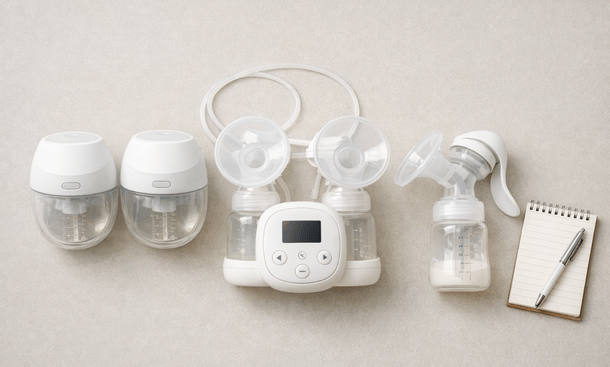
Wearable pumps sit inside your bra and collect milk in small cups attached directly to your breast. No tubes, no cords. You can walk around, type, take calls, and nobody around you knows what is happening under your blazer.
Double electric pumps are the traditional plug-in or rechargeable pumps with flanges, tubing, and a motor unit. They typically offer stronger, more customizable suction and are more effective at draining the breast fully compared to most wearables.
Hospital-grade pumps are clinical-level machines, usually rented rather than purchased. They have the strongest motors available and are designed for moms who need to establish or rebuild supply, or who are exclusively pumping.
Most working moms end up with a combination — often a wearable for convenience during the workday and an electric pump for morning and evening sessions at home.
Wearable pumps: freedom with trade-offs
Wearable pumps changed the game for working moms. The ability to pump during a meeting, on a train, or while walking between floors of an office building is genuinely useful. If discretion and mobility are priorities for you, a wearable is worth considering seriously.
The trade-offs are real though. Most wearables have weaker suction than traditional electric pumps. The collection cups have limited capacity — usually around four ounces per side — which can be a problem if you produce a lot. And they require more cleaning parts, which adds up when you are doing multiple sessions a day.
They also tend to work better for moms with an established supply than for moms who are still building one in the early weeks back at work.
Some of the most consistently reviewed wearable options include the Elvie Stride, the Willow Go, and the Momcozy S12 Pro. Each has a different price point and suction profile, so it is worth reading detailed comparisons before committing.

Electric double pumps: the reliable workhorse
If you can only have one pump, a double electric is the most versatile choice for most working moms. They drain both breasts simultaneously, offer adjustable suction levels, and are significantly more effective at triggering letdown for moms who struggle with the pump response.
Modern rechargeable double electrics have gotten much more portable. Options like the Spectra S1 Plus — one of the most recommended pumps among lactation consultants — run on a rechargeable battery, which means no wall outlet required.
What to look for in an electric pump:
Closed system design, meaning there is a barrier between the milk collection area and the motor. This prevents mold growth in the tubing and is a basic hygiene standard worth not compromising on.
Adjustable suction and cycle speed. Every mom’s letdown is different. A pump that lets you control both the speed of the cycle and the strength of suction gives you the ability to find what actually works for your body.
Battery life. If you are pumping away from an outlet — in a car, a lactation room without a plug, or a conference room — battery matters. Check real-world reviews, not just manufacturer claims.
Noise level. This matters more than people admit. A loud pump in a shared pumping room is stressful. A quieter one makes the whole experience easier.
Hospital-grade pumps: when you actually need one
Hospital-grade pumps are not for everyone, but there are specific situations where they make a meaningful difference.
You might genuinely benefit from a hospital-grade pump if your baby was born premature and is not yet nursing directly, if you are trying to rebuild a supply that has significantly dropped, if you are exclusively pumping and your baby is not nursing at all, or if you have had breast surgery that affects your milk production.
These pumps are typically rented through hospitals, lactation centers, or companies like Medela or Ameda. Monthly rental costs vary but are usually covered fully or partially by insurance when there is a medical reason. Your lactation consultant or OB can provide the documentation needed if you qualify.
For the average working mom with an established supply and a nursing baby at home, a hospital-grade pump is usually more than you need. But knowing the option exists matters.
What specs actually matter
Beyond the categories, here are the technical specs worth paying attention to — with a plain explanation of each.
Flange size: the flange is the funnel-shaped piece that goes against your breast. Most pumps come with a standard size, but fit matters enormously. A flange that is too large or too small reduces efficiency and can cause discomfort over time. Many lactation consultants offer flange fitting virtually now, and it is worth doing before you settle into a routine.
Suction strength (measured in mmHg): this refers to the pressure the pump generates. Higher is not automatically better — what matters is finding the level that triggers your letdown without causing pain. Most moms find their sweet spot somewhere in the middle range, not at maximum.
Cycle speed: this is how many suck-and-release cycles the pump completes per minute. Faster cycles in the early phase of a session mimic a baby’s initial rapid sucking to trigger letdown. Slower, deeper cycles mimic nutritive sucking. Pumps that let you adjust both give you more control.
Parts compatibility and availability: this is boring but important. If a valve cracks or a membrane wears out, you need to be able to replace it quickly. Before buying, check that replacement parts are available on Amazon or at a local pharmacy. Some newer or off-brand wearables have proprietary parts that are hard to find.

Insurance, cost, and what to do before you buy
Here is something a lot of moms do not know until after they have already paid out of pocket: most health insurance plans in the United States are required to cover a breast pump at no cost under the Affordable Care Act. Coverage varies by plan — some cover rentals, some cover purchase, some have a list of approved options.
Before you spend anything, call the member services number on your insurance card and ask specifically what breast pump coverage you have. You can also use services like Aeroflow Breastpumps, which handle the insurance verification for you and ship an approved pump directly to your home.
If your plan covers a basic electric but you want a wearable, some services let you pay the difference out of pocket. Know what you are working with before you make any decisions.
A few things worth doing before you finalize your choice:
Talk to a lactation consultant if you can. Many hospitals offer free consultations postpartum, and some insurance plans cover them. A consultant who has seen your nursing relationship can give you specific guidance on what type of pump will work best for your body and your output.
Read real reviews from moms with similar work situations, not just overall star ratings. A pump that works great for a work-from-home mom may be a poor fit for someone commuting and working in an open office.
And if possible, do not buy your backup pump before you have used your primary one for a few weeks. Your needs will become clearer once you are actually in the routine.
Once you have the right pump, the next challenge is keeping your supply steady when your location changes. Whether it is a work trip, a conference, or a family vacation, pumping away from home brings a whole new set of logistics. The guide on how to pump and protect your supply while traveling covers the airports, the hotels, the TSA rules, and everything in between.
And if you want to understand how your pump choice fits into a full strategy — from scheduling to nutrition to travel — the complete guide to maintaining your milk supply while working and traveling is where the whole picture comes together.
The right pump for your life is out there. Now you know exactly what to look for.

As a Felyro.com content author, I develop actionable content on breastfeeding, translating research-backed information into practical advice for mothers. My goal is to help families establish healthy feeding habits, improve maternal confidence, and support infant development.