

Table of Contents
- Why supply dips when life gets busy
- The foods that genuinely support milk production
- Hydration: the most underrated supply tool you have
- How stress silently drains your output
- Sleep, rest, and what to do when you cannot get enough
- Movement, exercise, and finding the right balance
- What actually works versus what is just marketing
Nobody tells you that going back to work while breastfeeding means managing two full-time jobs with one body. You are producing milk, recovering from pregnancy, performing at work, and running a household — often on broken sleep and whatever food you can grab between meetings.
And then someone asks why your supply dropped.
The answer is usually not one dramatic thing. It is the accumulation of small daily habits that quietly work against your body’s ability to produce milk. The good news is that the same logic works in reverse — small, consistent shifts in the right direction make a real difference, even inside a busy life.
Why supply dips when life gets busy
Milk production is a biological process that responds to your overall physical state. When your body is under chronic stress, under-fueled, or consistently dehydrated, it makes calculated trade-offs. Milk production is metabolically expensive — your body is generating a complete food source from scratch. When resources are scarce, that process gets quietly deprioritized.
This is not your body failing you. It is your body doing exactly what it is designed to do — protect your core functions first. Understanding that reframe matters because it shifts the question from “what is wrong with me” to “what does my body need right now.”
The answer is almost always some combination of more consistent nourishment, better hydration, and a reduction in the chronic stress load that modern working motherhood practically guarantees.
The foods that genuinely support milk production
Galactagogues — foods and herbs believed to support or increase milk supply — have been used across cultures for centuries. The scientific evidence behind them ranges from solid to anecdotal, but several have enough real-world consistency among nursing moms to be worth including in your diet.
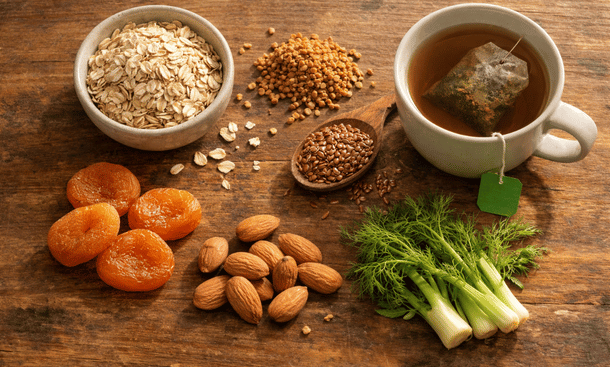
Oats are the most consistently recommended food for breastfeeding moms. They are rich in iron, and low iron levels are directly linked to reduced milk supply. A bowl of oatmeal in the morning is one of the simplest, most accessible things you can do. Steel-cut oats have a lower glycemic impact than instant, but any oats are better than none.
Fenugreek is an herb with the most research behind it of any galactagogue. It is available as a supplement, a tea, or in its seed form. Some moms notice a difference within 24 to 72 hours of consistent use. It is also one of the few galactagogues with actual clinical trials, though results are mixed and dosing matters. Worth noting: fenugreek is not recommended for moms with diabetes or thyroid conditions without consulting a doctor first.
Fennel — both the vegetable and the seed — has a long traditional history of use for milk support. It works similarly to fenugreek and is gentler on the digestive system for most people. Add it to salads, soups, or steep it as a tea.
Flaxseeds and flaxseed oil contain phytoestrogens, plant compounds that weakly mimic estrogen and may support prolactin activity. Ground flaxseed is easy to add to oatmeal, yogurt, or smoothies.
Leafy greens — spinach, kale, moringa — are nutrient-dense and contain calcium, iron, and folate, all of which support overall hormonal health and energy. Moringa in particular has growing evidence behind it as a lactation support food in several international studies.
Almonds and other nuts are calorie-dense, easy to carry, and provide healthy fats that support milk fat content. A small handful at your desk is more useful than a lactation cookie with questionable ingredients.
What does not have strong evidence behind it: most commercial lactation cookies, drinks, and supplements. Many contain oats and flaxseed — which do help — but charge a significant premium for the packaging. Make the oatmeal yourself. Save the money.
Hydration: the most underrated supply tool you have
Breast milk is approximately 87 percent water. If you are not drinking enough, your body simply does not have the raw material to produce at full capacity. This is not a metaphor — it is basic physiology.
The general recommendation for breastfeeding moms is around 128 ounces, or roughly 16 cups of fluid per day. That sounds like a lot, and it is more than most people drink. But it does not all have to be plain water. Herbal teas, broth, milk, and water-rich foods like cucumbers, watermelon, and oranges all count.
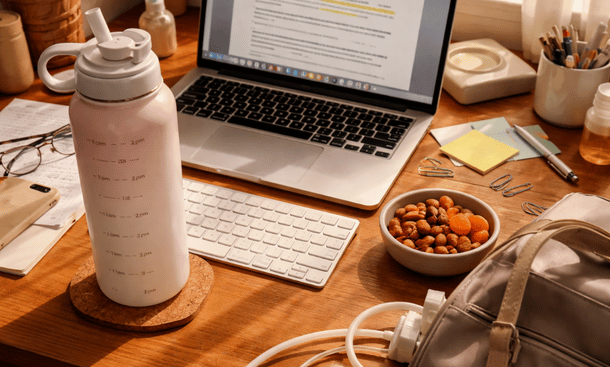
The most practical strategy: drink a full glass of water every single time you sit down to pump. Build it into the habit so it happens automatically. Keep a large water bottle at your work desk and a second one in your pump bag. If you find plain water boring, add lemon, cucumber, or a splash of juice.
Signs you are not drinking enough: your urine is dark yellow rather than pale, you feel thirsty during pump sessions, and your output seems to vary significantly based on how much you drank the day before.
How stress silently drains your output
Cortisol, the primary stress hormone, directly interferes with oxytocin — the hormone responsible for milk letdown. When your cortisol levels are chronically elevated, your letdown reflex becomes sluggish. You sit down to pump, the milk is there, but it does not release efficiently. Sessions run longer, output drops, and the frustration of watching the bottles adds more stress to the loop.
This is one of the most vicious cycles in breastfeeding. The stress of low supply causes more cortisol, which causes lower supply.
Breaking the loop does not require eliminating stress — that is not realistic. It requires building small moments of nervous system regulation into your day, particularly around pump sessions.
A few things that genuinely help: slow, deliberate breathing for sixty to ninety seconds before starting a session. Looking at photos or videos of your baby. A warm compress on your breasts before pumping. Keeping the pumping environment as calm and private as possible — even if that means putting headphones in and listening to something you enjoy.
These are not wellness extras. They are functional strategies that work with your biology to get milk moving.
If your workplace stress is severe and sustained — an unsupportive manager, an unreasonable workload, a hostile environment around pumping — that is worth addressing directly, because no amount of oatmeal and deep breathing will fully compensate for a fundamentally stressful work situation.
Sleep, rest, and what to do when you cannot get enough
Prolactin, the hormone that drives milk production, is released in higher quantities during sleep — particularly in the early morning hours. Chronic sleep deprivation suppresses prolactin levels over time and contributes to gradual supply decline.
The advice to “sleep when the baby sleeps” is well-intentioned and largely useless for a working mom with a to-do list, a household to manage, and approximately fifteen minutes of personal time per day. So instead of pretending more sleep is simply a choice you can make, here are realistic approaches.
Protect one longer sleep block per night if at all possible. Even a single four to five hour uninterrupted stretch does more for your hormonal recovery than six hours of fragmented sleep. If your partner, a family member, or a night nurse can take one feeding, that uninterrupted block becomes more achievable.
Rest is not the same as sleep, but it is not nothing either. Ten minutes horizontal with your eyes closed during lunch — even if you do not sleep — reduces cortisol. A short rest before your evening nursing session can improve letdown quality.
And if you are in a season of severe sleep deprivation, know that your supply will likely recover as sleep improves. It is not permanent damage. It is your body responding to current conditions.
Movement, exercise, and finding the right balance
Moderate exercise does not negatively affect breast milk supply or composition for most moms. It supports hormonal balance, reduces cortisol over time, and improves sleep quality — all of which indirectly benefit your supply.
The word to hold onto is moderate. High-intensity training, particularly if you are significantly under-fueling, can suppress supply by adding physical stress to an already taxed system. If you are noticing supply dips after intense workouts, try reducing intensity temporarily and see if output recovers.
A few practical notes: nurse or pump before exercising rather than after. Milk produced right after intense exercise can temporarily have slightly higher lactic acid content, which some babies object to — though most do not. Stay hydrated before, during, and after any movement. And eat enough to support both exercise and milk production — this is not the season for a calorie deficit.
Walking, yoga, swimming, and light strength training are consistently the most compatible forms of exercise with breastfeeding. They support your body without adding significant stress to the system.

What actually works versus what is just marketing
The lactation supplement market is enormous, and a significant portion of it is built on anxious moms spending money on products that offer very little beyond expensive oats and placebo confidence.
What has real evidence behind it: oats, fenugreek at adequate doses, moringa, staying hydrated, managing stress, consistent pump sessions, and getting enough calories. These are not exciting. They do not come in a pretty box. But they work.
What is mostly marketing: proprietary lactation blends with undisclosed quantities of ingredients, lactation bars that cost eight dollars each, drinks that are essentially flavored water with a trace of fenugreek, and supplements that list seventeen ingredients at quantities too small to have any physiological effect.
This does not mean commercial lactation products are always useless. Some moms find them helpful, and if something gives you confidence and helps you relax around pumping, that psychological effect has real value. But it should be an add-on, not your primary strategy.
Your primary strategy is food, water, consistency, and stress reduction. Everything else is supporting cast.
Supply support is not one big intervention. It is a collection of small, consistent choices made inside a life that is already full. The food you eat before you leave the house. The water bottle you keep at your desk. The sixty seconds of breathing before a pump session. None of it is dramatic. All of it adds up.
If you are just starting to understand why your supply shifted when you went back to work, the piece on why milk supply drops when you return to work explains the biology behind it — and knowing the why makes everything else easier to act on.
And when you are ready for the full picture — scheduling, pump choices, travel, nutrition, all of it woven together — the complete guide to maintaining your milk supply while working and traveling is where everything connects.
You are already doing more than you realize. Keep going.

As a Felyro.com content author, I develop actionable content on breastfeeding, translating research-backed information into practical advice for mothers. My goal is to help families establish healthy feeding habits, improve maternal confidence, and support infant development.