

Why timing matters more than most people expect
A lot of women assume that once they stop birth control, pregnancy just happens. And sometimes it does. But for many women, the months go by without a positive test — not because anything is wrong, but because they were simply missing the window.
Here is the reality. A healthy egg survives for only 12 to 24 hours after ovulation. Sperm, on the other hand, can live inside the reproductive tract for up to five days under the right conditions. That means your actual fertile window — the days when conception is biologically possible — is roughly six days long, ending on the day of ovulation itself.
Miss that window, and conception is not happening that cycle, no matter how often you try.
Ovulation tracking exists to help you stop guessing and start knowing. And once you understand what your body is actually doing each month, the whole process feels a lot less random.
Understanding your cycle before you start tracking
Before any tool makes sense, you need a basic map of what’s happening inside your body each month.
A typical menstrual cycle runs anywhere from 21 to 35 days. Day one is the first day of your period. Ovulation — the release of a mature egg from one of your ovaries — generally happens around the midpoint of your cycle, but not always on day 14. That number comes from a 28-day cycle average and does not apply to everyone.
Your cycle has two main phases divided by ovulation.
The follicular phase runs from day one through ovulation. During this time, rising estrogen levels trigger the development of follicles in your ovaries, one of which will mature and release an egg. This phase is the variable one — it can be shorter or longer depending on stress, illness, travel, or hormonal fluctuations.
The luteal phase runs from ovulation through the start of your next period. This phase is far more consistent, typically lasting 12 to 14 days in most women. If your luteal phase is shorter than 10 days, it’s worth mentioning to your doctor, as it can affect implantation.
Knowing your cycle length over several months gives you a baseline. Three months of data is more useful than one.
Basal body temperature: the slow and steady method
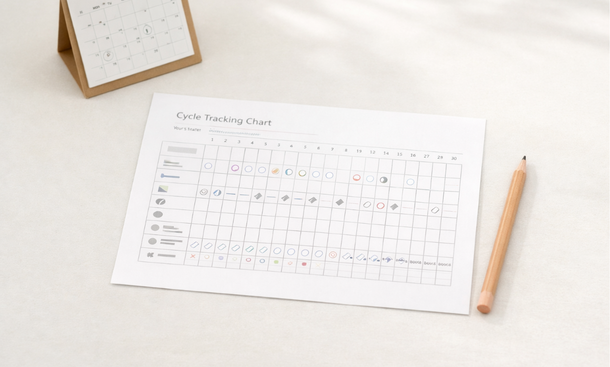
Basal body temperature, commonly shortened to BBT, is your resting body temperature taken first thing in the morning before you move, speak, eat, or get out of bed.
After ovulation, your body releases progesterone, a hormone that causes a small but measurable rise in resting temperature — typically 0.2 to 0.5 degrees Fahrenheit. When you track this shift over multiple cycles, a pattern emerges that tells you when in your cycle ovulation is occurring.
What you need: a basal body thermometer, which measures to two decimal places, unlike a standard fever thermometer. You take your temperature at the same time every morning before getting up, and record it daily.
The important thing to understand about BBT is that it confirms ovulation after it has already happened. It does not predict it in real time. So in your first few months of tracking, you are building a map. Over time, that map tells you when to expect ovulation in future cycles — which is where it becomes genuinely useful for timing.
BBT tracking becomes less reliable if you sleep fewer than three consecutive hours before taking your temperature, drink alcohol the night before, are sick, or take your temperature at a significantly different time than usual. Note those disruptions in your chart rather than ignoring them.
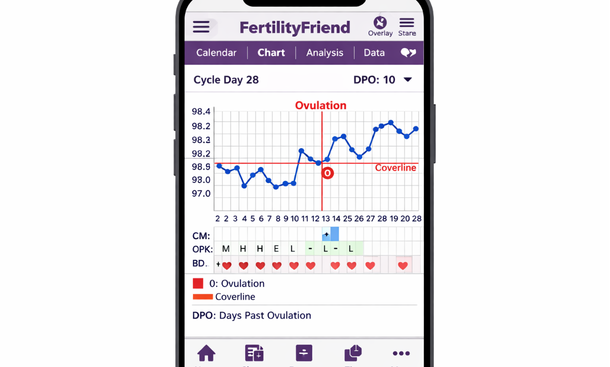
Apps like Fertility Friend and Natural Cycles can chart your BBT data and flag your temperature shift automatically. They won’t replace your own pattern recognition, but they make the data easier to read over time.
OPK strips: the most popular tool for a reason
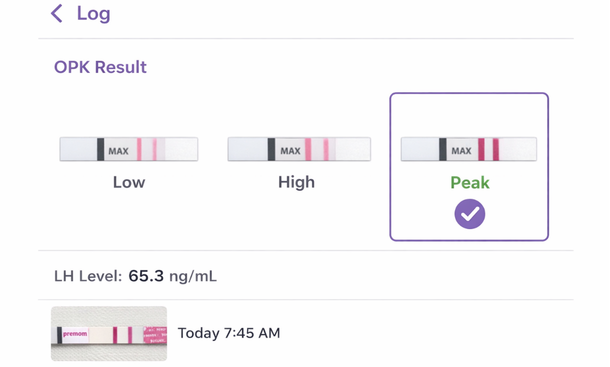
OPK stands for ovulation predictor kit. These are urine-based tests that detect the surge in luteinizing hormone, or LH, that triggers ovulation. LH surges 24 to 36 hours before an egg is released, which means a positive OPK gives you an advance window to work with — making it one of the most practical tools available.
Standard OPKs show two lines. The test line needs to be as dark as or darker than the control line to count as a positive. A faint line is not a positive. Many women make that mistake and act on it too early.
Digital OPKs, like the Clearblue Advanced, show a smiley face for peak fertility and give slightly more interpretive help, though they cost significantly more per test.
How to use them effectively:
Start testing a few days before your expected ovulation based on your cycle length. For a 28-day cycle, start around day 10. For a 35-day cycle, start closer to day 17. Test once daily at first, then twice daily — once in the morning and once in the early afternoon — as you approach your expected window. LH surges can be short, and testing only once a day occasionally misses them.
One important note for women with PCOS: elevated LH levels throughout the cycle can cause false positives on OPK strips, making them less reliable as a standalone tool. Combining OPKs with BBT tracking gives a clearer picture in those cases.
Cervical mucus: the free method your body already gives you
Your body produces a natural discharge throughout your cycle, and its consistency changes in a predictable pattern that reflects your hormone levels and fertility.
Right after your period, you may notice little to no discharge. As estrogen rises in the follicular phase, discharge gradually increases and becomes creamier in texture. As ovulation approaches, it shifts into what is commonly described as egg white cervical mucus — clear, slippery, stretchy, and similar in consistency to raw egg whites. This is your most fertile mucus. It supports sperm motility and survival.
After ovulation, progesterone causes mucus to become thicker, stickier, and less transparent.
Checking cervical mucus takes about a week of observation before the pattern becomes clear. You check by wiping with toilet paper before urinating and noting the texture and appearance. Some women check internally, which gives a clearer sample.
Cervical mucus tracking is especially useful when combined with BBT or OPKs because it gives you a real-time signal while your temperature shift gives you confirmation afterward. Together they triangulate your fertile window from multiple angles.
Fertility tracking apps: useful tool or false confidence
There are dozens of fertility apps on the market. Some are genuinely useful. Others create a false sense of precision that can actually delay women from getting help when they need it.
Apps that predict ovulation based on cycle length alone — which includes many of the most popular general period-tracking apps — are making statistical guesses. They assume your cycle is regular and that you ovulate at a predictable point. For many women, that assumption is wrong enough to matter.
Apps worth using are ones that incorporate your actual data rather than just your calendar.
Fertility Friend is one of the most comprehensive free options. It charts BBT, cervical mucus, and OPK results together and flags your temperature shift and probable ovulation day. It has a learning curve but gives you real pattern recognition.
Natural Cycles uses BBT as its core input and has FDA clearance as a birth control method, which gives it a level of scientific validation most apps lack. It works well for conception tracking too.
Premom is specifically designed around OPK strip reading. You photograph your strips inside the app and it reads the line darkness for you, which removes a lot of the subjective interpretation.
When tracking alone is not enough
Ovulation tracking is a powerful tool, but it is not a diagnostic one. There are situations where tracking data should prompt a conversation with your doctor rather than more months of trying.
Talk to your provider if:
- You have been tracking carefully for three or more cycles and consistently cannot identify a clear ovulation pattern
- Your BBT chart never shows a sustained temperature shift, which can indicate anovulation — cycles where no egg is released
- Your OPK results are consistently negative even when testing twice daily across an extended window
- Your cycles are very irregular, shorter than 21 days, or longer than 35 days
- You are 35 or older and have been trying for six months without success
- You are under 35 and have been trying for twelve months without success
Tracking data is genuinely useful to bring to that appointment. A printed chart or app export gives your doctor a much richer picture than “we’ve been trying for a while” alone.
Putting it all together without losing your mind
The most common mistake women make with ovulation tracking is doing too much too fast and burning out in the first two months.
Start with one method. OPK strips are the most accessible entry point for most women because they give a clear, actionable signal without requiring weeks of baseline data first. Add BBT tracking in your second or third cycle if you want to confirm ovulation and build a longer pattern. Add cervical mucus observation when it starts to feel manageable rather than overwhelming.
Use an app to consolidate the data rather than trying to interpret it all manually.
And give yourself at least two to three full cycles before drawing conclusions. One cycle of data tells you almost nothing. Three cycles starts to show you your actual pattern.
The goal is to feel informed, not consumed. Ovulation tracking works best when it becomes a quiet, consistent habit rather than a daily source of anxiety.
Understanding your fertile window is a big piece of the preconception puzzle — but if you are over 35, the conversation around timing gets a little more layered. Age affects not just when you ovulate but how your body responds to conception attempts overall. The article on getting pregnant after 35 covers exactly what changes, what still works in your favor, and how to approach preconception prep with that context in mind.
And if you want to see how cycle tracking fits inside the bigger picture of everything involved in getting your body ready, the complete guide to preparing for pregnancy connects all the pieces in one place.
