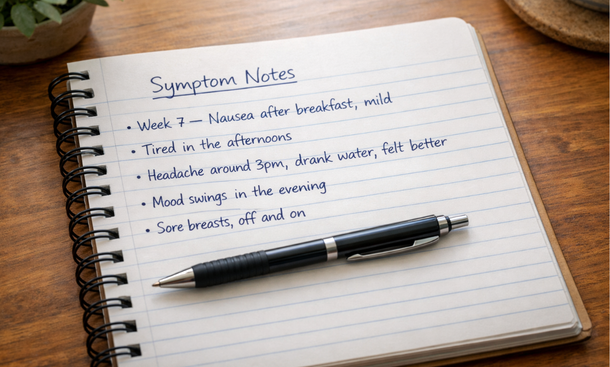
So you peed on the stick, it came back positive, and now every single thing your body does feels like a clue you need to decode immediately. I get it. When I was newly pregnant, I was tracking every twitch, every headache, every weird food aversion like I was training for some kind of medical detective exam. And honestly? That’s not entirely wrong. Tracking your symptoms during pregnancy is genuinely one of the smartest things you can do. The problem is when it stops being a tool and starts being a source of panic.
That line — right there — is what safe tracking is all about.
What “safe” actually means in this context
When most people hear “safe pregnancy tracking,” they think it means tracking the right symptoms or using the right app. And yeah, that’s part of it. But the bigger piece is about your relationship with the information you’re collecting.
Safe tracking means you’re logging symptoms to have more informed conversations with your OB. It means you notice a pattern and bring it up at your next appointment — not that you notice a pattern and spend four hours going down a Reddit rabbit hole at 2 AM convincing yourself something is wrong.
There’s a real difference between being informed and being consumed. Safe tracking lives on the informed side of that line.
If you want the full picture of how to build that kind of tracking routine from scratch, the complete guide to tracking pregnancy symptoms safely covers everything trimester by trimester. This page is about the mindset and the foundation before any of that.
Why tracking matters — and why it can go sideways
Here’s something your OB probably won’t have time to explain in a ten-minute appointment: your symptoms tell a story. A headache every afternoon in week eight might be dehydration. Nausea that spikes right after eating might point to something your doctor can actually help with. Spotting at week six paired with cramping is a completely different conversation than spotting alone.
None of that information gets communicated well when you just say “I’ve been feeling off.”
Tracking gives you specifics. Specifics lead to better care. That’s the whole point.
But here’s where it goes sideways: when tracking becomes a substitute for medical care instead of a complement to it. When you’re spending more time analyzing your own data than actually resting and taking care of yourself. When every entry in your symptom journal sends you into a spiral instead of giving you clarity.
That’s not safe tracking. That’s anxiety wearing a notebook.
Symptom Journal Entry
The three things safe tracking actually requires
You don’t need a fancy system. You don’t need five apps running at once. What you need is pretty straightforward.
Consistency over completeness. You don’t have to log every single symptom every single hour. What matters is that you check in with yourself at roughly the same time each day and note what feels notable. A daily five-minute check-in is worth ten times more than an obsessive hourly log that you burn out on by week nine.
A clear scope. Decide in advance what you’re tracking and why. Are you logging nausea to see if it has a pattern? Tracking fatigue to figure out if it’s tied to sleep or nutrition? Having a reason for each thing you track keeps you focused and keeps the data useful. Random symptom collection without context is just noise.
A reality check system. This one’s underrated. Build in a rule for yourself: if something you log is genuinely worrying you, you have one of two options. You either call your doctor or you put it on a list to bring up at your next scheduled appointment. What’s not on the menu is Googling it at midnight. That rule alone will save your sanity.
What safe tracking is not
It’s not diagnosing yourself. Full stop.
Your symptom journal is a communication tool. It’s not a diagnostic report. Even if you’re a nurse, a doctor, a med student — when it’s your own pregnancy, you are not the clinician. You’re the patient. And patients bring information to providers; they don’t treat themselves based on that information.
It’s also not a competition. This comes up more than you’d think, especially in online communities. Someone posts that they had zero nausea and another person panics because their nausea is “too bad.” Someone tracks fetal movement starting at week 16 and someone else worries because they haven’t felt anything yet. Every pregnancy is different. Your tracking data is yours. It doesn’t need to be benchmarked against anyone else’s experience.
Coffee Shop Chat
The mental health angle nobody talks about enough
Pregnancy anxiety is real and it is extremely common. And for a lot of women, symptom tracking can either help manage that anxiety or feed it — depending entirely on how it’s done.
If you find yourself checking your tracking app more than five or six times a day. If logging a new symptom immediately sends your heart rate up. If you feel relief for about thirty seconds after researching something and then the worry creeps back in — that’s worth paying attention to. That’s not a tracking problem. That’s an anxiety problem, and it deserves real support.
Talk to your OB about it. Talk to a therapist if you have access to one. A lot of major cities — New York included — have perinatal mental health specialists who work specifically with pregnant women on exactly this stuff. It’s not dramatic to ask for that support. It’s actually the smartest tracking move you can make.
Therapy Session Serenity
How to know if your tracking is working
Here’s my personal test: after a week of tracking, do you feel more informed or more anxious? If it’s more informed — great, you’re doing it right. If it’s more anxious, something in the approach needs to shift.
Good tracking should make your OB appointments more productive. It should help you notice real patterns. It should give you language to describe what you’re experiencing instead of just “I don’t know, I just feel weird.”
If your logs are turning into a source of dread, pull back. Track less. Track simpler. One entry a day, three things max. And if the anxiety doesn’t ease up, loop in your provider.
Before you move on
Getting the foundation right matters more than any app or template. Once you’re clear on what you’re tracking and why — and you’ve got a handle on the emotional piece — the practical stuff gets a lot easier.
A great next step from here is understanding exactly which symptoms deserve a spot in your log during the earliest weeks of pregnancy. First trimester symptoms you should be logging — and which ones to flag immediately gets specific about what’s worth tracking in weeks one through twelve and what should have you picking up the phone to your doctor.
As an author at Felyro.com, I create actionable content on pregnancy tracking, offering practical tools, tips, and insights that empower mothers-to-be to stay informed and confident throughout their pregnancy.