

Weeks one through twelve. Twelve weeks that feel like a lifetime and also like they’re moving too fast at the same time. Your body is doing something extraordinary right now — building an entirely new human from scratch — and it is not subtle about it.
The nausea, the exhaustion that hits you at 2 PM like a wall, the weird aversions to foods you used to love — all of it is your body deep in the work. But here’s the thing most people don’t tell you: not every symptom is created equal. Some you log, some you watch, and some you call your doctor about today.
Knowing which is which? That’s the whole game in the first trimester.
If you’re still figuring out the basics of building a tracking habit, the complete guide to tracking pregnancy symptoms safely is a solid starting point. This page gets specific — here’s exactly what your first trimester body might throw at you and how to handle each of it.
Why the first trimester is the most important time to start tracking
Most women don’t even know they’re pregnant until week four or five. By week six, the symptoms are already in full swing for a lot of people. That’s a narrow window to get your tracking routine set up — and it matters, because these early weeks carry some of the highest stakes in terms of what your body needs to communicate.
Early tracking catches patterns. It gives your OB context. And it gives you something concrete to hold onto when everything feels uncertain and overwhelming.
Starting in the first trimester also sets the tone for how you’ll track through the second and third. Get the habit right now and it sticks. Try to start over at week 20 and it’s a lot harder.
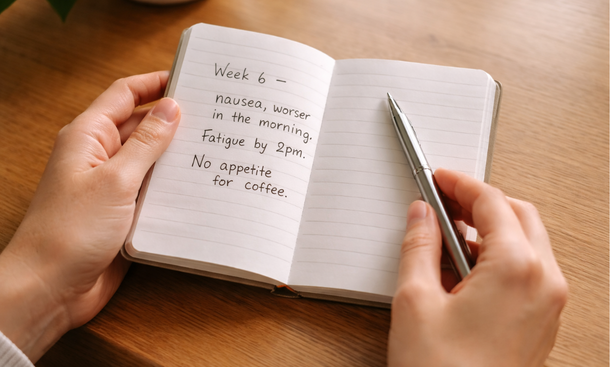
The symptoms worth logging every day
These are the ones that show up consistently for most pregnant women in the first trimester. They’re normal — but they’re worth tracking because changes in their pattern can be meaningful.
Nausea and vomiting. This is the big one. Log the time of day it hits, how long it lasts, whether you actually vomited or just felt like you might, and anything that seemed to trigger it or relieve it. Nausea that suddenly disappears before week 10 can sometimes be worth mentioning to your OB — though for many women it just lifts early and that’s fine.
Fatigue. First trimester exhaustion is unlike anything most women have experienced. It’s not “I didn’t sleep great” tired. It’s “I need to lie down after taking a shower” tired. Log when it hits hardest and whether anything helps. Your doctor can use this info to rule out things like anemia or thyroid issues.
Breast tenderness. Note the intensity on a simple scale — mild, moderate, severe. If it changes dramatically from one day to the next, that’s worth flagging.
Food aversions and cravings. These feel trivial but they’re not. Sudden inability to tolerate smells or foods you normally love is useful data, especially if it’s connected to your nausea pattern.
Bloating and constipation. Progesterone slows everything down in the first trimester. Log it because it affects your comfort and your nutrition, and your OB may want to make recommendations.
Headaches. Track frequency, intensity, time of day, and what you did about it. First trimester headaches are often tied to hydration, blood pressure changes, or hormonal shifts — your doctor needs specifics to help.
Mood shifts. This one gets skipped a lot and it shouldn’t. Hormones are doing a number on your emotional state right now. Logging “felt really low today” or “anxious for no clear reason” is legitimate medical data.
Symptoms to watch but not immediately panic about
Some things that happen in the first trimester are alarming-looking but often completely normal. Still worth noting. Not worth a 3 AM spiral.
Light spotting. Implantation bleeding can happen around weeks four to five and looks like light pink or brown spotting. Log it — the color, the amount, how long it lasted. If it’s paired with cramping, call your doctor. If it’s brief and light on its own, note it and bring it up at your next appointment.
Mild cramping. Your uterus is growing. Ligaments are stretching. Mild, occasional cramping without bleeding is common. Log the location, intensity, and duration. If it becomes severe or one-sided, that changes things.
Dizziness. Blood volume is increasing and blood pressure often drops in early pregnancy. Feeling lightheaded when you stand up quickly is common. Log it so you can track whether it’s getting better or worse.

Symptoms that need a call to your doctor — today
This is the part of the checklist that matters most. These are not “wait and see” situations.
Heavy bleeding. Any bleeding that resembles a period — in flow or in duration — needs a same-day call to your OB or a trip to urgent care. Do not wait.
Severe one-sided cramping or pain. This is a potential sign of an ectopic pregnancy, which is a medical emergency. If the pain is sharp, localized to one side, and especially if paired with shoulder pain or dizziness, call immediately.
High fever. Anything above 100.4°F during pregnancy needs medical attention. Don’t treat it with Tylenol and go to sleep. Call first.
Persistent vomiting. If you can’t keep any food or liquid down for more than 24 hours, you may be dealing with hyperemesis gravidarum. This is a real medical condition that requires treatment — not something to push through on your own.
Sudden disappearance of all symptoms. This one is controversial because sometimes symptoms just ease up. But if everything stops abruptly before week 10 with no gradual taper, it’s worth a conversation with your doctor, not just reassurance from a forum.

How to actually use this checklist without losing your mind
Here’s the format that works. One entry per day, at the same time — morning works well for most people before the chaos of the day kicks in. Rate each symptom you’re experiencing on a simple scale of one to three: one is mild and barely noticeable, two is moderate and affecting your day, three is severe and needs attention.
Note the time symptoms are worst, anything that seems to trigger them, and anything that helped. That’s it. Five minutes max.
At the end of each week, read back through your entries and highlight anything that escalated in intensity or frequency. That’s your list for your next OB appointment.
Where to put this in your overall routine
This checklist belongs in week four or five of your pregnancy — as soon as you have a confirmed positive test. Don’t wait until you feel symptoms to start logging. Starting with a baseline of “nothing notable today” is actually useful data.
Keep your log somewhere you’ll see it daily. A physical notebook on your nightstand. A notes app you check every morning. Whatever removes friction.
And bring it to every single appointment. Print it out if you have to. Your OB will notice and appreciate it — and you’ll get more out of every visit.
Before you move on
You’ve got your first trimester checklist and you know what to watch for. The next practical step is making sure you’ve got the right tools to actually capture all of this without it becoming a part-time job.
Take a look at the best pregnancy tracking apps for symptom logging in 2025 — a breakdown of what’s actually worth downloading, what to avoid, and which apps work best for different tracking styles.

As an author at Felyro.com, I create actionable content on pregnancy tracking, offering practical tools, tips, and insights that empower mothers-to-be to stay informed and confident throughout their pregnancy.