

Here’s the thing nobody tells you clearly enough: knowing when to call your doctor is a skill. It’s not instinct. It’s not something you just figure out in the moment when you’re scared and Googling at midnight. It’s something you learn in advance so that when something happens — and something will happen at some point across forty weeks — you already know what to do.
Most pregnancy symptoms are uncomfortable and completely normal. Your body is doing extraordinary work and it is loud about it. But some symptoms are your body sending a different kind of signal — one that needs a medical response the same day, sometimes the same hour.
This page is about knowing the difference. Not to scare you. Not to send you spiraling every time you feel a twinge. But so you can track your symptoms with confidence, knowing exactly where the line is.
If you’ve been building your tracking routine using the complete guide to tracking pregnancy symptoms safely, this is the piece that makes that whole system actually work in an emergency. Everything else in your journal is about patterns and communication. This page is about action.
Why most women wait too long
It’s worth saying this directly because it’s true across the board: most women who end up in serious situations during pregnancy waited longer than they should have before calling. Not because they were careless. Because they didn’t want to seem dramatic. Because they convinced themselves it was probably nothing. Because they didn’t want to bother anyone.
That hesitation has real consequences.
Your OB’s office has an after-hours line for a reason. Labor and delivery units take calls at 2 AM for a reason. The system is built for you to use it — and using it when something feels wrong is not overreacting. It’s exactly what you’re supposed to do.
The goal of tracking is to give you good data. The goal of this page is to make sure you know when that data tells you to pick up the phone right now.
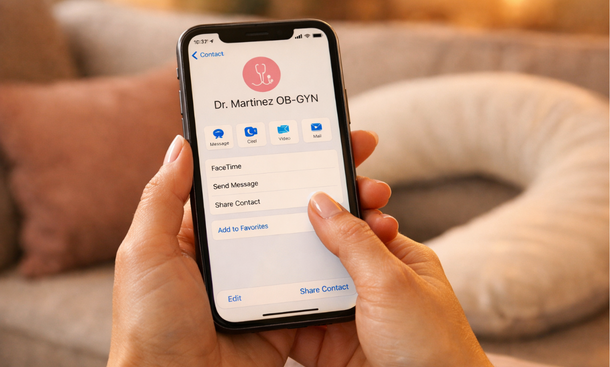
The call-now symptoms — no waiting, no Googling
These are the symptoms that require a phone call to your provider or a trip to the emergency room. Today. Not at your next scheduled appointment.
Heavy vaginal bleeding at any stage. Any bleeding that resembles a menstrual period in flow — regardless of what trimester you’re in — needs immediate evaluation. Light spotting in the first trimester can be normal. Heavy bleeding is never something to wait on.
Severe abdominal pain. Sharp, severe, or persistent abdominal pain — especially if it’s one-sided, constant rather than crampy, or getting worse — needs same-day evaluation. In early pregnancy this can indicate an ectopic pregnancy. Later in pregnancy it can signal placental abruption or other serious complications.
Sudden severe headache. Particularly in the second and third trimesters. A headache that comes on suddenly and feels different from anything you’ve had before — especially if it’s accompanied by visual disturbances like blurring, seeing spots, or flashing lights — is a potential sign of preeclampsia. Call immediately.
Vision changes. Blurry vision, seeing spots or flashing lights, sudden vision loss — these are neurological symptoms that in pregnancy can indicate dangerously elevated blood pressure. Do not drive. Call your provider or have someone take you to be evaluated.
Significant decrease in fetal movement. From week twenty-four onward, if your baby’s movement feels noticeably reduced compared to your baseline — or if kick counts are taking significantly longer than usual — call your OB that day. Reduced fetal movement is one of the earliest signs that something may need attention.
Signs of preterm labor before week thirty-seven. Regular contractions that don’t stop when you change position or drink water, combined with any of the following: pelvic pressure that comes and goes, low persistent backache, a gush or steady trickle of fluid, or a bloody mucus discharge. Any combination of these before thirty-seven weeks needs same-day evaluation.
High fever. A temperature above 100.4°F during pregnancy is not something to manage at home with Tylenol and hope. Call your provider first — they will tell you whether to come in or go to the ER.
Difficulty breathing at rest. Mild breathlessness when climbing stairs is normal in the third trimester. Struggling to breathe while sitting still is not. Sudden shortness of breath — especially with chest pain or rapid heart rate — needs emergency evaluation.

The watch-and-monitor symptoms
These are symptoms that don’t require an immediate call but do require attention. Log them carefully. If they escalate — in intensity, frequency, or character — they move up to the call-now list.
Light spotting without cramping in the first trimester. Note the color — pink or brown is generally less concerning than red — and the duration. If it stops within a day and isn’t accompanied by pain, log it and bring it up at your next appointment. If it continues or intensifies, call.
Mild swelling in feet and ankles. Normal and extremely common, especially by end of day in the third trimester. Log when it appears and whether it resolves overnight. If it suddenly becomes severe, affects your face or hands, or is accompanied by headache — that’s a call-now situation.
Braxton Hicks contractions. Practice contractions that are irregular, don’t increase in intensity, and stop when you change position or hydrate are normal from mid-pregnancy onward. Log them. If they become regular — consistently less than ten minutes apart — or if they don’t stop with position changes and water, call your provider.
Itchy skin. General pregnancy itching from stretched skin is common and manageable. Intense itching specifically on the palms and soles of the feet — especially at night — is a potential sign of intrahepatic cholestasis of pregnancy, a liver condition that needs to be tested for. Log the location and intensity and bring it up at your next appointment, or call sooner if it’s severe.
Urinary symptoms. Frequent urination is a normal pregnancy symptom from the start. Burning, pain, or blood when urinating is not — that’s a urinary tract infection and needs treatment. UTIs in pregnancy can escalate quickly to kidney infections, so don’t wait more than a day or two to call.
The decision framework — a simple guide
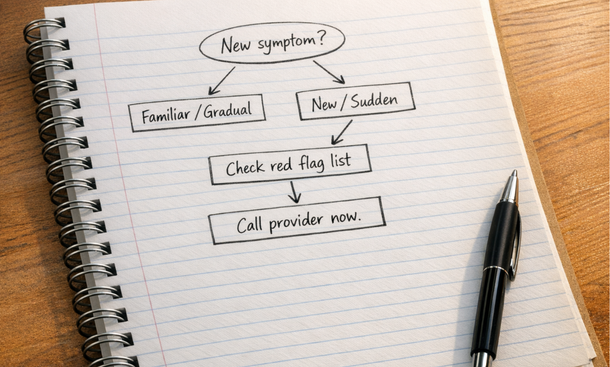
When a symptom appears and you’re not sure what to do, run through these three questions.
First: is this something I’ve felt before during this pregnancy, or is it new? New and sudden is always more concerning than familiar and gradual.
Second: is it getting better, staying the same, or getting worse? Anything that’s escalating over hours deserves a call.
Third: does it fit any of the call-now categories above? If yes, stop deliberating and call.
If the answer to all three is “familiar, stable, and not on the red flag list” — log it, note any changes, and bring it to your next appointment.
What to say when you call
A lot of women hesitate to call because they don’t know what to say or they’re worried about sounding like they’re overreacting. Here’s what to say.
Give your name, how many weeks pregnant you are, and your provider’s name. Then describe the symptom specifically: when it started, how severe it is on a scale of one to ten, whether it’s getting better or worse, and any other symptoms happening alongside it. That’s it. The person on the other end of the line is trained to ask follow-up questions.
If you’ve been keeping a symptom journal — and by this point in reading through this series, you should be — you have all of that information right in front of you. That’s the whole point of the log. Not just for appointments. For moments like this one.
A note on trusting yourself
Medical systems can be dismissive. It happens. If you call and feel like your concern wasn’t taken seriously, and the symptom persists or worsens, call back. Go to labor and delivery directly if you need to. You are the one in your body and your instinct that something is off is data too.
Tracking your symptoms consistently gives you something concrete to stand behind when you advocate for yourself. “I’ve been logging this for four days and it’s getting worse” is a different conversation than “I don’t know, I just feel off.” Your journal is your evidence. Use it.
Before you move on
You now have the full picture of what to track, when to act, and when to breathe. The red flags are clear. The decision framework is simple. And your tracking log is the thread that connects all of it.
If you want to go back to the very beginning of this whole approach — the mindset, the foundation, what safe tracking actually looks like before any apps or journals or checklists — safe pregnancy symptom tracking and what it really means is exactly where to start. It’s the piece that makes everything else on this list actually work.

As an author at Felyro.com, I create actionable content on pregnancy tracking, offering practical tools, tips, and insights that empower mothers-to-be to stay informed and confident throughout their pregnancy.