

Nobody warns you that the chair you pick for breastfeeding will become one of the most used pieces of furniture in your entire home. Not the crib. Not the changing table. The chair.
You will spend hours in it every single day — sometimes in full daylight, sometimes at 2 a.m. when your brain is barely functioning. And if that chair is not set up to support your body properly, you will feel it. In your back, your shoulders, your wrists. All of it.
So before we get into brands and price tags, let’s talk about what actually makes a nursing chair work. Because a chair that looks beautiful in a Pinterest nursery can be an absolute nightmare to feed in.
Why the chair you pick matters more than you think
Breastfeeding is a full-body experience. A good latch — the way your baby takes to the breast — depends on your positioning just as much as your baby’s. When your body is unsupported or awkwardly angled, you compensate. You hunch forward. You tense your shoulders. You shift constantly. And over time, that adds up to real physical strain.
A chair designed with breastfeeding in mind removes that compensation. It holds your body in a position where feeding feels natural rather than forced. That is the whole job.
Lumbar support — the feature nobody talks about enough
Lumbar support refers to how well the chair supports the lower curve of your back, the area just above your hips. Most people focus on cushioning and softness, but lumbar support is what keeps you from slouching during a 40-minute cluster feed session.
Look for a chair where the backrest has a slight curve or built-in contour at the lower back. Flat backs feel fine for 10 minutes. After 30, your spine starts doing all the work on its own.
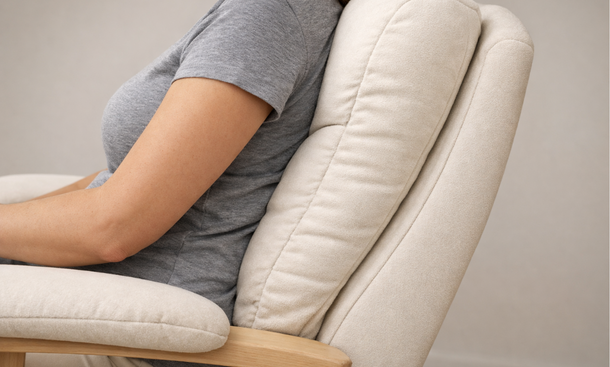
If you are shopping in a store, sit in the chair, lean back naturally, and notice what happens to your lower back. If you feel it pulling away from the backrest, the lumbar curve is not right for your body. If you are buying online, look specifically for chairs marketed with “lumbar contour” or “ergonomic backrest” in the product specs.
Armrest height and what it actually does for your latch
This one is underrated. When you breastfeed, you are holding your baby — and depending on the feeding position you use, you may be holding that weight for a long time. Armrests that sit at the right height let you rest your arms while you feed, which takes the strain off your shoulders and upper back.
Armrests that are too low mean you are holding everything up yourself. Too high and you end up shrugging your shoulders, which creates tension that travels right up to your neck.
The sweet spot is armrests that sit level with your natural elbow height when your arms are relaxed at your sides. Some chairs have padded armrests, which adds a layer of comfort, especially during longer feeds.
One thing to check: the width between the armrests. You need enough room to shift your baby from one side to the other without bumping into anything.
Seat depth — why being too deep is a real problem
Seat depth is the measurement from the front edge of the seat to the backrest. This matters more than most people expect.
A seat that is too deep forces you to either sit with your back unsupported or slide forward to the edge — which defeats the whole purpose of having a chair with lumbar support. You end up perching instead of sitting, and your posture falls apart.
A seat that is too shallow feels cramped and makes it hard to settle in.
The ideal depth lets you sit with your back fully against the backrest while your feet rest flat on the floor, with a small gap between the back of your knees and the front edge of the seat. If your feet are dangling or your knees are pressed forward, the depth is off.
For shorter moms — under 5’4″ — this is especially important. Many standard nursing chairs are sized for average to taller frames. Do not assume the chair will work for your body without checking.
Fabric that survives real life with a baby
Let’s be real about what happens to furniture when you have a newborn. There will be spit-up. There will be leaks. There will be moments where something spills and you are too exhausted to deal with it immediately.
The fabric on your nursing chair needs to handle all of that without becoming a hygiene situation.
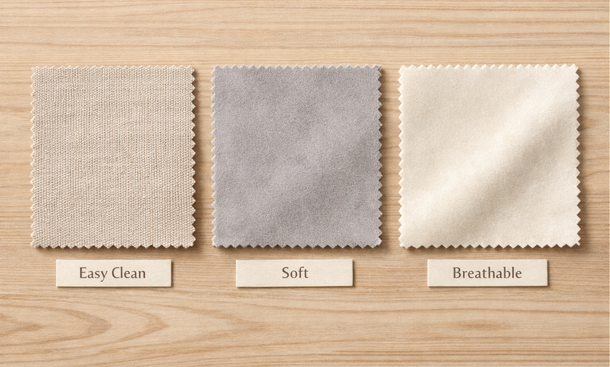
Fabric Swatches Display
Performance fabrics — tightly woven synthetic materials treated for stain resistance — are the most practical choice. They wipe clean easily and hold up to repeated washing or spot cleaning. Microfiber is soft and affordable but can pill over time. Leather and faux leather look sleek but can feel sticky against skin during skin-to-skin feeds, especially in warm weather.
Avoid anything with a delicate weave, dry-clean-only labels, or light-colored fabric that shows every mark. You can always throw a pretty throw blanket over the chair for photos. What you cannot undo is a chair that smells after three months.
Removable, washable cushion covers are a genuine luxury worth paying for if you find a chair that offers them.
Motion type — and why it changes everything at night
Most nursing chairs move in some way — rocking, gliding, or reclining. The type of motion matters depending on how you use the chair and what kind of sleeper your baby is.
Gliders move on a fixed track, forward and back, in a smooth controlled motion. They are quiet and predictable, which makes them great for putting babies to sleep without jarring transitions.
Rockers have a traditional curved base and move more freely. The motion is slightly less controlled, which some babies love, but they can be louder on hardwood floors.
Recliners let you lean back fully, which is great for middle-of-the-night feeds when you want to rest your own body. Some recliners also rock or glide, giving you multiple options in one chair.
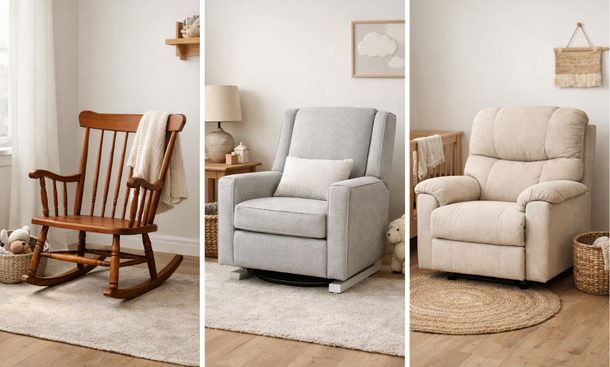
If you are a light sleeper or have a partner who is, go for a glider. The noise level of a rocker scraping across the floor at 3 a.m. is not something to underestimate.
The extras worth paying for
Once you have the core features covered, a few add-ons genuinely improve the experience.
A 360-degree swivel is one of them. Being able to rotate the chair without standing up is more useful than it sounds when you have a sleeping baby in your arms and need to grab something from the side table.
A built-in ottoman or matching footstool that glides with the chair keeps your legs supported during longer feeds and helps with positioning. A footrest that moves independently of the chair does not give you the same benefit.
Storage pockets on the side of the chair, or a built-in tray, can hold your phone, a burp cloth, or a snack — all the things you will inevitably need the moment you sit down and cannot get up.
What to skip
A few features that sound appealing but are rarely worth the extra cost.
Built-in speakers or sound machines. They break, the sound quality is usually underwhelming, and a separate sound machine is cheaper and more flexible.
Overly stylized designs with tufting, decorative buttons, or textured fabric. These collect lint, are harder to clean, and the buttons can be uncomfortable to lean against during long sessions.
Chairs that only recline without any rocking or gliding motion. You will miss the movement more than you think once you are trying to settle a baby at night.
The best nursing chair is the one that holds your body well, cleans up easily, and fits the way you actually live. It does not need to be the most expensive option in the store. It needs to work for your height, your space, and the hours you are going to spend in it.
If you are still figuring out which style of chair makes the most sense for your home, the complete guide to choosing a nursery chair for breastfeeding walks through everything from budget to setup so you can make a confident decision.
And if space is the thing holding you back, the piece on the best nursing chairs for small rooms covers compact options that do not cut corners on comfort — because not everyone has a dedicated nursery, and that is completely fine.

As a Felyro.com content author, I develop actionable content on breastfeeding, translating research-backed information into practical advice for mothers. My goal is to help families establish healthy feeding habits, improve maternal confidence, and support infant development.