

The preparation most women skip — and why it costs them
Most pregnancy content starts at the positive test. That is the wrong starting line.
By the time two lines appear on that test, your body has already been building the foundation for fetal development for several weeks. The neural tube — the early structure that becomes your baby’s brain and spinal cord — has already begun forming. The nutrient levels, hormonal balance, and cellular environment your body needs to support that process were either in place or they were not. You cannot go back and change what was already happening.
This is not meant to alarm you. It is meant to reframe the conversation. Pregnancy preparation is not something you do after conception. It is something you do before it — ideally three to six months before you start trying, sometimes longer depending on your health history and age.
I have been writing about pregnancy health for years, and the pattern I see most consistently is not women who did everything wrong. It is women who simply were not told early enough that this window existed and that what they did inside it genuinely mattered.
So this is that conversation. Straight, real, and without the fluff — the way we do things in New York.
Get your body ready before you start trying
Preconception health is the state of your physical and mental wellbeing before conception occurs, and it is the foundation everything else gets built on. Egg quality, hormone balance, nutrient levels, stress load — all of it plays a role before a single pregnancy test enters the picture.
The first thing worth understanding is that your hormones are running the show, and most women have no idea their levels are off until something goes wrong. Thyroid function is one of the biggest factors. An underactive or overactive thyroid can affect ovulation, implantation, and early pregnancy before you even know you are pregnant.
Conditions like polycystic ovary syndrome — commonly called PCOS — affect the regularity of ovulation and can make conception more complicated without proper management. Many women are walking around with PCOS and do not know it because the symptoms are easy to attribute to stress or irregular periods rather than a hormonal pattern worth investigating.
Before you start trying, ask your doctor for a full hormonal panel. Thyroid-stimulating hormone, estrogen and progesterone levels, and anti-Müllerian hormone — a marker of ovarian reserve — give you a real picture of where your reproductive system stands right now.
Mental health belongs in this conversation too. Chronic stress elevates cortisol, and high cortisol suppresses the hormones that trigger ovulation. Therapy, stress reduction, and honest conversations with your partner are not optional additions to preconception prep. They are part of the biological foundation.
For a deep dive into everything your body needs in this phase, the full page on preconception health tips covers hormones, nutrients, lifestyle habits, and mental health in detail.
The honest talk about early pregnancy discharge
Nobody warns you about this part. You get the positive test, maybe feel a little nauseous, and then you notice something physical that nobody mentioned in any of the pregnancy content you have ever read.
Vaginal discharge during early pregnancy is called leukorrhea. It is a thin, mild-smelling or odorless fluid that the body produces as estrogen levels rise and blood flow to the vaginal area increases. In most cases it is completely normal. But not all discharge is the same, and knowing the difference between what is expected and what warrants a call to your doctor is information every woman in early pregnancy needs.
White or off-white discharge that is thin and mild in smell is standard leukorrhea. Clear and watery discharge is also typically normal. Pink or light brown spotting around the time of implantation — when the fertilized egg attaches to the uterine lining — is one of the earliest signs of pregnancy many women notice before taking a test.
Yellow or green discharge with a strong odor, thick cottage cheese-like discharge with itching, or bright red bleeding with cramping all warrant a prompt call to your provider. These combinations can signal infections or early pregnancy complications that need medical attention rather than a wait-and-see approach.
The full breakdown of what is normal, what changes week by week, and when to call your doctor is on the early pregnancy discharge page — written specifically for women in the first trimester who need clear answers without the panic spiral.

Prenatal vitamins and supplements — what actually matters
Walk into any pharmacy and you are staring at an entire wall of prenatal vitamins with no guidance on which one is actually worth your money. Here is the framework that cuts through the noise.
Folic acid is the nutrient most people associate with prenatal vitamins, and for good reason. It plays a critical role in preventing neural tube defects in early fetal development. But the form matters. A significant portion of the population carries a genetic variation called MTHFR that affects how efficiently the body converts standard folic acid into its usable form. A prenatal vitamin containing methylfolate — the already-converted, bioavailable version — works regardless of your genetic status and is worth seeking out.
Beyond folate, the nutrients that most prenatals underdeliver on are iron, vitamin D, omega-3 DHA, choline, and iodine. Iron supports the significant increase in blood volume during pregnancy. Vitamin D affects both fertility and fetal bone development. DHA supports fetal brain and neurological development from the earliest weeks. Choline — one of the most overlooked preconception nutrients — is critical for fetal brain development and is absent from most standard prenatal formulas. Iodine supports thyroid function and neurological development and is missing from a surprising number of products.
The practical checklist for evaluating a prenatal vitamin label: check the folate form, confirm iron is at or near 27 milligrams, verify vitamin D is above 600 IU, look for DHA, and scan specifically for iodine and choline. If your current prenatal does not cover these bases, it may be worth switching or supplementing separately.
Start taking prenatal vitamins at least one to three months before you plan to conceive. Building nutrient stores takes time that a single daily pill cannot compress into a few days.
The complete guide to prenatal vitamins before pregnancy goes deeper on every nutrient, how to read labels, and when food alone is not enough.
Your preconception doctor visit — make it count
A preconception checkup is not the same as a regular annual physical. It has a specific purpose — identifying anything that could affect your ability to conceive, carry a pregnancy, or support fetal development in the earliest weeks — and it works best when you go in prepared.
The tests worth requesting at this appointment include a complete blood count to check for anemia, a full thyroid panel, blood glucose and insulin levels particularly if you have a family history of diabetes or signs of PCOS, STI screening, rubella and varicella immunity checks, and vitamin D levels. Not every provider will order all of these automatically. Knowing what to ask for is what makes the difference between a productive appointment and one that only scratches the surface.
Bring a full list of every medication, supplement, and herbal product you are currently taking. Some medications are known teratogens — substances that carry documented risks to fetal development — and need to be discontinued or switched before conception. Several herbal supplements that seem harmless can interfere with conception or carry risks in early pregnancy. Your provider needs the complete picture.
Genetic carrier screening — which checks whether you or your partner carry gene variants for conditions like cystic fibrosis or sickle cell disease — is now recommended for all couples planning a pregnancy regardless of family history. Knowing before conception gives you options and time to make informed decisions without the pressure of an active pregnancy timeline.
The questions most women forget to ask at this appointment — including vaccine timing, birth control clearance windows, and when to return if conception has not happened — are all covered on the preconception doctor visit checklist page.

Nutrition and lifestyle changes that move the needle
What you eat in the three to six months before conception directly affects egg quality, hormone production, the receptivity of the uterine lining, and your body’s ability to support implantation and early cell division. These are not abstract wellness concepts. They are documented physiological processes that respond to nutritional input.
The foods that deliver the most preconception impact are dark leafy greens for natural folate and iron, eggs for choline and high-quality protein, fatty fish for omega-3 DHA, legumes for folate and blood sugar stability, and colorful vegetables for the antioxidant load that protects eggs from oxidative stress.
On the other side, alcohol is the clearest dietary factor to remove during the preconception period. Even moderate consumption has been associated with reduced fertility and elevated risk in early pregnancy — often before a woman knows she is pregnant. Highly processed food, excess sugar, and trans fats drive chronic inflammation and insulin resistance, both of which disrupt the hormonal signaling that regulates ovulation.
Blood sugar balance deserves specific attention because it is one of the most underrecognized contributors to fertility challenges. You do not need a diabetes diagnosis for blood sugar dysregulation to be affecting your hormones. A diet heavy in refined carbohydrates triggers excess insulin production, which drives up androgen levels and disrupts ovulation. Pairing carbohydrates with protein, fat, and fiber at every meal is the practical response — not extreme restriction, just structural balance.
Lifestyle factors carry equal weight. Chronic sleep deprivation disrupts hormonal signaling. Excessive high-intensity exercise can suppress ovulation. Endocrine disruptors in plastics, non-stick cookware, and certain personal care products interfere with hormone function over time. None of these require an overnight life overhaul — they require consistent, incremental attention over several months.
The detailed breakdown of what to eat, what to cut, and how to build a realistic preconception eating pattern is on the diet and lifestyle changes before pregnancy page.
Tracking your cycle and fertility window the smart way
Even under ideal conditions, a healthy couple trying to conceive has roughly a 20 to 25 percent chance of success in any given cycle. A human egg is viable for only 12 to 24 hours after ovulation. The actual window of opportunity in each cycle is five to six days, with the highest probability concentrated in the two days before ovulation and the day of ovulation itself.
If you are not tracking, you are guessing. And guessing leaves a significant portion of your fertile window either missed or underutilized.
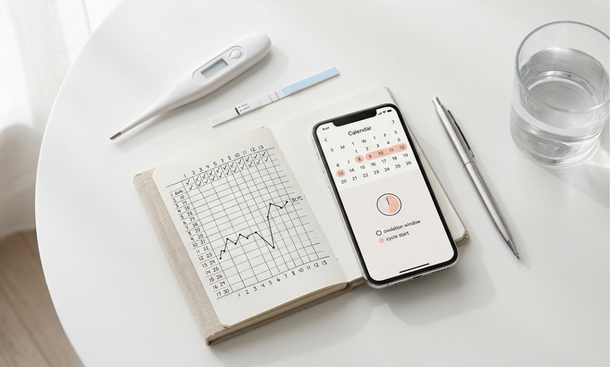
Ovulation predictor kits detect the luteinizing hormone surge that triggers ovulation 24 to 36 hours in advance — giving you actionable advance notice rather than confirmation after the fact. Cervical mucus observation gives you a physical fertility signal your body is already producing for free. At peak fertility, cervical mucus becomes clear, slippery, and stretchy — similar to raw egg white — signaling that ovulation is imminent. Basal body temperature charting confirms ovulation occurred and builds a picture of your cycle pattern over multiple months.
The most effective approach combines at least two of these methods. OPKs paired with cervical mucus observation cross-reference each other in a way that either method alone cannot. Adding basal body temperature charting provides a third confirming data point.
The common assumption that ovulation happens on day 14 of a 28-day cycle is a statistical average, not a biological constant. A woman with a 25-day cycle may ovulate around day 11. A woman with a 32-day cycle may not ovulate until day 18. Tracking your own cycle gives you your data — not an average that may not apply to your body at all.
The complete guide to tracking ovulation to get pregnant covers every method in detail, including how to read OPK results accurately, how to observe cervical mucus correctly, and how to use fertility apps as organizational tools rather than oracles.
Wrapping it up
Preparing for pregnancy is not a checklist you knock out in an afternoon. It is a deliberate process that unfolds over months — and the earlier you start, the better positioned you are when the time actually comes.
The six areas covered in this guide — preconception health, early pregnancy changes, supplementation, your doctor visit, nutrition and lifestyle, and cycle tracking — are not independent topics. They are interconnected systems. What you eat affects your hormone levels. Your hormone levels affect your cycle. Your cycle affects your fertile window. Your fertile window is where conception either happens or it does not.
Getting all of these systems working in the same direction, before you start trying, is the most effective thing you can do to support a healthy conception and a healthy early pregnancy.
Start with what feels most actionable right now. Book the preconception appointment if you have been putting it off. Switch to a methylfolate-based prenatal if yours does not contain it. Pull back on alcohol and processed food. Start paying attention to your cycle.
You do not have to do everything at once. You just have to start.
