

Here is something that does not make it onto most pregnancy checklists: the nursery chair. Not because it is unimportant — it is one of the most used pieces of furniture you will own in the first year — but because most people assume they can order it whenever and it will just show up.
That assumption costs a lot of new moms. Shipping delays, backorders, assembly surprises, and chairs that arrive damaged and need to be returned — all of it takes time. Time that runs out faster than expected once the third trimester gets going.
Getting the timing right is not complicated. But it requires thinking about it before you feel the urgency, which is exactly the point of putting it here.
The timing problem nobody puts on the registry
Most pregnancy planning advice focuses on the crib, the car seat, the stroller. The nursery chair tends to get treated as a nice-to-have — something to sort out once the bigger items are checked off.
The problem is that once you start shopping, the chair takes longer to arrive than almost anything else in the nursery. Standard furniture shipping for larger items runs anywhere from two to six weeks for in-stock pieces. Custom or made-to-order chairs — ones where you choose the fabric, finish, or configuration — can take eight to sixteen weeks or more.
If you start looking at week 36 because the nursery still feels unfinished and you suddenly realize you need a chair, you may be cutting it very close. Or missing the window entirely for the chair you actually want.
The nursery chair is not the item to leave for last.
Why buying too late is a real risk
Beyond shipping timelines, there are a few other reasons why late purchasing creates problems.
Damaged deliveries take time to resolve. Large furniture items ship on freight carriers and are more likely to arrive with damage than smaller packages. Filing a claim, getting a replacement part or a new unit shipped, and waiting for the second delivery can add two to four weeks onto your timeline. If you ordered at week 36 and the first delivery arrives damaged, you may be home with a newborn before the replacement shows up.
Assembly takes longer than expected. Many nursing chairs require some level of assembly — at minimum attaching the base or the ottoman. When you are in the third trimester and physically uncomfortable, assembling furniture is genuinely difficult. Giving yourself time to have someone else do it, or to do it yourself in stages without pressure, makes the whole process less stressful.
Returns are harder once the baby is here. If the chair arrives and it is not right for your body — the seat is too deep, the armrests are the wrong height, the fabric is not what you expected — returning or exchanging it is manageable before the baby comes. After, it becomes a much bigger logistical challenge.

The best window to start shopping
The sweet spot for starting your nursery chair search is between weeks 20 and 28 of pregnancy — the second trimester into the early third trimester.
At this point you are past the highest-risk period of early pregnancy, your energy is typically better than it will be in the third trimester, and you have enough time to research properly rather than rushing a decision. You also have enough runway to handle any shipping or delivery issues that come up without it becoming a crisis.
Here is how to break it down by week.
Weeks 20 to 24: Research phase. Start identifying what type of chair works for your space and your body. Read reviews. Visit stores if you can to actually sit in chairs. Note the dimensions of the space where the chair will go.
Weeks 24 to 28: Decision and purchase phase. Narrow down your options, finalize your choice, and place the order. If you are ordering a custom or made-to-order chair, place the order no later than week 24 to be safe.
Weeks 28 to 32: Delivery and setup phase. Most standard orders will arrive within this window. You have time to handle any issues before the third trimester makes everything more physically demanding.
Week 32 and beyond: The chair should already be in place. If it is not, move quickly and prioritize in-stock options that ship within a week or two.
What to do before you buy — the checklist
Before placing any order, work through this list.
Measure the space. Write down the exact dimensions of the area where the chair will go — width, depth, and the clearance needed to move around it. Compare these numbers against the actual product dimensions listed in the spec sheet, not the photos.
Identify your chair type. Decide whether you want a rocker, a glider, or a recliner. Each has different size, noise, and comfort trade-offs. If you are not sure, a glider is the most versatile starting point for most moms.
Check your height and frame. Seat depth and armrest height need to match your body. If you are shorter than 5’4″ or taller than 5’9″, look specifically for chairs sized for your range — not just standard adult sizing.
Set your budget before you look at options. It is easy to get pulled toward higher price points once you start browsing. Decide your range first and stay inside it. Quality chairs exist at every level from $200 to $800-plus. Knowing your ceiling keeps the decision cleaner.
Confirm the return policy. Before you buy from any retailer, read the return and exchange policy for large furniture items. Some retailers charge restocking fees. Others require you to arrange your own freight return, which can cost as much as the chair itself. Know this before you commit.
Check current lead times. Product pages often list estimated shipping times, but these can change based on inventory. Call or chat with the retailer to confirm the current lead time for the specific chair you are ordering before you place the order. Do not rely on estimates from a product page that may not have been updated recently.

Shopping in store vs. buying online
Both options work, but they have different strengths depending on what stage of the process you are in.
Shopping in store is most useful during the research phase. Sitting in a chair — actually testing the lumbar support, the armrest height, the seat depth, and the motion — tells you things that no product description or photo ever will. If you have access to a Buy Buy Baby, a Pottery Barn Kids, or a local baby furniture store, use it specifically for the test-sit. You do not have to buy there.
Buying online gives you access to a wider range of options, often at better prices, and allows you to read verified reviews from other moms who describe their real experience with the chair. The downside is that you cannot test the chair before it arrives. This is why reading reviews specifically from people who mention their height, their body type, or their nursing experience is more useful than reading general star ratings.
If you find a chair you love in a store, search the model name online before buying at retail. You may find it at a better price with better shipping terms elsewhere.
What to watch out for when ordering
A few things that catch people off guard when ordering a nursing chair for the first time.
White glove delivery vs. curbside delivery. Some large furniture items ship with white glove service — meaning delivery people bring it inside and sometimes assemble it. Others ship curbside, meaning the carrier drops it at your door and you handle the rest. Confirm which service applies to your order before you buy, especially if you are pregnant and cannot move heavy boxes.
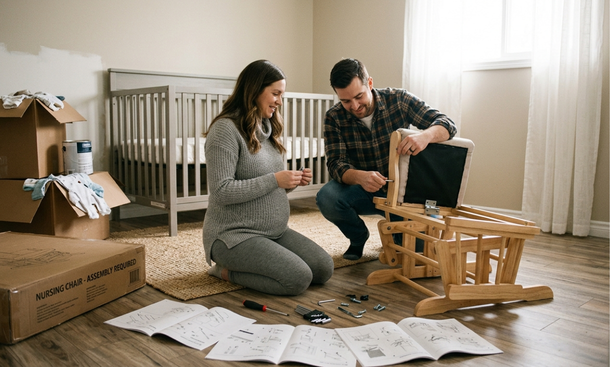
Assembly requirements. Even chairs listed as “easy assembly” can take 30 to 45 minutes and require two people. If you are in the third trimester, plan for someone else to handle this. Do not leave it for the week before your due date.
Fabric differences in person. Fabric swatches shown online are photographed under controlled lighting. The actual fabric can look slightly different in your home under different light. If color accuracy matters to you, request a physical swatch before ordering — many furniture retailers offer this for free.
If you are past your due date and still chairless
It happens. You got here and the chair situation is unresolved. Here is what to do.
Prioritize retailers with in-stock inventory and two-day or expedited shipping. Amazon, Wayfair, and Target carry nursing chairs that ship quickly — some within one to two days. Filter specifically for chairs marked as in stock and shipping from a domestic warehouse.
In this scenario, let go of the idea of finding the perfect chair. Find a chair that meets your core requirements — adequate lumbar support, the right seat depth for your height, washable or wipeable fabric — and get it ordered. You can always upgrade later. Right now, functional beats ideal.
A basic wooden rocking chair with a seat cushion, ordered and assembled in two days, is infinitely better than the perfect glider that will not arrive for six weeks.
Budget timing — when sales actually happen
If budget is a factor — and for most of us it is — there are predictable times when nursery furniture goes on sale.
The biggest sales windows for baby furniture are Black Friday and Cyber Monday, holiday weekends like Memorial Day and Labor Day, and end-of-season clearance periods in January and July. Buy Buy Baby and Pottery Barn Kids both run significant promotions during these periods that can reduce nursing chair prices by 20 to 30 percent.
If your due date falls in a way that aligns with one of these windows — and you are in the research phase around weeks 20 to 24 — it is worth timing your purchase to catch a sale. Just make sure you are not delaying the order so long that you miss your delivery window.
If you are registering for the chair as a gift, add it early. Registry items sometimes get purchased early in the pregnancy by family members who want to help with a big item. The earlier it is on the list, the better the chance it gets bought while there is still plenty of time for delivery and returns if needed.
What to do once the chair arrives
When the chair arrives, do not just set it up and move on. Take fifteen minutes to actually sit in it properly.
Sit with your back fully against the backrest. Check that your lower back feels supported — not pulled away from the chair. Rest your arms on the armrests and check the height. Your shoulders should be relaxed, not raised. Check the seat depth. Your feet should sit flat on the floor with a small gap between the back of your knees and the front edge of the seat.
If anything feels significantly off, contact the retailer while you are still within the return window. It is much easier to address now than after the baby arrives and returning furniture becomes a full logistical project.
If the chair needs a small adjustment — a lumbar pillow to add lower back support, a footstool to raise your feet slightly — note that now and get it sorted before your due date.
The nursery chair is not the most urgent item on the pregnancy checklist, but it is one of the most time-sensitive ones. The gap between when you need to order and when the chair actually arrives is longer than most people expect — and narrower than it feels when you are in the middle of second-trimester planning.
Start looking between weeks 20 and 28. Test chairs in person if you can. Confirm lead times before you order. And build in enough runway to handle whatever comes up between the order and the delivery.
Once you have the timing sorted, the next question is usually about the space itself — and the piece on how to set up a nursing corner for late-night breastfeeding walks through exactly how to build the setup around your chair so that everything is ready before the baby comes home.
And if you are still working through the broader decision — which chair type, which features, what to prioritize — the complete guide to choosing a nursery chair for breastfeeding covers all of it in one place so you can move forward with a clear head.

As a Felyro.com content author, I develop actionable content on breastfeeding, translating research-backed information into practical advice for mothers. My goal is to help families establish healthy feeding habits, improve maternal confidence, and support infant development.