

You’ve been through it. The faint positive, the waiting, the loss. And now you’re sitting here wondering what comes next — not just physically but emotionally, logistically, all of it. When can you actually try again. Whether your body needs time. Whether this changes your odds going forward.
These are the right questions to be asking and there are real answers to them.
Most people who experience a chemical pregnancy go on to conceive and carry a healthy pregnancy. That’s not just something people say to make you feel better — it’s what the data shows. But understanding your own timeline, your body’s signals, and what to watch for in the next cycle makes a real difference when you’re tracking closely.
If you’re still getting oriented on the full picture, the complete overview of what a chemical pregnancy is is worth reading first. This page is specifically about what comes after — recovery, timing, fertility, and moving forward with intention.
What your body is doing right now
After a chemical pregnancy, your body goes through a reset. HCG levels drop back toward zero — usually within one to two weeks of the loss. Once that happens, your hypothalamus and pituitary gland pick up on the absence of pregnancy hormones and begin signaling your ovaries to prepare for the next cycle.
For most people, ovulation returns within two to four weeks of a chemical pregnancy. That’s faster than many people expect. Your body doesn’t need weeks of recovery the way it might after a later loss. The hormonal disruption is relatively brief and the system tends to recalibrate on its own.
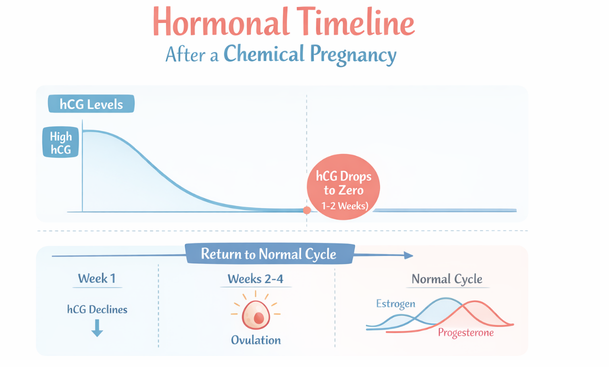
That said, every person’s body is different. Some people ovulate quickly and their next cycle arrives right on schedule. Others find their first post-loss cycle is longer or irregular. Both are normal.
Do you need to wait before trying again
This is one of the most common questions and the answer has shifted over time in the medical community.
The old recommendation was to wait one full cycle before trying again after any early pregnancy loss. The reasoning was partly about emotional readiness and partly about ensuring the uterine lining had time to fully recover.
More recent research has found that waiting one cycle is not medically necessary after a chemical pregnancy for most people. There is no strong evidence that trying in the cycle immediately following a chemical pregnancy increases the risk of another loss. In fact, some studies suggest fertility may be slightly elevated in the cycle right after an early loss — likely because of the hormonal activity that was just happening.
That said, your doctor’s guidance matters here. If you have underlying conditions, if your hCG has not yet returned to zero, or if you are still experiencing symptoms, waiting until the next cycle makes clinical sense. The general principle is: once bleeding has stopped, hCG is undetectable, and you feel physically ready — your body is likely ready too.
The emotional timeline is its own thing
Physical recovery and emotional recovery don’t always move at the same pace and that’s worth saying out loud.
Some people feel ready to try again quickly. The loss was early, they’ve processed it, and trying again feels like forward momentum. That’s valid.
Other people need more time. The loss hit hard regardless of how early it was and they’re not ready to go through the two-week wait again yet. That’s equally valid.
There is no correct emotional timeline after a pregnancy loss. What matters is that you’re making decisions based on what you actually need rather than what you think you’re supposed to feel.

If you’re finding that grief is significantly affecting your daily functioning weeks after the loss, talking to a therapist who specializes in pregnancy loss is a genuinely useful resource — not a last resort.
What to track in your next cycle
If you’re using a tracking app or monitoring your cycle closely, the cycle after a chemical pregnancy gives you useful data.
Watch for when ovulation returns. Your basal body temperature chart, LH strips, or app predictions can help you identify your first post-loss ovulation. Some people find it arrives right on schedule. Others see it delayed by a week or two.
Your first period after a chemical pregnancy may also look a little different — slightly heavier, a different duration, or with more cramping than usual. This is typically just the uterine lining completing its reset and is not a cause for concern on its own.
If your period hasn’t returned within six to eight weeks of the chemical pregnancy, or if you’re experiencing ongoing symptoms, that’s worth checking in with your doctor about.
Does a chemical pregnancy affect future fertility
For the vast majority of people, no. A single chemical pregnancy does not reduce fertility or increase the statistical risk of future pregnancy loss in a meaningful way.
Chromosomal abnormalities — which are the most common cause of chemical pregnancies — are largely random events. Having one does not make the next one more likely unless there is an underlying chromosomal issue with one or both partners, which is something that can be tested if recurrent losses are occurring.
Where the picture gets more complex is with recurrent chemical pregnancies — typically defined as two or more. At that point, investigation into possible causes becomes more useful and more warranted. Hormonal testing, uterine assessment, clotting panels, and in some cases chromosomal analysis of both partners may be recommended.
One chemical pregnancy is common. It does not define your fertility story.
When to loop in a specialist
A single chemical pregnancy does not typically require a referral to a reproductive endocrinologist. Your OB or midwife can handle the follow-up conversation in most cases.
Consider asking for a referral if you’ve had two or more early losses, if your cycles are not returning to normal after the loss, if you have known conditions like PCOS, thyroid disease, or clotting disorders that could be contributing, or if you’re over 35 and want a more proactive approach to monitoring.
Getting answers early — rather than waiting to see if it happens again — is a completely reasonable position to take, and a good provider will support that.
Moving forward with more information
A chemical pregnancy is hard. It’s a loss that often happens before the world even knew there was a pregnancy, which can make it feel isolating. But knowing your body, understanding your cycle, and tracking with intention puts you in a stronger position going into your next cycle.
If you’re ready to go back to the beginning and understand the full scope of what causes chemical pregnancies — why they happen, what the risk factors are, and what you can actually do about them — the details are all in chemical pregnancy causes: why it happens and why it’s not your fault.

As an author at Felyro.com, I create actionable content on pregnancy tracking, offering practical tools, tips, and insights that empower mothers-to-be to stay informed and confident throughout their pregnancy.