

Average IVF cost in the United States
Average IVF cost in the United States can make your stomach drop a little. A single IVF cycle often costs around $12,000 to $20,000 before medication, genetic testing, embryo freezing, or storage. In some cities, the total can climb higher. That is why it helps to understand the numbers before you sit in a clinic office nodding like everything sounds normal. For the full financial picture, my complete IVF cost guide breaks down treatment, medication, insurance, and hidden fees in one place.
IVF is not one simple bill. It is more like a stack of related costs. Some are medical. Some are lab-based. Some are pharmacy charges. Some show up later, which, honestly, feels rude when you are already trying to keep your head straight.
The average cost gives you a starting point. It does not tell you exactly what you will pay. Your final price depends on your clinic, diagnosis, medication needs, insurance, location, and whether you need more than one cycle.
What is the average IVF cost?
In the United States, one IVF cycle commonly falls between $12,000 and $20,000 for the core treatment. That usually means ovarian stimulation monitoring, egg retrieval, basic lab fertilization, embryo culture, and sometimes one embryo transfer.
Medication is often separate. IVF medication may add about $3,000 to $7,000 or more, depending on your protocol.
So a more realistic total for one full IVF attempt may be closer to $15,000 to $30,000.
That range is big, I know. But IVF pricing is not standardized across the country. A clinic in New York, Los Angeles, or Boston may charge differently than a clinic in a smaller city. Even clinics in the same area may package services differently.
One clinic may look cheaper because it excludes medication, anesthesia, ICSI, genetic testing, freezing, and storage. Another may look more expensive because it includes more in the quote.
So when someone says the average IVF cost is one number, take it as a rough guide, not a promise.
Why IVF cost varies so much
IVF cost varies because the treatment is personalized. The clinic is not just handing everyone the same package and calling it a day.
Costs can shift based on:
- Clinic location.
- Doctor and lab fees.
- Medication dosage.
- Number of monitoring visits.
- Whether ICSI is used.
- Whether embryos are frozen.
- Whether genetic testing is done.
- Whether transfer happens fresh or frozen.
- Insurance coverage.
- Donor sperm, donor eggs, or gestational carrier needs.
- Repeat cycles.
Age can also affect cost indirectly. It does not always change the clinic’s base price, but it can affect medication needs, number of embryos, testing recommendations, and how many cycles may be needed.
Diagnosis matters too. Someone doing IVF for tubal factor infertility may have a different plan than someone with diminished ovarian reserve, male factor infertility, endometriosis, recurrent pregnancy loss, or unexplained infertility.
That is why two friends can go to the same clinic and pay different totals.
Average IVF cost before medication
The base IVF cycle cost often covers the main clinic and lab work.
It may include:
- Cycle coordination.
- Monitoring visits.
- Blood work.
- Ultrasounds.
- Egg retrieval.
- Basic fertilization.
- Embryo culture.
- One transfer, depending on the clinic.
This base cost may be around $12,000 to $20,000.
But “base” is the key word. It may not include all the things you actually need.
Some clinics quote a retrieval cycle only. That means the cost covers stimulation, retrieval, and lab work, but not embryo transfer. Other clinics include a fresh transfer, but not a frozen transfer. Some include monitoring. Some do not.
Before comparing numbers, ask each clinic what the base cycle includes. If you do not, you may compare a full package to a partial package and think one clinic is cheaper when it is not.

Average IVF medication cost
Medication can add a lot to the total IVF cost.
Many people pay around $3,000 to $7,000 for medication, but it can be lower or higher. Some protocols cost more because they require higher doses or longer stimulation. Some people need extra medications for egg maturation, cycle suppression, or hormonal support.
Medication costs may include:
- Injectable stimulation drugs.
- Antagonist medication to prevent early ovulation.
- Trigger shot.
- Progesterone after retrieval or transfer.
- Estrogen for frozen transfer cycles.
- Antibiotics or other support medications.
Insurance coverage can make a huge difference. Some plans cover fertility medications. Some cover only diagnosis-related medication. Some cover nothing. Some require specialty pharmacies.
If you are paying cash, ask the clinic whether they work with pharmacies that offer self-pay discounts. Ask if generic or lower-cost alternatives are appropriate for your protocol. Do not change medication without your clinic’s approval, but do ask questions.
Medication is one place where a little homework can matter.
Average cost with ICSI
ICSI stands for intracytoplasmic sperm injection. That means one sperm is injected directly into one egg in the lab.
ICSI may be recommended for male factor infertility, previous fertilization problems, frozen eggs, or when genetic testing is planned.
ICSI is often billed separately. It may cost around $1,000 to $2,500 or more, depending on the clinic.
Some clinics include ICSI in the IVF package. Others do not. Some use it for nearly every IVF cycle. Others use it only when medically indicated.
Ask your clinic:
- Is ICSI included?
- Is ICSI recommended in my case?
- What does it cost if added?
- Is it required if we do genetic testing?
This is one of those add-ons that can be medically useful, but it should not be a mystery charge.
Average cost of genetic testing
Preimplantation genetic testing, often called PGT, checks embryos before transfer. It can screen for chromosome issues or specific inherited conditions, depending on the type of testing.
PGT is usually separate from the base IVF cost. It may add several thousand dollars.
There are often two charges:
- Embryo biopsy at the clinic.
- Genetic analysis at an outside lab.
Some labs charge by the embryo. Others charge in batches. Shipping may also cost extra.
PGT is not required for everyone. It may be recommended based on age, recurrent pregnancy loss, genetic history, or clinic policy. Some patients choose it because they want more information before transfer.
Ask for the full genetic testing estimate. Not just the biopsy fee. The outside lab fee matters too.
Average frozen embryo transfer cost
A frozen embryo transfer, often called FET, may be billed separately from the egg retrieval cycle.
A frozen transfer may cost around $3,000 to $6,000 or more. Medication and monitoring may add to that number.
Frozen transfer costs may include:
- Cycle monitoring.
- Estrogen and progesterone medication.
- Embryo thawing.
- Transfer procedure.
- Ultrasound guidance.
- Pregnancy blood test.
Some clinics include one transfer in a package. Others separate retrieval and transfer. If your embryos are frozen because of PGT, high hormone levels, scheduling, or medical reasons, you may need a separate FET cycle.
This is why “one IVF cycle” can be a confusing phrase. Some people mean stimulation plus retrieval. Some mean retrieval plus transfer. Some mean the full attempt from medication start to pregnancy test.
Ask the clinic to define it.
Embryo freezing and storage costs
If you have embryos to save, freezing and storage may be another expense.
Embryo freezing may cost around $1,000 to $2,000 or more. Annual storage may cost several hundred dollars to over $1,000 per year.
Some clinics include the first year of storage. Some do not.
This can feel like a future problem, but it is part of the real IVF budget. If you have embryos stored for several years, storage fees add up.
Ask:
- Is embryo freezing included?
- Is the first year of storage included?
- What is the annual storage fee?
- What happens if we move embryos later?
- Are transfer or shipping fees separate?
Embryos are not just a medical issue. They are also a long-term financial and emotional responsibility.
Average IVF cost with insurance
Insurance can lower IVF cost, but coverage varies wildly.
Some states have fertility coverage laws. Some employers offer fertility benefits. Some plans cover diagnosis but not treatment. Some cover medication but not IVF procedures. Some require prior authorization. Some require trying IUI first.
With insurance, your out-of-pocket cost may include:
- Deductible.
- Copays.
- Coinsurance.
- Medication costs.
- Non-covered services.
- Out-of-network bills.
- Lifetime fertility benefit limits.
A plan may say it covers IVF, but still exclude PGT, embryo storage, donor services, or certain medications.
Call your insurance company and ask for fertility benefits in writing if possible. Ask your clinic’s financial coordinator to verify coverage too.
Do not rely only on “yes, fertility is covered.” That phrase needs details.
Average out-of-pocket IVF cost
If you are paying fully out of pocket, one complete IVF attempt may commonly land somewhere between $15,000 and $30,000 or more.
That may include:
- Base IVF cycle.
- Medication.
- Anesthesia.
- ICSI.
- Freezing.
- Transfer.
- Storage.
- Pregnancy testing.
If you add PGT, donor eggs, donor sperm, embryo donation, gestational carrier arrangements, or repeat cycles, the total can rise much higher.
Out-of-pocket IVF can feel unfair because it is not a luxury purchase. It is medical care. But many families are still left to piece together payment plans, loans, savings, grants, and help from relatives.
If that is your situation, you are not alone. You are not bad with money. The system is expensive.
IVF cost by location
Where you live can affect average IVF cost.
Larger cities and high-cost areas may have higher clinic fees. Competition can also affect pricing. Some areas have multiple fertility clinics. Others have only one nearby option.
Travel can also change the math. A lower-cost clinic in another state may look appealing, but add:
- Flights or gas.
- Hotels.
- Meals.
- Time off work.
- Childcare.
- Local monitoring costs.
- Last-minute travel changes.
For some people, traveling for IVF saves money. For others, it adds stress and expense.
If you compare local and out-of-town clinics, calculate the full cost. Not just the clinic fee.
Why one cycle may not be enough
The average IVF cost can be misleading because many people need more than one attempt.
One egg retrieval may lead to several embryos and more than one transfer. Or it may lead to no embryos. One transfer may work. Or it may not. Some people need another retrieval.
This is the brutal part of IVF budgeting. You are paying for a chance, not a guarantee.
Your doctor may be able to give you an estimate based on your age, diagnosis, ovarian reserve, sperm factors, and previous treatment history. But no one can promise the outcome.
When planning, ask your clinic:
- What is the estimated chance of success for my situation?
- How many cycles do people like me often need?
- What happens financially if no eggs are retrieved?
- What happens if no embryos develop?
- What does a second cycle cost?
- Are there package or refund programs?
You do not ask these questions because you are negative. You ask because you are prepared.
How to compare IVF costs between clinics
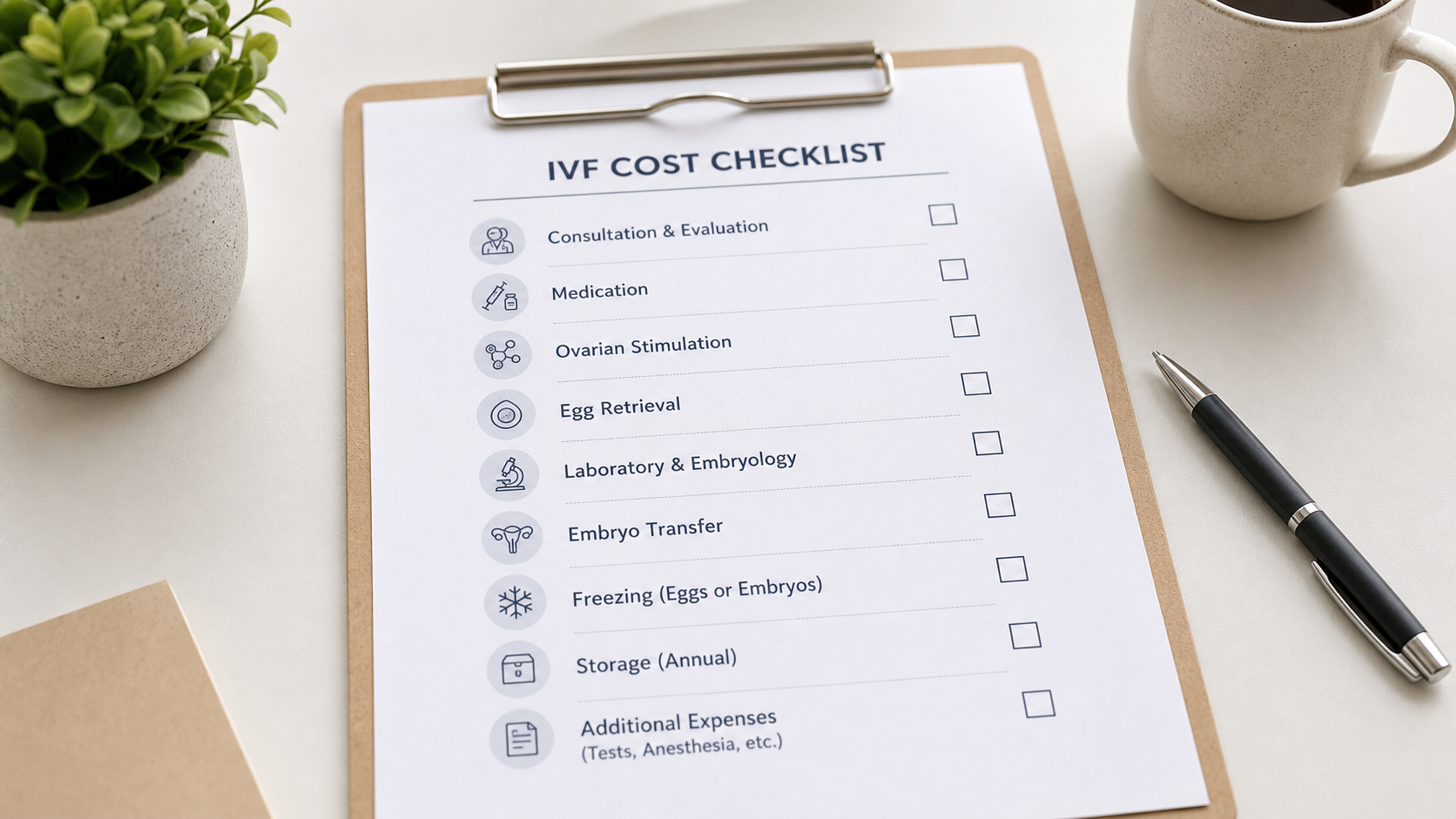
To compare clinics, ask for itemized estimates from each one.
Use the same categories:
- Consultation.
- Testing.
- Base cycle.
- Monitoring.
- Medication.
- Egg retrieval.
- Anesthesia.
- Fertilization.
- ICSI.
- Embryo culture.
- PGT.
- Freezing.
- Storage.
- Fresh transfer.
- Frozen transfer.
- Pregnancy blood tests.
- Outside lab fees.
- Cancellation fees.
Then compare line by line.
A clinic with a higher base cost may include more. A clinic with a lower base cost may require more add-ons.
Also compare communication. If the financial team explains things clearly, that matters. IVF is stressful enough without vague billing.

What to ask before paying anything
Before you sign or pay a deposit, ask:
- What is the estimated total cost for my treatment plan?
- What is included?
- What is excluded?
- What is due upfront?
- What can be paid later?
- What happens if the cycle is canceled?
- What happens if medication needs change?
- Are outside labs involved?
- Do you offer payment plans?
- Do you work with financing companies?
- Are refunds available in any situation?
- Who can I contact if a bill looks wrong?
Get the answers in writing when possible. Memory gets messy when hormones, appointments, and emotions are all in the room.
Conclusion
Average IVF cost in the United States is usually around $12,000 to $20,000 for the base cycle, but a more realistic total can be $15,000 to $30,000 or more once medication, anesthesia, ICSI, transfer, freezing, storage, and testing are included. Insurance may lower the cost, but coverage depends on your plan, employer, state, and clinic billing.
If you want to understand the parts inside the quote, read what does IVF cost include. For the full overview of pricing, insurance, financing, hidden fees, and budget planning, go back to the main IVF cost guide.
Table of contents
- What is the average IVF cost?
- Why IVF cost varies so much
- Average IVF cost before medication
- Average IVF medication cost
- Average cost with ICSI
- Average cost of genetic testing
- Average frozen embryo transfer cost
- Embryo freezing and storage costs
- Average IVF cost with insurance
- Average out-of-pocket IVF cost
- IVF cost by location
- Why one cycle may not be enough
- How to compare IVF costs between clinics
- What to ask before paying anything
- Conclusion
