

Why what you take before pregnancy matters more than you think
Most women start thinking about prenatal vitamins the moment they see a positive test. That instinct makes sense, but the timing is actually a little late. By the time you know you are pregnant, your body has already been building the foundation for fetal development for several weeks — and that foundation either has what it needs or it does not.
The first four weeks of pregnancy, which most women spend not knowing they are pregnant at all, are when the neural tube forms. The neural tube is the early structure that develops into the baby’s brain and spinal cord. The nutrients required for that process need to already be present in sufficient amounts in your system. That is not something you can catch up on after the fact.
This is why preconception nutrition is not optional. It is the point. Taking a prenatal vitamin at least one to three months before you start trying gives your body time to build up nutrient levels that a single daily pill cannot accomplish overnight.
If you are still mapping out your full preconception plan, our complete guide to preparing for pregnancy gives you a clear starting point for everything that needs to happen before and alongside supplementation.
Folic acid and folate — and why the difference is not just semantics
This is the conversation that most prenatal vitamin marketing completely glosses over, and it genuinely matters depending on your genetics.
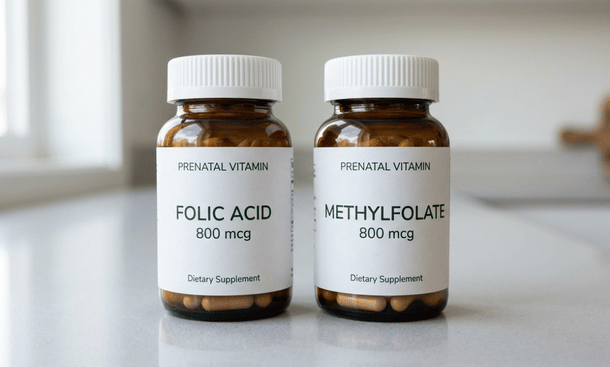
Folic acid is the synthetic form of vitamin B9. It is the version you will find in most standard prenatal vitamins and in fortified foods. Folate is the naturally occurring form found in leafy greens, legumes, and citrus. Both support the development of the neural tube and help prevent serious birth defects — but here is where it gets nuanced.
A significant portion of the population carries a genetic variation called MTHFR, which stands for methylenetetrahydrofolate reductase. This variation affects how efficiently your body converts folic acid into its active, usable form. Women with this variation may not be getting the full benefit of standard folic acid supplements even if they are taking the recommended dose every single day.
The solution is a prenatal vitamin that contains methylfolate, which is the already-converted, bioavailable form of folate that your body can use directly regardless of your MTHFR status. It is sometimes listed on labels as 5-MTHF or L-methylfolate.
You do not need a genetic test to make the switch. Many reproductive specialists now recommend methylfolate-based prenatals as a default simply because they work better across the board.
The nutrients most prenatal vitamins get wrong
Folic acid gets all the attention, but a well-formulated prenatal vitamin is doing a lot more than one nutrient of work. Here is what else deserves a spot on your radar.
Iron is one that many prenatals underdeliver on. During pregnancy, your blood volume increases by nearly 50 percent, and iron is what your body uses to produce the additional red blood cells required to support that. Iron deficiency during pregnancy is extremely common and is associated with fatigue, preterm birth, and low birth weight. Look for a prenatal with at least 27 milligrams of iron, which is the standard recommended dose for pregnant women.
Vitamin D is chronically low in a large percentage of the population, particularly in northern climates and among people who spend limited time outdoors. Low vitamin D during pregnancy has been linked to gestational diabetes, preeclampsia, and impaired fetal bone development. Most prenatals include vitamin D, but many include only 400 IU, which is widely considered insufficient by current research. A dose of 1,000 to 2,000 IU is more commonly recommended by specialists.
Omega-3 DHA, which stands for docosahexaenoic acid, supports fetal brain and eye development and has been associated with reduced risk of preterm birth. Many standard prenatals do not include it at all, which means you may need a separate fish oil or algae-based DHA supplement alongside your prenatal.
Choline is one of the most overlooked nutrients in prenatal nutrition despite strong evidence of its role in fetal brain development. Most prenatal vitamins contain little to no choline. Eggs and liver are among the richest dietary sources, but if those are not regular parts of your diet, a separate choline supplement is worth discussing with your provider.
Iodine supports thyroid function and fetal neurological development. It is absent from a surprising number of prenatal formulas. Check your label specifically for this one.
How to read a prenatal vitamin label without losing your mind
Standing in a pharmacy aisle trying to decode supplement labels is nobody’s idea of a good time. Here is a straightforward framework for evaluating what you are looking at.
Start with the folate form. If it says folic acid only and you want to play it safe, look for a formula that uses methylfolate or a combination of both.
Check the iron dose. Anything below 27 milligrams means you may need to supplement separately if your levels are low.
Look for vitamin D and note the IU amount. Under 600 IU is generally considered inadequate for pregnancy support.
Scan for DHA. If it is not listed, plan to add a separate omega-3 supplement.
Check the iodine line. It should be present and ideally at or near 150 micrograms, which is the recommended daily intake during preconception and pregnancy.
Finally, look at the overall ingredient list for unnecessary fillers, artificial colors, and allergens that might cause digestive issues. Many women find that prenatal vitamins cause nausea, particularly on an empty stomach. Taking yours with food or before bed rather than first thing in the morning can make a meaningful difference in tolerability.

Food first — what your diet should be doing alongside your supplement
A prenatal vitamin is not a substitute for a nutrient-dense diet. It is a safety net for the gaps your diet cannot fully cover on its own — and every diet has gaps.
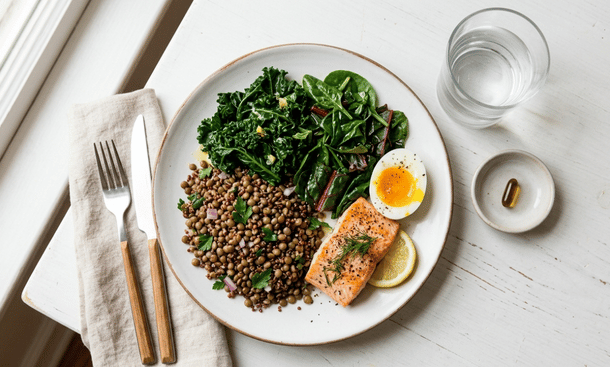
Leafy greens like spinach, kale, and romaine are among the best natural sources of folate. Lentils and chickpeas deliver both folate and iron. Fatty fish like salmon and sardines provide DHA and vitamin D. Eggs cover choline and vitamin D. Dairy and fortified plant milks contribute calcium and iodine.
The pattern here is not complicated. A diet built around whole foods — vegetables, legumes, quality proteins, healthy fats — covers most of your nutritional bases more effectively than any supplement stack. Where supplements earn their place is in filling the specific gaps that even a solid diet tends to leave, particularly folate, vitamin D, iron, and DHA.
If you are also working on broader dietary and lifestyle changes as part of your preconception prep, the page on diet and lifestyle changes before pregnancy goes deeper into what your plate should look like before you conceive.
When to start taking prenatal vitamins and for how long
The standard recommendation is to begin taking a prenatal vitamin at least one month before you start trying to conceive, though three months is the more commonly cited ideal window among reproductive specialists. This gives your body time to build nutrient stores rather than simply maintaining day-to-day levels.
If your pregnancy was unplanned, start as soon as you find out. The nutrient support is still highly valuable throughout the first trimester and beyond regardless of when you begin.
Most providers recommend continuing prenatal vitamins throughout the entire pregnancy and into the postpartum period, particularly if you are breastfeeding. Nursing depletes many of the same nutrients that pregnancy demands, and maintaining supplementation during that phase supports both your recovery and your baby’s development through breast milk.
One practical note: consistency matters more than perfection. Taking your prenatal vitamin most days is significantly better than taking it sporadically. Build it into an existing routine — alongside your morning coffee, your evening skincare, or whatever daily habit you already have locked in.
Wrapping it up
Choosing the right prenatal vitamin is not about finding the most expensive option or the one with the prettiest packaging. It is about understanding what your body actually needs before pregnancy begins and making sure what you are taking delivers it in a form your body can use.
Check for methylfolate, adequate iron, vitamin D above 600 IU, DHA, choline, and iodine. Take it consistently. Pair it with a diet that does the heavy lifting on whole food nutrients. And start earlier than you think you need to.
If your next question is about what your preconception doctor visit should cover — including which blood tests will confirm whether your nutrient levels are actually where they need to be — the page on your preconception doctor visit checklist walks you through exactly what to ask and what to expect.
