

There is a specific kind of misery that comes with being sick while pregnant. You are already exhausted. Your body is already working overtime. And now you have a fever, a cough that won’t quit, and a medicine cabinet full of things you’re not sure you can touch.
I went through this during my second trimester. A nasty head cold, complete with congestion and a sore throat, right in the middle of a New York winter. And my first instinct — reaching for the DayQuil I’d been relying on for years — stopped me cold the second I remembered I was pregnant.
So I called my OB, did my research, and figured out what was actually safe. That’s what this article is. The real list, organized clearly, so you’re not making decisions in a fog at 2am when you feel terrible.
Why getting sick during pregnancy hits differently
Your immune system during pregnancy is intentionally suppressed. Not because something is wrong — because your body is making space for a baby that is genetically different from you. That immune modulation means you’re more susceptible to infections and you tend to feel them harder than you would otherwise.
A fever during pregnancy also carries more weight than it does outside of pregnancy. High fevers especially in the first trimester have been associated with neural tube defects and other complications. So managing symptoms — including fever — is not just about comfort. It’s genuinely important.
That’s why knowing what you can safely take is not optional information. It’s practical and necessary.
The safest approach: treat one symptom at a time

One of the most important things to understand about cold and flu medication during pregnancy is this: combination products are your enemy.
DayQuil, NyQuil, Theraflu, and similar multi-symptom products combine several active ingredients at once — a decongestant, a cough suppressant, a pain reliever, sometimes an antihistamine. Some of those ingredients are fine during pregnancy. Others are not. And when they’re all mixed together you can’t take the safe ones without also taking the ones you should avoid.
The smarter approach is to identify your specific symptoms and treat each one individually with a targeted, single-ingredient product. It takes a few more bottles but it keeps you in control of what’s actually going into your body.
For the full picture of every medication category during pregnancy — not just cold and flu — the complete guide to safe medications during pregnancy lays it all out in one place.
Fever and pain: what to reach for
Acetaminophen (Tylenol) is your primary tool here and it does double duty. It brings down fever and relieves the body aches and headaches that come with the flu. It’s considered safe across all three trimesters when used at the recommended dose for the shortest time necessary.
Do not substitute ibuprofen or aspirin here. Both carry real concerns during pregnancy — ibuprofen especially in the third trimester can affect fetal heart development. Stick with Tylenol for fever and pain management.
If your fever goes above 100.4°F (38°C) call your provider before just managing it at home. Tylenol can help while you wait to hear back but a significant fever during pregnancy always warrants medical guidance.
Congestion and stuffy nose
This is where things get more complicated and where trimester matters a lot.
Pseudoephedrine (Sudafed) is generally recommended to avoid during the first trimester due to a possible association with certain birth defects. After the first trimester some providers give the green light for short-term use but it’s always a conversation — not an assumption.
Phenylephrine — the decongestant found in many pharmacy versions of Sudafed and in combination cold products — has less data overall and is treated with similar caution.
Saline nasal spray is safe at any point during pregnancy and genuinely effective for mild to moderate congestion. It’s not glamorous but it works and there are zero concerns about fetal exposure.
Nasal corticosteroid sprays like Rhinocort (budesonide) are a solid option for congestion that lingers. They work locally with minimal systemic absorption and budesonide in particular has a good safety profile during pregnancy.
The honest answer on decongestants is this: avoid them in the first trimester entirely and talk to your provider before using them in the second or third.
Cough

Dextromethorphan (DM) is the cough suppressant found in most OTC cough medications — look for “DM” on the label. It’s considered generally safe during pregnancy and is one of the more well-studied OTC ingredients in this category. Robitussin DM and similar products with dextromethorphan as the only active ingredient are what most OBs point to when a cough suppressant is needed.
Guaifenesin is an expectorant — it loosens mucus so you can cough it up more effectively. It’s found in plain Mucinex and similar products. The data here is slightly more mixed for the first trimester specifically but most providers consider it acceptable after that window. If you’re in your first trimester check with your provider before using guaifenesin regularly.
Honey sounds too simple but the research on it for cough relief is actually solid. A spoonful of honey — especially in warm tea — can soothe throat irritation and reduce cough frequency. Safe at any point in pregnancy. Worth trying before you reach for anything else.
What to avoid: combination cough products that include alcohol, codeine, or multiple active ingredients you haven’t vetted individually.
Sore throat
Salt water gargling is effective, free, and completely safe. Half a teaspoon of salt in eight ounces of warm water gargled for 30 seconds several times a day can meaningfully reduce throat pain.
Chloraseptic spray and throat lozenges containing benzocaine or menthol are generally considered safe for short-term use during pregnancy. They work locally and systemic absorption is minimal.
Acetaminophen also helps with sore throat pain — it’s not just for headaches and fever.
Avoid throat sprays or lozenges with high doses of zinc or herbal ingredients that haven’t been reviewed by your provider. “Natural” on the label does not automatically mean safe during pregnancy.
Runny nose and sneezing
Plain antihistamines are your friend here. Loratadine (Claritin) and cetirizine (Zyrtec) are both considered safe during pregnancy and can help dry up a runny nose without the decongestant concerns.
Diphenhydramine (Benadryl) can also help and has the added benefit of making you drowsy if nighttime sleep is suffering — but keep it short-term and occasional rather than a daily habit.
What to avoid entirely
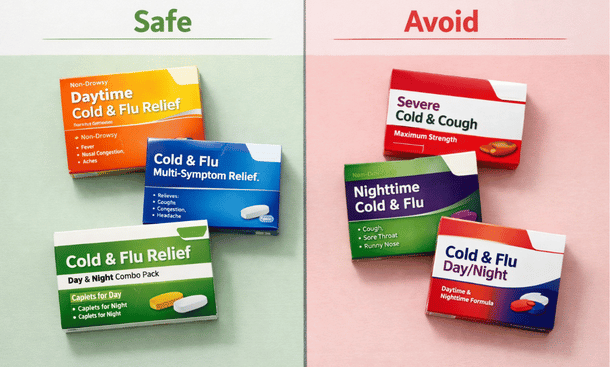
To make this as clear as possible — these are the things that should stay on the shelf:
NyQuil and DayQuil — combination products with ingredients that haven’t been vetted for pregnancy safety as a bundle. The alcohol content in liquid NyQuil is an additional concern.
Aspirin and ibuprofen — for pain and fever management during cold and flu, these are not appropriate substitutes for Tylenol during pregnancy.
Combination decongestant products — anything with pseudoephedrine or phenylephrine combined with other active ingredients makes it impossible to control what you’re taking.
Herbal cold remedies — elderberry, echinacea, and similar products are popular but the data on safety during pregnancy is limited. Some herbal products can affect hormone levels or uterine activity. Check with your provider before using any of them.
High-dose zinc supplements — used commonly for cold duration reduction but not well-studied in pregnancy and potentially problematic at high doses.
When to call your doctor
A cold during pregnancy is usually manageable at home. The flu is a different conversation. Influenza during pregnancy can escalate quickly and pregnant women are at higher risk for serious complications including pneumonia.
Call your provider if:
Your fever exceeds 100.4°F and doesn’t respond to Tylenol within a reasonable time. You develop chest pain or difficulty breathing. Your symptoms last more than 10 days without improvement. You have any concerns about fetal movement during illness.
The flu vaccine during pregnancy is not only safe — it’s recommended. It protects you and passes antibodies to your baby. If you haven’t gotten one this season it’s worth discussing with your OB.
A Quick reference by symptom
Fever and body aches — Acetaminophen (Tylenol). Safe all trimesters. Congestion — Saline spray any time. Sudafed only after first trimester with provider approval. Cough — Robitussin DM or plain honey. Avoid combination products. Sore throat — Salt water gargle, throat lozenges, acetaminophen. Runny nose and sneezing — Claritin or Zyrtec. Safe all trimesters.
Getting sick while pregnant is genuinely rough but you have more options than you might think. The key is treating individual symptoms with single-ingredient products you’ve verified are safe rather than grabbing a combination product out of habit.
Tylenol for fever and pain. Saline spray for congestion. Robitussin DM for cough. Claritin for sneezing and runny nose. Those four cover most of what a cold or flu will throw at you.
And when in doubt — call your OB. That’s not overreacting. That’s being smart about a situation where two people are affected by every decision you make.
Once you’re feeling better, heartburn has a way of moving right in — especially as your bump grows. If that burning feeling after every meal is becoming a regular thing, heartburn relief during pregnancy: safe antacids list walks you through exactly what works, what to avoid, and a few natural remedies that actually make a difference.

Carlene R. Priddy offers strategic advice and practical guidance for governorsbefore, during, and after their mandatesto strengthen governance and public leadership.