

Twenty-four weeks. If you’ve been counting — and let’s be honest, you have been — you know this number carries weight. It’s the week that shows up in every pregnancy book, every app notification, every conversation with your OB. Viability. The word gets thrown around a lot but most people don’t actually know what it means in practice.
It doesn’t mean your baby is ready to be born. It means that with intensive medical support a baby born at this point has a chance of surviving outside the womb. That chance varies enormously depending on the hospital, the resources available and the individual baby. But the threshold exists and crossing it matters — medically and emotionally.
Month six is also packed with developmental milestones that go way beyond that single number. Your baby is opening their eyes for the first time. Their lungs are beginning to produce a substance that will eventually let them breathe air. Their brain is growing at a rate that’s almost hard to comprehend.
Let’s get into all of it.
Week 22: The approach to viability
Before we hit 24 weeks it’s worth understanding what’s happening in the lead-up. At week twenty-two your baby weighs about 430 grams and measures roughly 27 centimeters. The skin is still thin and translucent — you can see blood vessels beneath the surface. Fat layers haven’t built up yet so the skin appears wrinkled and loose.
The brain is developing rapidly. The cerebral cortex — the part responsible for thought, memory and voluntary movement — is becoming more complex. Billions of neurons are forming connections.
Survival at 22 weeks is possible but rare and requires the most advanced neonatal care available. Most hospitals consider 22 to 23 weeks the gray zone — where decisions about intervention become deeply individual and ethically complex.
Week 23: Closing in
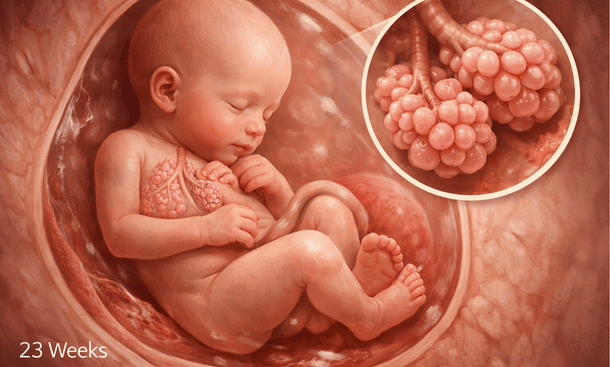
By week twenty-three the lungs are developing small air sacs called alveoli. These are essential for breathing but they won’t be functional without help for several more weeks. The lungs also need to start producing surfactant — a coating that keeps the air sacs from collapsing when the baby exhales.
At 23 weeks surfactant production has barely begun. This is the core reason why premature babies struggle to breathe — without enough surfactant the lungs collapse with every breath.
Your baby’s hearing is well established now. They’re responding to music and voices with movement. Their inner ear is fully developed.
Week 24: The viability milestone
Here it is. Twenty-four weeks.
Survival rates at 24 weeks with intensive neonatal care range from roughly 40 to 70 percent depending on the facility and circumstances. Those numbers sound both encouraging and sobering at the same time. That’s because they are. Babies born at this stage face significant challenges — respiratory distress, underdeveloped organs, neurological risks. NICU stays measured in months not days.
But crossing this threshold shifts something in how medicine approaches your pregnancy. Decisions about intervention in an emergency become different after 24 weeks. Your care team will talk about this with you even if everything is going perfectly — because it’s information you deserve to have.
What’s happening developmentally at 24 weeks specifically is significant. The eyes — which have been fused shut since week nine — are beginning to open. Not fully. Not all at once. But the eyelids are separating and the eyes can now respond to light that filters through the uterine wall.
Taste buds are present and functioning. Your baby is swallowing amniotic fluid that carries the flavors of what you eat. Research suggests this is one of the early ways babies begin developing food preferences.
Week 25: Brain growth you can see on a scan
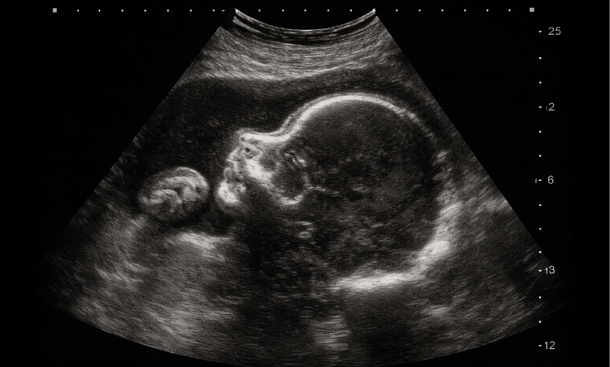
At week twenty-five the brain is undergoing a process called gyrification — the formation of folds and grooves on the surface of the cerebral cortex. A smooth brain can’t hold as many neurons as a folded one. Those folds are what allow for the complexity of human thought.
At 25 weeks the brain surface is still relatively smooth but the folding has begun. Over the next several weeks it will become increasingly complex.
Your baby now weighs about 660 grams. They’re gaining roughly 200 grams per week from here. Hands are fully formed with fingerprints already established — unique to them and no one else on the planet.
Week 26: Eyes open, lungs working harder
Week twenty-six is when eye opening becomes more consistent. Your baby is beginning to see — not with the clarity of a newborn but with the ability to detect light and shadow. If you shine a flashlight at your belly some babies will turn toward it or away from it.
Surfactant production is increasing meaningfully this week. A baby born at 26 weeks still has serious respiratory challenges but their odds improve significantly compared to just two weeks earlier. Modern medicine can supplement surfactant artificially — it’s given directly into the lungs at birth for premature babies — but the more the baby produces naturally the better.
The immune system is also developing. Antibodies are being transferred from you through the placenta. This passive immunity will protect your baby in their first months of life before their own immune system is fully operational.
What viability actually means for your pregnancy
Here’s the thing about the viability milestone that doesn’t always get said clearly: it’s not a finish line. Reaching 24 weeks doesn’t mean you stop worrying or that everything is guaranteed. What it means is that the medical conversation around your pregnancy has shifted. Your baby is a patient now in a different sense.
For most pregnancies that reach this point everything continues normally through to a healthy full-term birth. The viability threshold matters most in situations where something goes wrong — preterm labor, placental complications, emergencies. Knowing where you stand gives you and your doctors a shared framework for decision-making.
It also tends to deepen the emotional reality of pregnancy in ways that are hard to articulate. Something about knowing your baby could — even with intervention, even imperfectly — exist in the world outside you changes how the pregnancy feels. More concrete. More urgent. More real.

The numbers behind neonatal survival
Survival rates for premature babies have improved dramatically over the past 30 years. At 24 weeks survival with intensive care is now possible at specialized centers in ways it simply wasn’t before. At 28 weeks survival rates exceed 90 percent at most advanced NICUs. At 32 weeks they approach those of full-term babies.
This progress is the result of advances in surfactant therapy, ventilation techniques, infection management and neonatal nutrition. Understanding these numbers isn’t about preparing for the worst — it’s about understanding the medical landscape your pregnancy exists within.
Your goal — and your baby’s goal — is still 40 weeks. But knowing what happens if you don’t get there is information that belongs to you.
Month six is where the pregnancy stops feeling like a countdown and starts feeling like a collaboration. Your baby is here — present, responding, growing in ways you can track and feel and sometimes even see on a scan. The viability milestone is real and meaningful but what’s more meaningful is everything that’s happening around it: the eyes opening, the brain folding, the lungs preparing, the fingerprints already set.
From here the pregnancy moves into its final stretch and the changes keep accelerating. Month seven and eight bring the most dramatic growth surge of the entire pregnancy — your baby is going to put on serious weight and their brain development hits another gear entirely. All of that is covered in baby growth in the third trimester: months 7 & 8.
And if you want to see how month six fits into the complete picture — from that very first heartbeat all the way to birth — the complete month-by-month fetal development guide has every stage mapped out in one place.

As an author at Felyro.com, I create actionable content on pregnancy tracking, offering practical tools, tips, and insights that empower mothers-to-be to stay informed and confident throughout their pregnancy.