
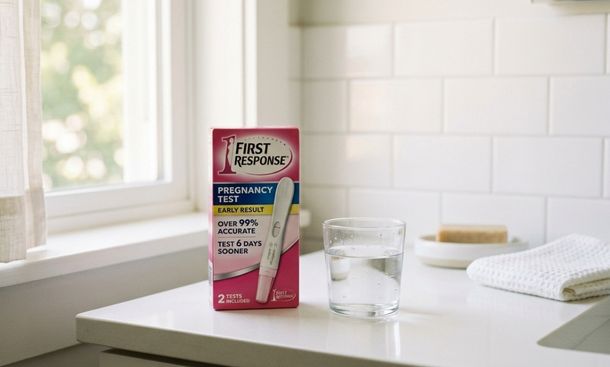
If you are anything like most women in that agonizing two-week wait, patience is not exactly your strongest suit right now — and honestly, fair enough. The good news is that not all pregnancy tests are created equal, and timing your test correctly can make the entire difference between a reliable result and a heartbreaking false negative. First Response Early Result is engineered to pick up trace hCG levels days before your period is even late. For the full picture on how discharge changes and early symptoms align with your test window, the complete guide to using a First Response test during early pregnancy is worth reading start to finish.
1. What makes First Response different from other tests
Not all pregnancy tests are designed the same way. Standard drugstore tests are calibrated to detect hCG, human chorionic gonadotropin, the hormone your body produces after a fertilized egg implants in the uterus, at around 20 to 25 mIU/mL. First Response Early Result is calibrated to detect hCG at concentrations as low as 6.5 mIU/mL. That lower threshold is what gives it its early detection advantage.
This sensitivity matters most in the days immediately after implantation, when hCG is present but still building toward levels that a less sensitive test would register.
2. How hCG levels work in early pregnancy
After implantation, which typically happens between six and twelve days past ovulation, your body begins producing hCG almost immediately. The hormone is generated by the cells that will eventually form the placenta, and it signals your ovaries to keep producing progesterone so the uterine lining is maintained and the pregnancy continues.
hCG roughly doubles every 48 to 72 hours in a healthy early pregnancy. A level that sits just below 6.5 mIU/mL on day eight past ovulation may be well above 20 mIU/mL by day eleven or twelve. The hormone is there. It is simply not yet high enough to trigger a visible result.
3. The earliest possible testing window
First Response states on its packaging that it can detect pregnancy up to six days before a missed period. For a woman with a standard 28-day cycle and ovulation around day 14, that puts the earliest possible testing window at around eight days past ovulation.
At six days before a missed period, only about 16 percent of pregnant women will get a positive result. By five days before a missed period, that number rises to around 40 percent. By the day of the missed period, First Response detects over 99 percent of pregnancies. So yes, you can test six days early — but the earlier you test, the higher the chance of a false negative.
4. What affects your test accuracy
The time of day you test matters significantly. Morning urine is more concentrated, making hCG more detectable in your first bathroom trip of the day. Testing in the afternoon after drinking fluids can dilute the sample and reduce the test’s ability to pick up low hormone levels.
Cycle irregularity also plays a role. If your cycles are not the standard 28 days, or if ovulation happened later than you thought, your estimated testing window shifts accordingly. Evaporation lines can also cause confusion — reading a test after the recommended window increases the risk of mistaking a colorless drying mark for a positive.
5. How to get the most reliable result
Test first thing in the morning with your first urine of the day. Do not drink large amounts of water before testing. Wait until at least ten to twelve days past ovulation if you can hold out that long. If you get a negative and your period does not arrive, test again in 48 hours — hCG doubles every two days, so a result that was undetectable on Monday may be clearly positive by Wednesday.
Conclusion
First Response is one of the most powerful tools available for early detection, but it works best when you understand what it is measuring and why timing matters so much. The test is not magic — it is chemistry. And your body’s chemistry follows its own timeline.
Understanding your test is only one part of the early pregnancy picture. If you have not yet read about what implantation discharge looks like and how it differs from other types of vaginal discharge, the article on implantation discharge versus other discharge breaks down the differences in color, texture, and timing so you know what your body is telling you before the test confirms it. And for everything in one place, the full guide on First Response pregnancy testing and early pregnancy discharge covers every stage of that early window.
