
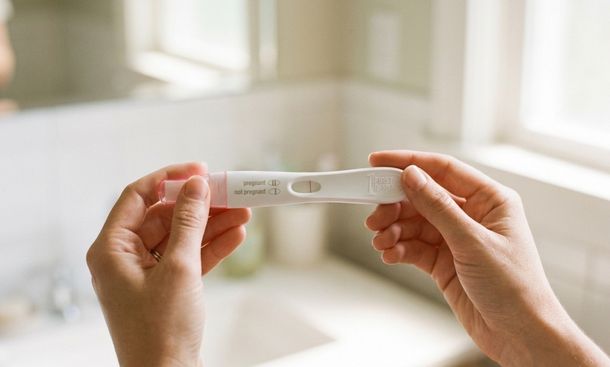
You took the test, you held it up to every light source in your bathroom, and now you are staring at what might be the faintest line you have ever seen in your life. A faint line on a pregnancy test is one of the most searched and most misunderstood results out there, and it genuinely matters whether that shadow is a true positive or an evaporation line. Reading a First Response result correctly requires knowing what you are actually looking at and when you took the test. For context on how discharge patterns and early hCG levels factor into your result, the full guide to First Response pregnancy testing and early pregnancy signals is a solid place to start.
1. Why faint lines happen on First Response tests
A First Response Early Result test works by detecting hCG in your urine through a strip embedded with antibodies that bind to hCG molecules. When enough hCG is present, those antibodies trigger a dye reaction that produces a visible colored line in the result window. The intensity of that line is directly proportional to the concentration of hCG in your urine at the moment of testing.
A faint line means hCG is present but at a low concentration. This is why faint lines are so common in early testing. If you are testing five or six days before your missed period, your hCG levels may be just barely crossing the detection threshold of 6.5 mIU/mL. The hormone is there. The test is finding it. But because the concentration is low, the resulting line is light.
2. What a faint positive actually means
A faint line is still a line. On a First Response test, any second line — no matter how light — that appears within the result window during the recommended reading time indicates that hCG was detected in your urine. That means a pregnancy is most likely present.
The darkness of the line does not tell you whether the pregnancy is healthy, viable, or progressing normally. It only tells you how much hCG was in your urine at that specific moment on that specific day. Many women who go on to have completely healthy pregnancies start with lines so faint they photograph them in different lighting three times just to confirm they are real.
3. Evaporation lines vs. faint positives
An evaporation line forms when urine dries on the test strip during or after the result window. As the liquid evaporates, it can leave a faint impression in the area where a result line would appear. This mark is not a result — it is a drying artifact.
Color is the most important distinguishing factor. A faint positive on a First Response test will have color — some degree of pink, even if very light. An evaporation line is typically gray, colorless, or has a slightly shiny quality. Timing is equally reliable — any line that appears after the result window has closed should not be read as a result. Set a timer and read within the window every time.
4. When to retest and what to expect
Wait 48 hours before retesting. Because hCG roughly doubles every 48 to 72 hours in a healthy early pregnancy, waiting two days gives your hormone levels time to climb to a more easily detectable concentration. Always use first morning urine. Stick with the same brand and product line if you want to compare line darkness across tests, since different brands have different sensitivity thresholds.
5. What to do after a faint positive result
Once you have a faint positive that appeared within the result window, carries pink color, and reproduced on a second test — contact your healthcare provider. A blood hCG test measures the exact hormone level rather than interpreting a visual line, and a follow-up draw 48 hours later confirms whether levels are rising as expected. Start or continue prenatal vitamins with folic acid if you have not already.
Conclusion
A faint line on a First Response test is not a trick, and it is not your imagination. It is chemistry doing its job at the earliest possible stage of detection. Read your result within the correct window, look for pink color, retest in 48 hours with first morning urine, and then let your healthcare provider take it from there.
A faint positive is the beginning of a much bigger conversation your body is about to have with you. The next part of that conversation is about timing — knowing when the right moment to test actually is based on your cycle and discharge patterns. The article on when to take a pregnancy test for the most accurate result gives you a practical, cycle-aware framework. And for the full picture, the complete guide on First Response pregnancy testing and early pregnancy discharge brings it all together.
