

Week thirteen feels like crossing a finish line. The first trimester fog lifts a little, the nausea starts backing off for most people, and there’s this collective exhale that happens somewhere around the start of the second trimester. You made it through the hardest part, right?
Kind of. The second and third trimesters are genuinely easier for a lot of women. But they come with their own roster of symptoms — some predictable, some that catch you completely off guard — and the tracking work doesn’t stop here. If anything it gets more specific.
The things you’re logging in week twenty are different from what you were logging in week eight. The red flags are different too. And fetal movement tracking — which becomes a real part of your routine starting around week twenty-four — adds an entirely new layer to the daily habit.
If you built your tracking foundation in the first trimester using the complete guide to tracking pregnancy symptoms safely, this is where you evolve that system. Same daily habit, updated focus.
What changes after week twelve
The hormonal surge of the first trimester starts to level out. Progesterone and estrogen find a steadier rhythm. For most women that means nausea fades, energy comes back somewhat, and the emotional volatility of those early weeks softens.
But your body is also growing fast now. The uterus is expanding significantly every week. Your center of gravity is shifting. Your cardiovascular system is working harder. Your joints and ligaments are loosening in preparation for birth. All of that produces symptoms — and all of it is worth tracking.
The other thing that changes is the clinical stakes of certain symptoms. A headache in week eight is almost always hormonal. A severe headache in week thirty-two needs to be evaluated for preeclampsia the same day. Context matters enormously in the second and third trimesters and your tracking log is what provides that context.
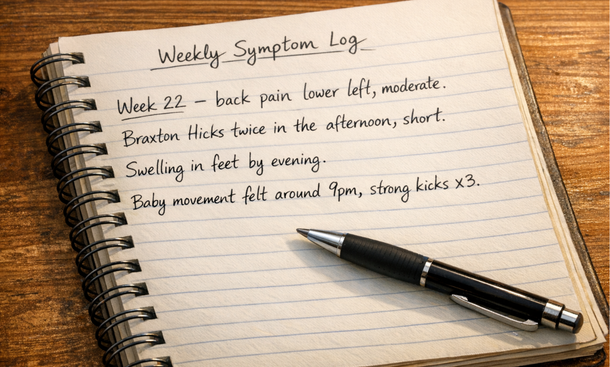
Second trimester symptoms to log — weeks 13 to 27
Round ligament pain. Sharp, stabbing pain on one or both sides of the lower abdomen — usually triggered by sudden movement like rolling over in bed or standing up quickly. It’s ligaments stretching to accommodate your growing uterus. Log when it happens and what triggered it. If it becomes constant rather than positional, mention it to your OB.
Back pain. Lower back pain is almost universal in the second trimester. Log the location — lower back, mid-back, one-sided — and the intensity. One-sided back pain that radiates into your hip or leg can sometimes indicate sciatic nerve involvement, which your provider may want to address with physical therapy referrals.
Braxton Hicks contractions. These practice contractions typically start becoming noticeable somewhere between weeks sixteen and twenty-four. Log the time, duration, and frequency. The key distinction your OB will ask about: Braxton Hicks are irregular, don’t increase in intensity, and stop when you change position or drink water. Real contractions do none of those things.
Swelling. Mild swelling in the feet and ankles by end of day is normal in the second and third trimesters. Log when it appears, how severe, and whether it goes down overnight. Sudden significant swelling — especially in the face or hands — is a different story entirely and needs immediate attention.
Heartburn and indigestion. Your growing uterus is pushing up against your stomach. Log how often it’s happening and what seems to trigger it. Your OB has safe options to help — but they need to know the frequency first.
Nasal congestion. Pregnancy rhinitis is real and annoying and rarely mentioned. Increased blood flow to mucous membranes causes persistent stuffiness in a lot of women from the second trimester onward. Worth logging because it affects sleep quality which affects everything else.
Skin changes. Linea nigra, melasma, stretch marks, itchy skin — log any new skin changes and when they appeared. Severe itching — especially on the palms and soles of feet — can occasionally indicate a liver condition called intrahepatic cholestasis of pregnancy, which needs to be ruled out by your doctor.
Third trimester symptoms to log — weeks 28 to 40
Fetal movement. This becomes one of your most important daily tracking tasks starting around week twenty-eight. Kick counts — the standard method — involve noting how long it takes to feel ten distinct movements. Most providers recommend doing this once a day at a consistent time when the baby is typically active.
Log the time you started, the time you reached ten movements, and any day where it took significantly longer than usual or where movement felt noticeably decreased. A sudden drop in fetal movement is always worth a call to your OB.

Pelvic pressure. As the baby drops lower in preparation for birth — which can happen weeks before delivery for some women — you’ll feel significant pressure low in the pelvis. Log the intensity and when it started. Pressure that comes in waves or is accompanied by cramping needs to be evaluated.
Shortness of breath. The uterus is now pressing against the diaphragm. Mild breathlessness when climbing stairs or moving quickly is common. Log it because sudden or severe shortness of breath — especially at rest — is not normal and needs immediate attention.
Sleep disruption. Getting comfortable becomes progressively harder. Log how many hours you’re getting and what’s disrupting sleep — needing to urinate frequently, discomfort, leg cramps, anxiety. Your provider can make recommendations and the pattern data helps them understand what’s driving it.
Leg cramps. Common at night in the third trimester. Log which leg, time of night, duration, and frequency. Persistent leg pain — especially with warmth, redness, or swelling in one leg — needs to be evaluated for deep vein thrombosis, which is more common during pregnancy.
Contractions. In the weeks before your due date, logging contractions becomes critical. Note start time, duration in seconds, and interval between them. This data is exactly what your OB or midwife needs when you call to report early labor.

Expecting Calmly Together
The symptoms that escalate in clinical importance after week twenty
Some symptoms that were merely uncomfortable in the first trimester become significantly more serious in the second and especially the third. These are the ones your tracking log needs to flag immediately.
Severe or sudden headaches. Particularly in the third trimester, severe headaches — especially accompanied by visual disturbances, upper right abdominal pain, or sudden swelling — can indicate preeclampsia. This is a medical emergency. Do not wait for your next appointment.
Decreased fetal movement. Any day where you feel significantly less movement than usual — especially if kick counts take much longer than your baseline — call your OB. Not tomorrow. That day.
Signs of preterm labor before week thirty-seven. Regular contractions, pelvic pressure that comes and goes, low backache that comes and goes, or a gush or trickle of fluid before thirty-seven weeks needs a same-day evaluation.
Sudden severe swelling. Face, hands, or sudden dramatic increase in foot and ankle swelling warrants a call to your provider, particularly if accompanied by headache or vision changes.
How to adjust your journal template for these trimesters
The basic five-minute structure from the first trimester still works. You just update the fields to reflect what’s relevant now.
From week twenty-eight, add a dedicated kick count line to your daily entry. Time started, time reached ten movements, any notes on pattern changes. This single addition takes thirty seconds and is genuinely one of the most important things you can track in late pregnancy.
Add a contractions field from week thirty-two onward. Even if you’re not feeling anything notable, having “no contractions today” as a logged baseline is useful when things do start.
Everything else stays the same. Body scan, intensity rating, what helped, flag for OB. The habit doesn’t change — just the content.
What to bring to your third trimester appointments
Third trimester appointments happen more frequently — every two weeks from week twenty-eight, then weekly from week thirty-six. Your log becomes even more valuable here because your provider is actively monitoring for signs of preeclampsia, preterm labor, and fetal wellbeing.
Before each appointment read back your entries since the last visit. Circle any days where fetal movement was reduced. Highlight any new symptoms that appeared. Note any contractions you’ve been feeling even if they seemed like Braxton Hicks.
Walking in with that information organized means your provider spends the appointment time actually helping you rather than trying to reconstruct what happened over the past two weeks.
Before you move on
Knowing what to track is one thing. Knowing when what you’re tracking crosses into emergency territory is another — and it’s honestly the most important skill you can develop as you move through the second and third trimesters.
The next piece of this is understanding exactly which symptoms can never wait — the ones that need a phone call today, not a note in your journal for next week’s appointment. Pregnancy red flag symptoms and when to call your doctor breaks that down clearly so you know exactly where the line is.

As an author at Felyro.com, I create actionable content on pregnancy tracking, offering practical tools, tips, and insights that empower mothers-to-be to stay informed and confident throughout their pregnancy.