

Why tracking ovulation actually changes your odds
Here is something that surprises a lot of women when they first hear it. Even under ideal conditions, a healthy couple trying to conceive has roughly a 20 to 25 percent chance of success in any given cycle. That number is not a reason to worry — it is a reason to be strategic.
The biology is straightforward. A human egg is viable for only 12 to 24 hours after ovulation. Sperm can survive in the reproductive tract for up to five days under the right conditions, which means the actual window of opportunity in each cycle is around five to six days — and only two to three of those days carry the highest probability of conception.
If you are not tracking ovulation, you are essentially guessing. And guessing, even with good timing instincts, leaves a significant portion of your fertile window either missed or underutilized.
Tracking ovulation does not guarantee pregnancy. Nothing does. But it gives you real information about your own cycle — information that is genuinely useful whether you conceive quickly or eventually need to discuss timeline concerns with your provider.
If you are still building the broader foundation that makes ovulation tracking most effective — nutrient levels, hormonal balance, preconception nutrition — our complete guide to preparing for pregnancy covers the full picture of what needs to be in place before timing becomes your primary focus.
The fertile window — what it is and why most women miscalculate it
The fertile window is the span of days in your cycle when intercourse can result in conception. It includes the five days before ovulation and the day of ovulation itself — six days total, with the two days immediately before ovulation and the day of ovulation carrying the highest probability.
The widely cited assumption that ovulation happens on day 14 of a 28-day cycle is a statistical average, not a biological constant. Cycle length varies between women and within the same woman from month to month. Stress, illness, travel, changes in sleep, and shifts in body weight can all push ovulation earlier or later than expected.
A woman with a 25-day cycle may ovulate around day 11. A woman with a 32-day cycle may not ovulate until day 18 or later. Using day 14 as a fixed target when your cycle does not match that average means you may be timing intercourse after ovulation has already occurred — and at that point, the window has closed for that cycle.
This is the core reason ovulation tracking matters. It tells you when your body is actually approaching ovulation rather than when a calendar formula predicts it should be.
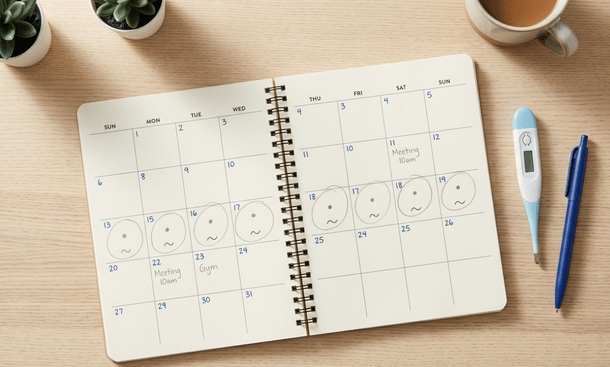
Basal body temperature — how to use it correctly
Basal body temperature, commonly abbreviated as BBT, is your resting body temperature measured at its lowest point — immediately upon waking, before any movement, eating, drinking, or getting up.
After ovulation, the hormone progesterone causes a slight but measurable rise in basal body temperature — typically between 0.2 and 0.5 degrees Fahrenheit. This rise is sustained for the remainder of the cycle until menstruation begins, at which point temperature drops again.
The important thing to understand about BBT charting is that it confirms ovulation has already occurred rather than predicting it in advance. The temperature rise happens after the egg has been released. This means BBT alone, used in isolation, does not give you enough advance warning to act on in the current cycle.
Where BBT charting becomes genuinely powerful is over multiple cycles. After two to three months of consistent charting, patterns emerge. You can see when in your cycle ovulation consistently tends to occur, identify unusually short luteal phases — the period between ovulation and menstruation — that might warrant a conversation with your provider, and spot cycles where ovulation may not have happened at all.
For accuracy, you need a basal body thermometer rather than a standard thermometer. Basal thermometers measure to two decimal places, which is the precision level required to detect the small temperature shifts involved. Take your temperature at the same time every morning. Even a 30-minute variation in wake time can affect readings enough to obscure the pattern.
Ovulation predictor kits — what they measure and how to read them
Ovulation predictor kits, commonly called OPKs, detect the luteinizing hormone surge — the spike in LH that triggers ovulation approximately 24 to 36 hours before the egg is released. This makes them one of the most actionable tools available for timing intercourse because they give you advance notice rather than confirmation after the fact.
Standard OPKs use a test line and control line system similar to a pregnancy test. A positive result is indicated when the test line is as dark as or darker than the control line. A line that is present but lighter than the control line is considered negative regardless of how close it appears.
Testing once per day is a reasonable starting approach, but once you begin seeing the test line darkening, switching to twice-daily testing — morning and early evening — captures the LH surge more reliably. LH surges can be brief, particularly in some women, and a once-daily test taken at the wrong time of day can miss the peak entirely.
Digital OPKs eliminate the subjective line-reading by displaying a clear positive or negative symbol. They are more expensive per test but reduce interpretation error, which matters if you find yourself squinting at paper strips trying to determine whether the line qualifies as dark enough.
Advanced fertility monitors, like the Clearblue Fertility Monitor, track both LH and estrogen and identify a wider fertile window including the high-fertility days before the LH surge. They are significantly more expensive than standard OPKs but produce more comprehensive data for women who want the most complete picture of their cycle.
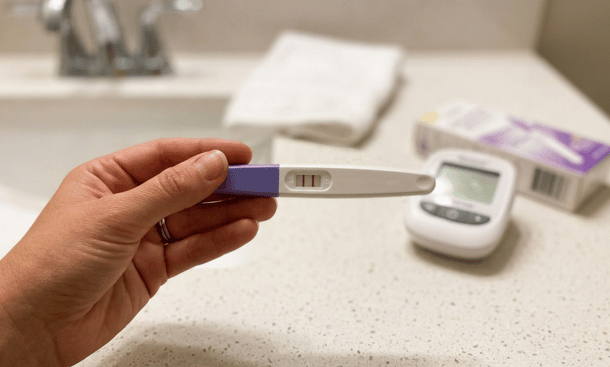
Cervical mucus — the free fertility signal your body is already giving you
Cervical mucus is one of the most reliable fertility indicators available, it costs nothing, and most women have never been taught to pay attention to it.
Throughout the menstrual cycle, cervical mucus — the fluid produced by the cervix — changes in consistency, color, and volume in response to shifting estrogen levels. These changes directly reflect where you are in your cycle relative to ovulation.
In the days immediately following menstruation, many women notice little to no mucus. As estrogen rises in the lead-up to ovulation, mucus begins to appear — initially sticky or creamy in texture, then progressively more fluid and abundant. At peak fertility, cervical mucus becomes clear, slippery, and stretchy — often described as resembling raw egg white. This egg white cervical mucus, sometimes abbreviated as EWCM, is the body’s most visible signal that ovulation is imminent or occurring.
After ovulation, progesterone causes mucus to become thick and tacky again, creating a barrier that is less hospitable to sperm.
Observing cervical mucus requires nothing more than paying attention to what you notice on toilet paper or underwear throughout the day. Some women also check directly at the cervical opening for a more consistent reading. Either approach works.
The reason this signal matters specifically for timing is that egg white cervical mucus also supports sperm survival and motility — it creates an environment that helps sperm reach the egg. The presence of this mucus type is therefore both a timing indicator and an active part of the conception process.
Apps, tools, and combining methods for better accuracy
No single fertility tracking method is perfectly accurate in isolation. Each has limitations, and combining two or more approaches produces a significantly more reliable picture of your fertile window.
The most effective combination for most women is OPKs paired with cervical mucus observation. OPKs give you the hormonal signal with advance notice. Cervical mucus gives you a physical confirmation that your body is responding as expected to that hormonal shift. Together, they cross-reference each other in a way that either method alone cannot.
Adding BBT charting to this combination provides a third data point that helps you confirm ovulation occurred and build a picture of your cycle pattern over time.
Fertility tracking apps — including Clue, Natural Cycles, Ovia, and Flo — can help you log and visualize this data. Their value is primarily in pattern recognition and cycle prediction over multiple months rather than in any algorithm that outperforms your own observed data. The app is only as accurate as the information you put into it.
A few practical points on app use worth stating clearly: a free cycle tracking app is not a contraceptive method. Apps that market themselves as birth control require specific protocols and have documented failure rates. For conception purposes, apps are organizational tools — useful but not infallible.
For women with irregular cycles, PCOS, or a history of hormonal imbalance, tracking methods may need to be adapted. OPKs can show falsely elevated LH readings in women with PCOS. BBT charts may be harder to interpret in cycles without consistent ovulation. In these cases, working with a provider who can combine at-home tracking data with clinical monitoring gives the most complete and reliable information.
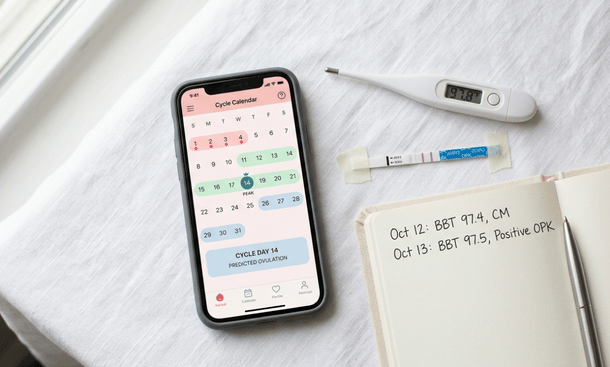
Wrapping it up
Tracking ovulation is not about obsessing over your cycle. It is about having accurate information instead of assumptions. When you know when your body is actually approaching ovulation — not when a calendar formula says it should be — you can time intercourse during the days that genuinely matter and stop spending energy on the days that do not.
Start with OPKs and cervical mucus observation. Add BBT charting if you want a fuller cycle picture over time. Use an app to organize your data rather than relying on it to do your thinking for you. And give yourself two to three cycles to get comfortable with the process before expecting perfect clarity.
The data you collect from tracking is also genuinely useful information to bring to your provider if conception takes longer than expected. Documented cycle patterns, luteal phase lengths, and ovulation timing give a clinician far more to work with than a general description of your cycle.
Once you have your tracking system in place and you are actively trying to conceive, revisiting the foundational information on preconception health tips and what your body needs is worth doing — because the physical preparation that supports conception does not stop being relevant once you start tracking.
