

You’re tracking your cycle. You know your body pretty well at this point. And then something feels off — a faint positive that disappears, some spotting that doesn’t quite feel like your usual period, cramping that hits different. You start Googling at 11pm and end up more confused than when you started.
That’s exactly why this page exists.
Chemical pregnancy symptoms are easy to miss — or to dismiss as a weird cycle. But if you’re actively tracking, you’re probably picking up on details that most people overlook. Let’s talk about what your body is actually doing and what those signs mean in real time.
If you’re still getting familiar with the basics, the complete guide to what a chemical pregnancy is is a solid place to start. Here we’re going deeper into the physical experience — what you feel, when you feel it, and how to read it.
The timeline matters more than you think
Chemical pregnancies happen fast. We’re talking about a window between week four and week five of your cycle — sometimes earlier. By the time most people realize something might have happened, it’s already resolving.
This is why tracking makes such a difference. If you’re monitoring your hCG levels, your basal body temperature, or using a sensitive early detection test, you’re far more likely to catch what’s happening than someone who isn’t paying close attention.
The most common symptoms
A faint positive that fades
This is usually the first sign people notice. You test early — maybe at 9 or 10 days past ovulation — and you get a line. It’s light but it’s there. You test again the next day expecting it to get darker. Instead it stays the same or gets lighter. By day three or four it’s gone.
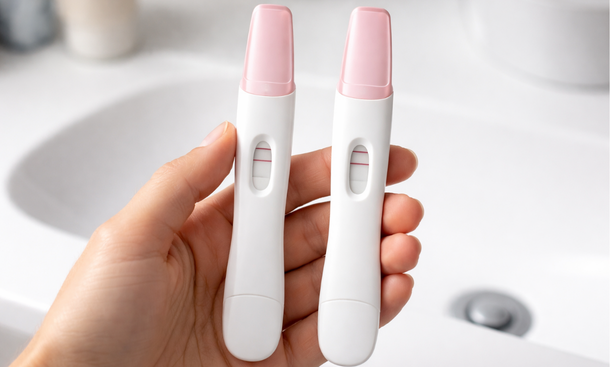
In a normal progressing pregnancy, hCG doubles roughly every 48 hours in early weeks. In a chemical pregnancy, hCG rises briefly and then drops. A fading test line is your body telling you exactly that — levels went up and are now coming back down.
This is one of the clearest indicators for people who test early and often. If you only test once and it’s already dropping, you might just see a negative and never know what happened.
Bleeding that feels heavier or different than usual
After a chemical pregnancy, most people experience bleeding that resembles a period — but there are usually some differences. It may be slightly heavier than your normal flow. You might notice more clotting than usual. It can start a few days after your expected period date or right around it.
Some people also notice the blood looks different — darker at first, then brighter red. This is the uterine lining shedding along with the pregnancy tissue, which is why it can feel more intense than a typical period.
If you weren’t tracking closely, this could easily read as just a late, heavy period. Which is exactly why so many chemical pregnancies go unrecognized.
Cramping
Cramping during a chemical pregnancy can range from mild to noticeably uncomfortable. It tends to start around the time bleeding begins and usually resolves within a day or two.
For most people it feels like strong period cramps. Some describe it as lower abdominal pressure rather than sharp pain. It’s your uterus contracting to shed the lining — the same mechanism as menstrual cramps, just with a bit more going on underneath.
If cramping is severe, one-sided, or accompanied by shoulder pain, that’s worth a call to your doctor — those can be signs of an ectopic pregnancy, which is a different situation entirely.
Early pregnancy symptoms that suddenly stop
Some people experience brief pregnancy symptoms before the loss — mild nausea, breast tenderness, fatigue, or just that general feeling of something is different. These symptoms are driven by rising hCG. When hCG drops, the symptoms disappear.

Relaxed Yet Weary
If you noticed those signs and then they vanished abruptly — right before or around the time bleeding started — that pattern is worth noting, especially if your test results were going in the wrong direction at the same time.
Little to no symptoms at all
Here’s the thing: a lot of people have zero noticeable symptoms. No nausea, no fatigue, no unusual cramping. Just a faint positive that fades and bleeding that arrives close to when their period was expected anyway.
This is actually pretty common. Chemical pregnancies end so early that the body doesn’t always have time to produce significant symptoms. If you weren’t testing early, you’d have no idea anything happened beyond your usual cycle.
This is one of the reasons the actual rate of chemical pregnancies is hard to measure — many happen without anyone realizing it.
How chemical pregnancy symptoms differ from a regular period
This is the question everyone actually wants answered. Here’s a honest breakdown:
A chemical pregnancy might look like a regular period if you weren’t testing. The difference shows up in the details — a positive test that fades, bleeding that’s slightly heavier or later than usual, and a cycle that feels a little off without a clear reason why.
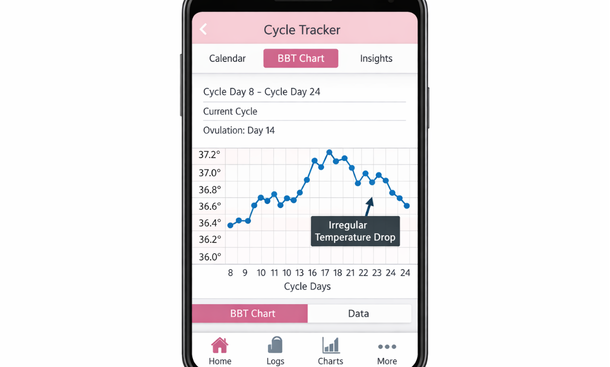
If you were tracking your basal body temperature, you might also notice your temperature pattern doesn’t quite follow the typical post-ovulation drop that happens before a normal period. These small signals add up when you’re tracking consistently.
When symptoms need medical attention
Most of the time, a chemical pregnancy resolves on its own without any intervention needed. But there are situations where you should contact your doctor:
Heavy bleeding that soaks more than a pad an hour for two or more hours is worth a call. Fever, chills, or signs of infection alongside bleeding should not be ignored. And as mentioned above — one-sided pain or shoulder pain alongside bleeding needs to be evaluated to rule out ectopic pregnancy.
For the majority of people, the physical recovery is relatively quick. The emotional recovery can take longer, and that’s completely valid.
What comes after the symptoms resolve
Once the bleeding stops and your hCG returns to zero, your body typically resets to its normal cycle within four to six weeks. Many people ovulate again within two to four weeks of a chemical pregnancy. the difference between a chemical pregnancy and an early miscarriage

As an author at Felyro.com, I create actionable content on pregnancy tracking, offering practical tools, tips, and insights that empower mothers-to-be to stay informed and confident throughout their pregnancy.