

You have done the research. You know you need a nursing chair. But then you get to the store — or deep into a product rabbit hole online — and suddenly there are three completely different types staring back at you, each one claiming to be the best option for breastfeeding moms.
A rocking chair. A glider. A recliner.
They all involve sitting. They all involve some kind of movement. And they all look comfortable enough in photos. But they perform very differently once you are actually in them at midnight with a hungry baby and a sore back.
This breakdown is going to make that decision easier. No fluff, no vague recommendations — just the real differences, and how to figure out which one fits your life.
The choice that matters more than the nursery aesthetic
Before getting into the chairs themselves, it is worth saying this clearly: the type of chair you choose will affect your posture, your comfort during feeds, your baby’s ability to settle, and honestly — your mood during those long night sessions.
A chair that looks beautiful but does not support your lower back is going to wear you down. A chair that is too deep for your frame is going to have you hunching forward every single feed. And a chair that makes noise every time it moves is going to become your enemy the moment you are trying to transfer a sleeping baby.
These are not small things. So let’s go through each option properly.
The rocking chair — classic, but is it right for you?
The rocking chair is the oldest option and the one most people picture when they think of a nursery. It has a curved base and moves in a natural arc — forward and back — with a motion that responds to your body weight.
What works well
The motion is soothing and rhythmic, which many babies respond to instinctively. There is something genuinely calming about the natural flow of a real rocker. Traditional wooden rockers are also typically more durable and easier to clean than heavily upholstered options, which matters more than you think by month three.
What does not work as well
The motion on a rocking chair is less controlled than a glider. If you push off too hard, the chair keeps going — and that unpredictability can be a problem when you are trying to ease a baby into sleep without jarring them. Wooden rockers also tend to be louder, especially on hardwood or tile floors. The legs scrape and tap with each movement, which is not ideal in a quiet house.
Upholstered rocking chairs solve some of the noise issue but can sacrifice the clean lines that make wooden rockers easy to wipe down.
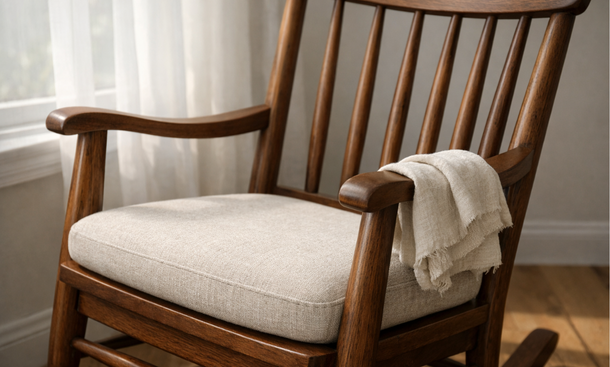
Best for: Moms who want a classic look, prefer natural materials, and do not mind a bit more movement variability. Also a solid option if you plan to keep the chair long after the nursing phase ends.
The glider — why it became the nursing chair default
The glider became the go-to nursing chair for a reason. Instead of a curved base, it sits on a fixed track — a mechanism that allows the seat to move smoothly forward and back within a set range. That means the motion is controlled, consistent, and quiet.
What works well
The glider’s motion is smooth in a way that a rocking chair simply is not. There is no risk of the chair swinging too far in either direction, which makes it much easier to nurse and settle a baby simultaneously. Most gliders are heavily upholstered with padded armrests — which, if sized correctly for your frame, takes a significant amount of strain off your arms and shoulders during feeds.
Gliders are also typically quieter than rockers. The track mechanism does not produce the same floor-contact noise, which matters when you are creeping around a sleeping baby.
What does not work as well
The mechanism under a glider needs maintenance over time. Cheaper models can start to squeak within a year of regular use, and the track can wear unevenly if the chair is used heavily. The upholstery on many gliders is also harder to fully clean — most have fixed cushions that cannot be removed and washed.
Gliders tend to be bulkier than rockers. If you are working with a small nursery or a tight corner, the footprint of a standard glider plus ottoman can eat up more space than you expect.
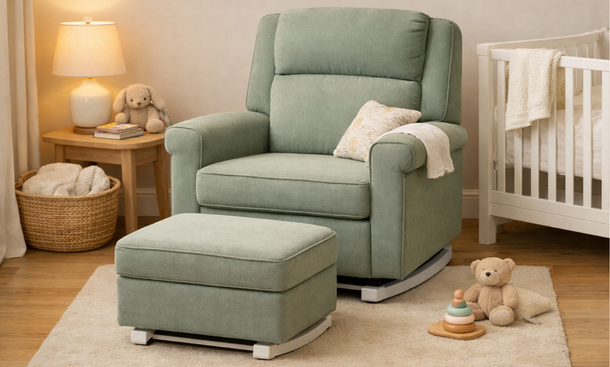
Best for: Moms who prioritize smooth and quiet motion, want full arm support during feeds, and are not working with an extremely small space.
The recliner — the underdog that deserves more attention
The recliner does not get talked about enough in the nursing chair conversation, and that is a mistake. A recliner — especially one designed with a rocking or gliding base — can be one of the most functional options for breastfeeding, particularly for longer feeds and night sessions.
What works well
The ability to lean back changes everything when you are running on minimal sleep. Laid-back nursing, also called biological nurturing — a position where the mother reclines and the baby lies on her chest — is one of the most natural and comfortable feeding positions there is. A recliner makes that position easy without requiring you to prop yourself up with seventeen pillows.
Recliners also tend to have deeper seats and more overall body support than standard gliders or rockers, which works well for taller moms or anyone who wants to feel fully held by the chair.
What does not work as well
A basic recliner without any rocking or gliding motion limits you. You can feed comfortably, but you lose the ability to use rhythmic movement to settle your baby — which is a real tool, especially in the early weeks. Look specifically for models that combine reclining with gliding or rocking functionality.
Size is also a factor. Recliners tend to be the largest of the three options. In a compact nursery, a recliner can overwhelm the space entirely.
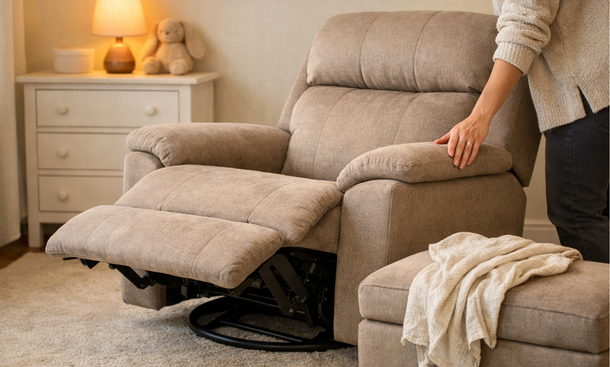
Best for: Moms who plan to do laid-back nursing, want maximum body support, or know they will be spending very long stretches in the chair during overnight feeds.
How to choose based on your body and your space
Here is a simple way to think through it.
Choose a rocking chair if: You want a classic look, prefer natural materials, plan to use the chair beyond the nursing years, and do not need ultra-quiet motion.
Choose a glider if: You want smooth and consistent movement, need padded arm support, and are not working in a very tight space. This is the most versatile option for most moms.
Choose a recliner if: You plan to nurse in a reclined position, want maximum back and body support, are taller than average, or know you will be doing long overnight feeds regularly.
Your height and frame matter too. If you are under 5’4″, test seat depth carefully before buying any of these — many standard models are sized for taller frames and will leave you perching forward rather than sitting fully supported.
What about combo chairs?
Some chairs combine features — a glider that also reclines, or a rocker with a swivel base. These can be genuinely useful if you want flexibility, but they come with trade-offs.
Combo mechanisms are more complex, which means more points of potential failure over time. They also tend to be heavier and pricier. If you find one that hits all your requirements and fits your budget, it is worth considering. But do not pay for features you will not actually use.
Price range — what you actually need to spend
You do not need to spend a fortune to get a chair that works well.
Rocking chairs range from around $150 for a basic wooden model to $600 or more for an upholstered version from a specialty brand. Gliders sit between $200 and $900 for most quality options, with the sweet spot for durability and comfort usually falling in the $300 to $500 range. Recliners designed for nursing start around $250 and can go well above $800 for models with premium fabric and multi-function bases.
Whatever your budget, prioritize the functional features — lumbar support, armrest height, seat depth, and fabric durability — over brand name or visual style. A $350 glider that fits your body correctly will serve you far better than a $700 designer rocker that has you hunching forward every feed.
There is no single best chair for every mom. The right answer depends on how you plan to nurse, how much space you have, and what your body needs during those long feeding sessions.
If you want to go deeper on the specific features that make any of these chairs truly functional for breastfeeding — things like lumbar curve, seat depth, and fabric durability — the piece on what to look for in a nursing chair for breastfeeding covers all of that in detail.
And if you are still building out your understanding of the full setup — chair type, placement, accessories, and timing — the complete guide to choosing a nursery chair for breastfeeding is the place to start.

As a Felyro.com content author, I develop actionable content on breastfeeding, translating research-backed information into practical advice for mothers. My goal is to help families establish healthy feeding habits, improve maternal confidence, and support infant development.