
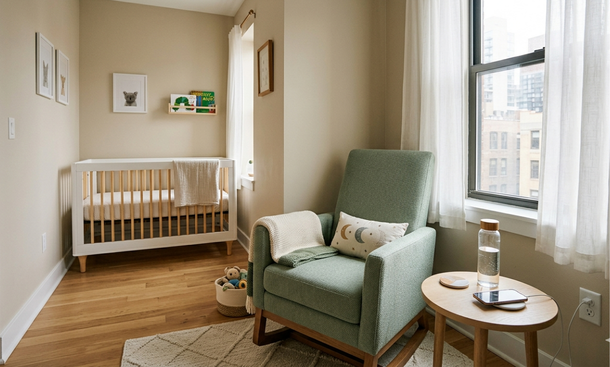
Not every nursery looks like the ones you see on Instagram. Some of us are working with a corner of the bedroom. Some are carving out space in a studio apartment where the “nursery” is separated by a bookshelf and good intentions. And some of us are in a New York City apartment where space is just — that is the situation, and we are making it work.
The good news is that a small room does not mean you have to skip the nursing chair. It means you have to be smarter about which one you pick. Because the wrong chair in a tight space does not just look bad — it makes the room feel impossible to move through, and it makes those late-night feeds feel more stressful than they need to be.
This is about finding a chair that actually fits your life, your room, and your body — without making you choose between comfort and square footage.
Small space, real needs
Here is the thing about breastfeeding in a small space: you will still be spending a serious amount of time in that chair. Newborns feed eight to twelve times a day in the early weeks. That is a lot of hours. The chair still needs to support your back, hold your arms at the right height, and feel comfortable enough that you are not dreading every single session.
Compact does not mean uncomfortable. It means intentional. And there is a real difference between a chair that was designed to be smaller and a chair that just looks smaller in product photos but arrives and takes over your entire room.
Learning to spot that difference before you buy is the whole point.
What “compact” actually means for a nursing chair
When a chair is described as compact, that word can mean different things depending on who is using it.
For our purposes, a genuinely compact nursing chair has a footprint — the amount of floor space it occupies — of roughly 28 to 32 inches wide and 30 to 34 inches deep when in its upright position. Anything larger than that starts to feel dominant in a small room, especially once you factor in the space you need around it to actually sit down and stand up with a baby in your arms.
Height matters less for room feel but matters a lot for how the chair works with your body. A chair that is too tall or too short for your frame will create the same postural problems whether it is compact or full-sized.
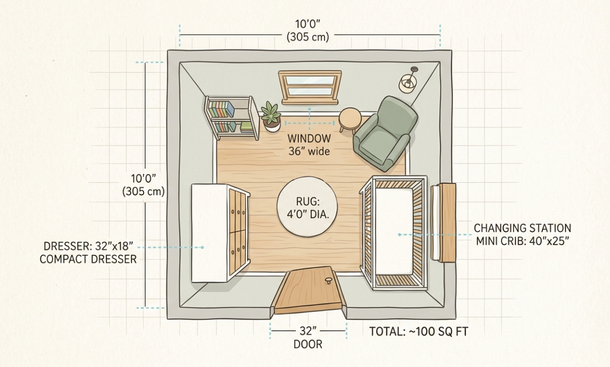
When you are shopping, look for the actual product dimensions in the listing — not the styled photo. A chair photographed in a large, open room can look half the size it actually is. Always go to the specs.
The features you cannot compromise on — even in a small room
Choosing a smaller chair does not mean accepting less support. There are features that matter regardless of the size of your room.
Lumbar support. This is the support at the lower curve of your back, just above your hips. Even in a slim chair, the backrest should follow the natural curve of your spine. A flat backrest on a compact chair will leave you hunching forward within twenty minutes, and that adds up fast.
Armrest height. Your elbows should rest on the armrests naturally when your shoulders are relaxed. If you have to raise your shoulders to reach the armrests, or drop your arms down awkwardly, the height is off. This matters for your neck and upper back during feeds.
Seat depth. In compact chairs, seat depth is where manufacturers sometimes cut corners. A seat that is too shallow feels cramped. A seat that is too deep — even in a small chair — forces you to perch at the edge rather than sit fully supported. Look for a depth that lets you sit back with your feet flat on the floor and a small gap behind your knees.
Stable base. In a small room, you will be navigating around the chair in tight quarters. A chair with a stable, non-wobbling base that does not shift across the floor when you sit down or stand up is essential.
Chair types that work best in tight spaces
Not all nursing chair styles are equally suited to small rooms. Some are much more manageable than others.
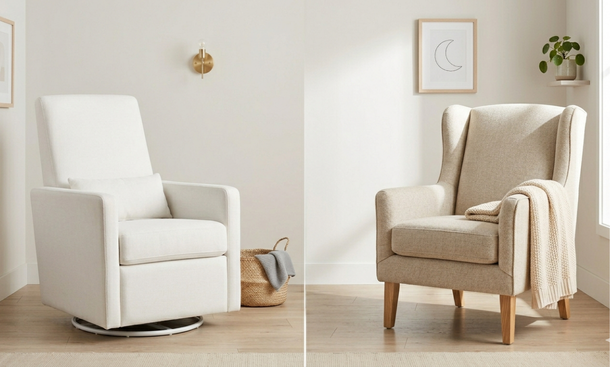
Armless or slim-arm gliders are one of the best options for tight spaces. The absence of wide armrests reduces the overall footprint significantly. The trade-off is that you will need to use a nursing pillow — a curved pillow placed around your waist — to support your baby’s weight during feeds, since you lose the armrest as a resting point. For many moms, that is a completely acceptable swap.
Wingback-style nursing chairs with a compact frame can work well if the room has enough wall clearance. The high back provides good head and neck support, and the visual weight of the chair reads as vertical rather than wide — which makes a small space feel less crowded.
Swivel gliders without a separate ottoman are worth considering if you normally pair a chair with a footstool. A swivel base lets you rotate to grab things from a side table without standing up, which partially compensates for not having a dedicated footrest. Going ottoman-free can save three to four square feet of floor space — which in a small nursery is genuinely significant.
Rocking chairs with a slim wooden frame are another strong option for small spaces. A traditional wooden rocker takes up less visual and physical space than a padded glider, is easier to move around when needed, and does not require a matching ottoman. The trade-off is less cushioning, which you can address with a seat cushion and a lumbar pillow.
What to measure before you buy anything
This step stops so many frustrating returns. Before you buy, do this.
Measure the corner or wall space where you plan to put the chair. Write down both the width and the depth available. Then add at least 18 inches of clearance on each open side — that is the minimum amount of space you need to comfortably sit down and stand up without bumping into furniture.
Also measure doorways if the chair will need to pass through them on delivery. Many nursing chairs come partially assembled, but some arrive fully built. A chair that cannot make it through the nursery door is a problem that is completely avoidable.
If you are placing the chair near a window, account for how far the chair will extend when it glides or rocks. A chair sitting six inches from a wall needs that six inches of clearance to move properly — or the wall becomes a stop, and the motion becomes useless.
Placement ideas that make a small nursery feel bigger
Where you put the chair in the room changes how the whole space feels.
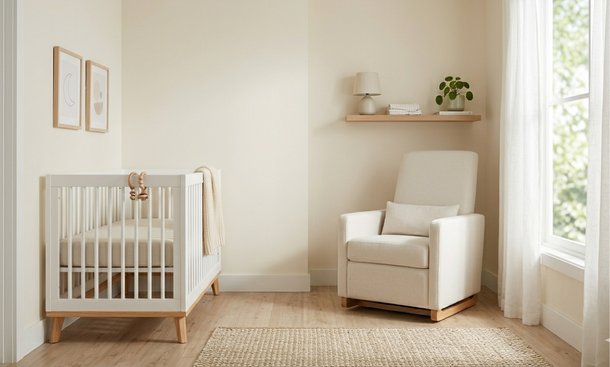
Corner placement is usually the best option in a small nursery. Tucking the chair into a corner keeps the center of the room open and makes movement through the space easier. It also gives you two walls of context — which can feel more supportive and enclosed in a good way during night feeds.
Placing the chair near a window works well for daytime feeds and gives you natural light without requiring additional lamps. Just make sure the chair is not directly in a draft, and that window treatments can block light when you need the room dark.
Avoid placing the chair in the middle of the room or directly in the path between the door and the crib. In a small space, any obstacle in a high-traffic path becomes a frustration point — especially at 3 a.m. when you are half asleep.
The chairs worth looking at
Rather than pointing to specific models that may change, go in looking for these characteristics.
A chair with overall dimensions under 32 inches wide and 34 inches deep. A seat height between 17 and 19 inches from the floor — this works for most heights and keeps your feet flat. A back height of at least 38 inches so your head and neck have support during feeds. A weight capacity of at least 250 pounds, which speaks to structural quality more than anything else. And a fabric that is either performance-rated for stain resistance or comes with removable covers.
Brands that consistently produce smaller-format nursing chairs include Babyletto, DaVinci, and Storkcraft — all of which offer slim-profile gliders designed specifically for compact nurseries. Delta Children also has a range of smaller-scale options at a lower price point. Reading verified reviews from people who specifically mention apartment living or small nurseries will give you the most honest picture of how a chair actually performs in a tight space.
What to avoid when shopping small
A few things that routinely disappoint moms who are working with limited space.
Avoid chairs that require a matching ottoman to function properly. If the chair’s armrests are not high enough to support your arms without the footstool, you are locked into needing both pieces — and that doubles the floor space commitment.
Avoid chairs described as “petite” or “small” without actual dimensions listed. Those words mean nothing without numbers. Always verify.
Avoid heavily tufted or buttoned upholstery in a small room. It adds visual bulk to a chair that needs to feel light in the space. Smooth, clean fabric lines read as less heavy — and in a small nursery, visual weight matters almost as much as physical footprint.
And avoid assuming that a lower price means a smaller chair. Pricing in nursing chairs does not consistently track with size. Some of the most expensive options are also the bulkiest.
A small room is a real constraint — but it is one that has good solutions. The key is going in with the right measurements, knowing which features are non-negotiable, and not trusting product photos to tell you the truth about size.
If you want to understand more about what makes any nursing chair — compact or full-sized — actually functional for breastfeeding, the piece on the best features to look for in a nursing chair breaks all of that down in detail.
And if you are still in the early stages of figuring out your whole setup, the complete guide to choosing a nursery chair for breastfeeding is where to start — it covers everything from chair type to timing so you can make a decision you will feel good about.

As a Felyro.com content author, I develop actionable content on breastfeeding, translating research-backed information into practical advice for mothers. My goal is to help families establish healthy feeding habits, improve maternal confidence, and support infant development.