

Nobody warned me that stress could literally shut down my milk supply. I knew breastfeeding would be hard. I expected sore nipples and sleepless nights. But I didn’t know that the anxiety I felt about whether my baby was getting enough milk would actually prevent my milk from letting down.
It’s the cruelest irony. You’re worried about your supply so your stress levels spike and then your stress actually decreases your supply which makes you more stressed and the whole thing spirals.
I spent weeks in this cycle before a lactation consultant finally explained the biological connection between stress and milk production. Once I understood what was happening in my body, I could actually do something about it instead of just telling myself to relax, which is the most useless advice ever given to a new mother.
Let me break down exactly how stress affects lactation and more importantly, what you can actually do about it when you’re running on three hours of sleep and your life feels completely out of control.
The Biology of Stress and Milk Production
When you’re stressed, your body releases cortisol. That’s your main stress hormone and it exists for good evolutionary reasons. Cortisol helps you respond to threats by increasing blood sugar, suppressing non-essential functions, and keeping you alert.
The problem is that cortisol directly interferes with oxytocin. Oxytocin is the hormone responsible for your milk ejection reflex, also called letdown. When your baby nurses or you pump, oxytocin causes the muscle cells around your milk-producing glands to contract and push milk through the ducts and out through your nipple.
High cortisol levels inhibit oxytocin release. Your body is literally prioritizing survival over milk production because from an evolutionary standpoint, if you’re stressed enough that cortisol is flooding your system, this probably isn’t a safe time to be nursing a vulnerable infant.
Of course your body doesn’t know the difference between actual danger and the stress of modern motherhood. Your cortisol spikes whether you’re being chased by a predator or staring at a pile of unopened mail while your baby screams and you haven’t showered in four days.
If you’re new to breastfeeding and want to understand the complete picture of how milk production actually works before tackling stress management, learning about the supply and demand basics will give you essential context
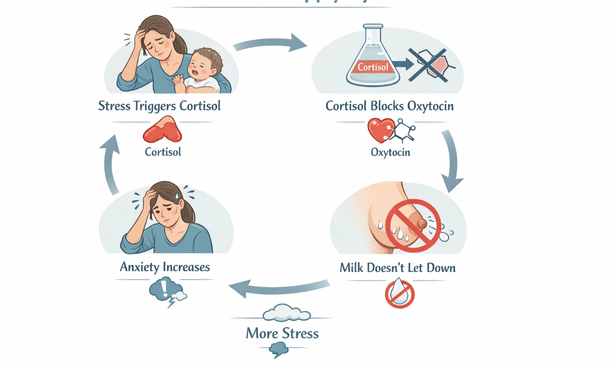
The result is that you sit there nursing or pumping and nothing happens. Or milk comes out much more slowly than usual. You feel your breasts are full but the milk won’t release. It’s incredibly frustrating and of course that frustration creates more stress.
Chronic stress also affects prolactin, the hormone that actually makes milk. While acute stress mainly impacts letdown, ongoing elevated cortisol can decrease prolactin production over time. That means chronic stress can reduce the amount of milk your body makes, not just how well it flows.
Sleep deprivation makes all of this worse because lack of sleep increases cortisol levels. New moms are caught in this terrible cycle of stress causing poor sleep causing more stress causing decreased milk production causing more anxiety.
Understanding this isn’t just academic. Once you know that stress physically blocks your letdown reflex, you can start addressing it as a physiological issue instead of beating yourself up for not being calm enough.
Signs That Stress Is Affecting Your Supply
How do you know if stress is the culprit versus other supply issues? Here are the signs that cortisol is interfering with your letdown:
You feel full or engorged but milk won’t come out when you nurse or pump. Your breasts have milk in them but the ejection reflex isn’t triggering. This is the classic sign of oxytocin inhibition.
You have inconsistent letdowns. Some feeding sessions milk flows easily and others nothing happens even though everything else about the situation is the same. Stress levels vary throughout the day so this inconsistency points to cortisol interference.
Your supply is fine when you’re calm but tanks during stressful periods. Maybe you pump well on weekends when your partner is home but struggle on weekdays when you’re alone with the baby.
You notice a direct correlation between stressful events and decreased output. Your mother-in-law visits and suddenly your pumping sessions yield half what they normally do. You have a fight with your partner and the next nursing session your baby seems frustrated at the breast.
You can feel the physical sensation of anxiety or tension in your chest when you’re trying to nurse. Some women describe it as a tightness or inability to relax into the feeding.
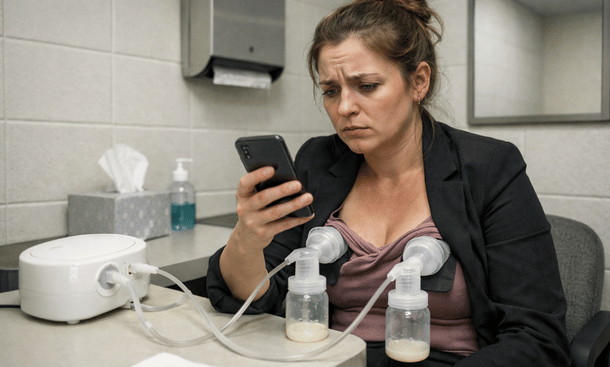
If any of this sounds familiar, stress is likely playing a role in your supply challenges. The good news is that unlike anatomical issues or hormonal disorders, stress is something you can actively work on managing.
What Doesn’t Work: The “Just Relax” Trap
Before we talk about what actually helps, let’s acknowledge what doesn’t work. Telling a stressed-out new mom to “just relax” is about as helpful as telling someone with depression to “just cheer up.”
You can’t think your way out of a stress response. Your nervous system doesn’t work that way. Cortisol doesn’t care that logically you know you should calm down.
Feeling guilty about being stressed makes everything worse. You’re not failing because you’re anxious. You’re having a normal human response to one of the most demanding experiences of your life.
Ignoring the stress and trying to power through doesn’t work either. Your body will continue to respond physiologically whether you acknowledge the stress or not.
What does work is giving your nervous system concrete tools to down-regulate the stress response. You need practical strategies that actually lower cortisol and increase oxytocin, not just aspirational advice to be more zen.
Practical Strategies That Actually Lower Cortisol
Let’s talk about what you can realistically do when you’re exhausted, overwhelmed, and trying to feed a baby.
Deep breathing before nursing or pumping. I know this sounds basic but it genuinely works. Before you start a feeding session, take six deep breaths. Inhale for four counts, hold for four, exhale for six. This activates your parasympathetic nervous system and reduces cortisol.
Do this every single time you nurse or pump. Make it a non-negotiable part of your routine. It takes less than a minute and it signals your body to shift from stress mode to rest mode.
Skin-to-skin contact with your baby. Taking off your shirt and your baby’s shirt and just holding them against your chest increases oxytocin production in both of you. It’s literally releasing the exact hormone you need for letdown while simultaneously reducing cortisol.
Try to do at least 10-15 minutes of skin-to-skin daily. It doesn’t have to be during nursing though that’s a great time for it. You can do it while watching TV or scrolling your phone.
Looking at photos of your baby while pumping. If you’re separated from your baby and pumping at work or elsewhere, pull up photos and videos of them on your phone. Your brain releases oxytocin in response to seeing your baby’s face even when they’re not physically present.
Some women find it helpful to smell a piece of their baby’s clothing or a blanket that smells like them while pumping. Engaging multiple senses amplifies the oxytocin response.
Warm compresses on your breasts. Warmth promotes relaxation and can help trigger letdown. Use a warm washcloth, a heating pad on low, or even just pump after a warm shower. The physical warmth helps override the tension that stress creates.
Gentle breast massage. While nursing or pumping, use your free hand to massage your breast with circular motions starting from the chest wall and moving toward the nipple. This physical stimulation helps move milk and gives you something to focus on besides your anxiety.

These aren’t luxuries or optional extras. These are practical interventions that physiologically change your hormone levels and improve milk flow.
Creating an Environment That Supports Letdown
Your physical environment affects your stress levels more than you might realize. Small changes can make a significant difference in how relaxed you feel during nursing or pumping sessions.
Set up a comfortable nursing station. A good chair or spot on your couch where you actually want to sit. Pillows that support your back and arms. Everything you need within reach so you’re not jumping up constantly.
Control the lighting. Harsh overhead lights increase cortisol. Use softer lamps or natural light when possible. Some women find dimming the lights before nursing helps them relax.
Minimize interruptions. Put your phone on do not disturb except for essential contacts. Close the door if you have one. Give yourself permission to ignore everything else for 20 minutes.
Use distraction strategically. Some women find that watching a show or scrolling social media helps them stop obsessing about whether milk is flowing. Others find this makes them more tense. Figure out what works for you.
Have water and snacks readily available. Thirst and hunger are stressors. Taking care of basic needs helps your body feel safe enough to release milk.
If you’re pumping at work and the environment is stressful, do what you can to make it better. Bring a photo of your baby, use headphones to listen to relaxing music or a podcast, bring a cozy sweater or blanket. Control what you can control.
The Sleep-Stress-Supply Connection
You cannot address stress without addressing sleep. Sleep deprivation is one of the biggest drivers of elevated cortisol in new mothers.
I know you can’t just decide to sleep more when you have a newborn who wakes every two hours. But you can prioritize sleep when opportunities exist instead of using that time to catch up on everything else.
When someone offers to hold the baby so you can shower or do laundry, sleep instead. The laundry can wait. Your cortisol levels can’t.
If you have a partner, work out a system where you get at least one longer stretch of sleep. Maybe they handle the first stretch of the night so you can sleep from 8pm to midnight uninterrupted. Or they do the early morning shift so you can sleep until 7am.
Some women find that pumping before the longest sleep stretch and having their partner do one bottle feeding gives them 4-5 hours of unbroken sleep which makes an enormous difference in stress levels and milk production the next day.
If your baby will take a bottle and you have safe help available, there is no shame in getting sleep. The idea that you have to do every single feeding yourself is unrealistic and sets you up for burnout.
Exhaustion makes everything harder. You can’t regulate your stress response when you’re running on empty. Sleep is not a luxury, it’s a necessary component of maintaining milk production.
Partner Support and Asking for Help
Your stress levels are directly affected by how supported you feel. If you’re trying to do everything alone, your cortisol stays elevated and your supply suffers.
Your partner needs to understand that helping you stay calm isn’t just being nice, it’s directly impacting your ability to feed your baby. When they take tasks off your plate, they’re supporting milk production.
Be specific about what you need. “I need you to handle dinner every night this week.” “I need you to take the baby for an hour every evening so I can decompress.” “I need you to stop asking me questions during nursing sessions.”
If your partner isn’t naturally helpful or doesn’t understand why you’re stressed, this is where relationship work matters. You can’t breastfeed successfully while also managing all household tasks, all baby care, and emotional labor for everyone. Something has to give.
Accept help from people who offer it. If someone wants to bring a meal, say yes. If your mom offers to do laundry, let her. If a friend offers to hold the baby while you nap, take them up on it.
Asking for help is not weakness. It’s recognizing that milk production requires your body to feel safe and resourced. That doesn’t happen when you’re drowning in stress and responsibilities.

When Stress Management Isn’t Enough
Sometimes you can do everything right and stress still feels unmanageable. That might indicate you’re dealing with postpartum anxiety or depression, not just normal new-parent stress.
If you’re having intrusive thoughts, persistent feelings of dread, panic attacks, or if anxiety is interfering with your ability to function, talk to your doctor. Postpartum mood disorders are common and treatable.
Some women need medication to manage postpartum anxiety or depression. There are many medications that are safe while breastfeeding. Don’t suffer unnecessarily because you’re worried about medications affecting your baby.
Therapy can be incredibly helpful for developing coping strategies and processing the massive life transition of becoming a parent. Many therapists now offer virtual sessions which makes it easier to access care when you’re home with a baby.
Support groups, whether in-person or online, help you feel less alone. Connecting with other moms who are struggling with the same challenges reduces the isolation that amplifies stress.
Taking care of your mental health isn’t separate from taking care of your milk supply. They’re interconnected. You can’t pour from an empty cup and you can’t nurse effectively when your nervous system is constantly in fight-or-flight mode.
Putting It All Together
Stress and milk supply are inextricably linked through cortisol and oxytocin. Understanding this biological connection helps you see that managing stress isn’t optional if you want to successfully breastfeed, it’s essential.
You don’t need to be perfectly calm all the time. That’s impossible. But you do need tools to help your nervous system down-regulate before and during nursing or pumping sessions.
Simple practices like deep breathing, skin-to-skin contact, creating a comfortable environment, and prioritizing sleep can significantly impact your cortisol levels and improve milk flow. These aren’t indulgences, they’re physiological interventions.
Getting adequate support from your partner, accepting help, and addressing your mental health needs are all part of creating conditions where your body can successfully produce and release milk.
Remember that understanding how to naturally increase your milk supply through multiple approaches gives you a foundation for troubleshooting when things feel off. Stress management is just one piece, but it’s a piece that too often gets dismissed or oversimplified.
If you’re working on building your supply through multiple approaches like choosing the right foods to boost production, you’re giving yourself the best possible chance of success by also addressing the stress that can undermine all those other efforts.
You’re doing something incredibly hard. Give yourself credit for that and give your body what it needs to succeed.

As a Felyro.com content author, I develop actionable content on breastfeeding, translating research-backed information into practical advice for mothers. My goal is to help families establish healthy feeding habits, improve maternal confidence, and support infant development.