

Why emotional readiness is not a soft topic
When most people talk about preparing for pregnancy, they mean folic acid and fertility tracking and prenatal appointments. Those things matter. But they address the body and leave the mind largely untouched — as if the two operate independently, which they do not.
Your emotional state before pregnancy has measurable effects on your physical experience of it. Women who enter pregnancy with unaddressed chronic stress, untreated anxiety, or significant depression face higher risks of complications including preterm birth, low birth weight, and postpartum depression. The research on this is not new or fringe. It is well-established and consistently underemphasized in standard preconception guidance.
Emotional preparation is not about achieving some perfect state of calm before you conceive. Nobody arrives at pregnancy without fear or ambivalence or unresolved questions. What it is about is building enough self-awareness, enough support, and enough internal stability that pregnancy does not become the thing that breaks you open in ways you were not prepared for.
That distinction matters. And it is worth taking seriously before you are already in the thick of a first trimester.
The feelings nobody warns you about
Deciding to have a baby is supposed to feel exciting. And it often does. But it almost always feels like other things too — things that are harder to say out loud in a culture that treats pregnancy as an unambiguous celebration.
Ambivalence. Even women who have wanted children for years can feel a sudden pull of doubt when conception becomes a real, immediate plan. That doubt does not mean you are making the wrong decision. It means you are a person with a complex inner life who is about to make one of the most significant commitments of your life. Ambivalence is information, not a verdict.
Grief. Pregnancy changes your life in ways that involve real losses — of freedom, of a particular version of your relationship, of the self you have been building for decades. Feeling grief alongside excitement is not contradictory. It is honest.
Fear. Fear of something going wrong. Fear of being a bad parent. Fear of repeating patterns from your own childhood. Fear of losing yourself. These fears are almost universal, and almost universally left unspoken because they feel shameful next to what is supposed to be a joyful decision.
Pressure. From family who ask when you are having children. From a partner whose timeline differs from yours. From your own internalized sense of what you should want and when you should want it. Pressure is one of the least useful inputs for a decision this significant, and learning to separate your actual readiness from external pressure is genuinely difficult work.
None of these feelings make you unready. Suppressing them without examination is what creates problems — not the feelings themselves.

Relationship readiness: the conversation most couples avoid
If you have a partner, your emotional preparation for pregnancy is not a solo project. And the conversations most couples skip before conceiving are often the exact conversations that surface as conflict during pregnancy or in the early months of parenthood.
The topics worth covering — actually covering, not skimming — before you start trying:
Parenting values and approach. How were you each raised, and what do you want to carry forward or leave behind? Discipline, religion, education, extended family involvement — these are not abstract questions. They become concrete and urgent faster than most people expect.
Division of labor. Who does what at home right now, and how do you each expect that to change with a baby? Research consistently shows that the division of domestic labor shifts significantly after a first child and that the shift often catches women off guard. Talking about it before it happens is not pessimistic. It is practical.
Financial picture. What does your current financial situation actually look like? Childcare costs, maternity and paternity leave, potential changes to income — these need real numbers attached to them, not vague reassurances that you will figure it out.
Each person’s needs. What does each of you need in order to feel supported through pregnancy and early parenthood? This question is often skipped entirely and then answered through resentment.
These conversations are not always comfortable. Having them before pregnancy gives you significantly more space and energy to work through them than having them during it.
When your history makes this harder
For many women, emotional preparation for pregnancy is complicated by things that happened long before the decision to conceive.
A difficult childhood. If you grew up with a parent who was absent, abusive, emotionally unavailable, or struggled with addiction or mental illness, the idea of becoming a parent yourself can surface layers of fear and unresolved material. The worry that you will repeat what was done to you is one of the most common and least spoken fears women carry into this decision.
Here is what the research actually shows: conscious awareness of your own history is one of the most protective factors against repeating it. Simply being the kind of person who worries about this is already a meaningful departure from the pattern.
Previous pregnancy loss. Miscarriage, pregnancy termination, stillbirth, or infant loss change how a person approaches subsequent pregnancies in ways that are profound and often invisible to people around them. The anxiety that follows pregnancy loss is not irrational — it is a reasonable response to having learned that pregnancy does not always go the way it is supposed to. If this is part of your history, it deserves specific attention before you try again, not just during the next pregnancy.
Mental health history. A history of depression, anxiety, OCD, trauma, or eating disorders does not disqualify anyone from parenthood. But these conditions do interact with pregnancy in ways worth preparing for. Hormonal shifts during and after pregnancy can trigger episodes in women who have been symptom-free for years. Having a treatment plan in place before conception — not scrambling to build one during a first trimester — makes a significant difference.
Infertility or a long road to conceive. The emotional toll of a difficult fertility journey reshapes the experience of pregnancy in ways that are often not acknowledged. Women who have spent months or years trying to conceive do not always feel the uncomplicated joy that pregnancy is supposed to bring. Relief, hypervigilance, and a strange grief for the experience of simple, easy pregnancy are all normal responses that deserve space.

Fear of pregnancy loss and how to carry it
Miscarriage is the most common complication of pregnancy, occurring in roughly 10 to 20 percent of known pregnancies — and more frequently in women over 35. Most people know this statistically but experience it as a shock when it happens to them, in part because pregnancy loss is still treated as something to be moved through quickly and quietly.
If you have not experienced a loss, you may still carry fear of it. That fear is not irrational. It is a reasonable response to knowing that early pregnancy is genuinely uncertain.
Some things that help:
Letting the fear exist without letting it run the show. Trying to eliminate fear of loss before pregnancy is not a realistic or useful goal. What is useful is developing a relationship with uncertainty that does not require false reassurance. You cannot know that everything will be fine. You can know that you are capable of handling hard things if they come.
Being honest with your partner about the fear. Many couples carry anxiety about loss separately, each trying to protect the other. This creates isolation at exactly the moment when connection matters most.
Knowing your history. Recurrent miscarriage — defined as two or more consecutive losses — warrants medical investigation, not just reassurance. If this is part of your history, a reproductive endocrinologist or maternal-fetal medicine specialist can often identify and address underlying causes.
Preparing emotionally, not just medically. If you have had a loss, working with a therapist before attempting another pregnancy is not excessive caution. It is good preparation for what is genuinely a high-stakes emotional experience.
Building a support system that actually supports you
Support is one of the most cited protective factors for maternal mental health — and one of the most variable in its actual quality. Having people around you is not the same as having support.
Genuine support during preconception and pregnancy looks like:
At least one person you can be completely honest with. Not performing gratitude or excitement — actually saying what is hard, what you are afraid of, what is not going the way you expected. This might be a partner, a close friend, a sibling, or a therapist. It needs to be someone who can hold difficult emotions without immediately trying to fix them.
A provider you trust. Your OB-GYN or midwife should be someone you feel comfortable asking questions and expressing concerns to. If your current provider dismisses your concerns or makes you feel like a burden when you ask questions, finding a different one before pregnancy is worth the effort.
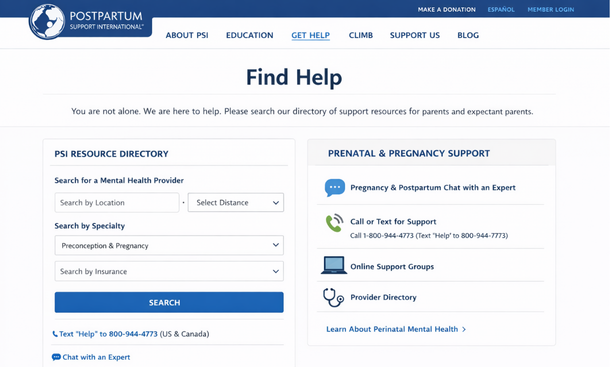
Community with women in a similar season. This might be an in-person group, an online community, or a small circle of friends who are also navigating preconception or early parenthood. Shared experience reduces the isolation that makes this season harder than it needs to be. Organizations like Postpartum Support International have resources that begin at preconception, not just after birth.
Professional support if you need it. Therapy is not a last resort for people in crisis. It is a tool for anyone navigating significant life transitions — which is exactly what preconception and pregnancy are. If you are in New York or another major city, finding a therapist who specializes in reproductive mental health is very possible. If access is a barrier, online therapy platforms have expanded options considerably.
Practical tools for emotional grounding
Abstract advice about taking care of your emotional health is not especially useful without something concrete to do with it.
Journaling. Specifically, reflective journaling — not a log of events, but an honest exploration of what you are feeling and thinking. Questions worth sitting with: What am I most afraid of about becoming a parent? What did I not get from my own parents that I most want to give my child? What does readiness actually feel like to me versus what I think it should feel like?
Therapy. Worth repeating. If you have been thinking about starting, this is the moment. Look specifically for therapists with experience in perinatal mental health, reproductive trauma, or life transitions.
Mindfulness practice. Not as a cure for anxiety but as a skill for sitting with uncertainty without being overwhelmed by it. Even ten minutes of daily mindfulness practice over several months builds a measurable shift in how your nervous system responds to stress. Apps like Insight Timer offer free guided sessions specifically designed for women in preconception and pregnancy.
Reducing information overconsumption. The internet is an infinite source of worst-case scenarios for anything pregnancy-related. Setting limits on how much time you spend researching symptoms, statistics, and risks is a legitimate and necessary act of self-care. Know what you need to know. Then step back.
Physical movement as emotional regulation. Exercise is one of the most reliably effective interventions for anxiety and low mood. This does not mean training for a marathon. It means moving your body in ways that feel good regularly — walking, swimming, dancing, yoga — as a mood regulation tool, not just a fitness strategy.
How to know when you are genuinely ready
This is the question underneath everything else on this list. And the honest answer is that there is no clean, unambiguous version of ready.
Nobody feels fully prepared for parenthood before it happens. The learning curve is too steep and the experience is too specific to anticipate completely in advance. What readiness actually looks like — the functional kind, not the idealized kind — is something more like this:
You have thought seriously about why you want to become a parent, and your answer is rooted in something real rather than external pressure or a vague sense of what comes next.
You have had the hard conversations with your partner, or with yourself if you are doing this solo, and you have not just skipped them because they were uncomfortable.
You have some form of support in place — a provider you trust, at least one person you can be honest with, and some sense of community.
You have addressed or are actively addressing anything in your mental health history that could become significantly harder during pregnancy without support.
You are willing to not know how it will go and to move forward anyway.
That last one is perhaps the most important. Emotional readiness for pregnancy is not the absence of fear. It is the capacity to act alongside it.
Emotional readiness is foundational — but it does not stand alone. Once you feel grounded in where your head and heart are, the next natural step is making sure your body is equally prepared. The article on preconception health walks you through every physical step — from your first doctor’s visit to the nutrition basics your body needs before conception even begins.
And when you are ready to see the full landscape of everything involved — body, mind, timing, and medical prep — the complete guide to preparing for pregnancy brings it all together in one place.
