

Look, I remember sitting in my tiny Manhattan apartment at 2am with my three-week-old, absolutely convinced my body was failing us. She’d been nursing for what felt like hours and I was googling “am I starving my baby” with tears streaming down my face. Turns out I wasn’t producing too little milk at all. I just had no clue how breastfeeding actually worked.
That panic? It’s ridiculously common. Most moms I talk to have been there, convinced they don’t make enough milk when really their supply is totally fine. The problem isn’t our bodies. It’s that nobody explains how this whole system actually functions before we’re sitting there with a hungry newborn wondering what the hell we’re doing.
So let me break it down for you in plain English because understanding how milk production works is the first step to feeling confident about feeding your baby.
The Basic Science Nobody Tells You
Your breasts start prepping for milk production during pregnancy. Those hormones making you feel like garbage? They’re also building the infrastructure your body needs to feed a baby. By your second trimester you’ve already got colostrum hanging out in there waiting.
When your baby is born and the placenta comes out, your progesterone levels tank. That hormonal shift tells your body “hey, the baby’s out, time to make milk.” Within 48 to 72 hours your milk comes in and suddenly you’ve got these rock-hard breasts that feel completely foreign.
But here’s the thing that matters most: once your milk comes in, production switches to a supply and demand system. Your body makes milk based on how much milk gets removed from your breasts. Empty breasts make milk faster. Full breasts slow down production. It’s actually pretty brilliant when you think about it.
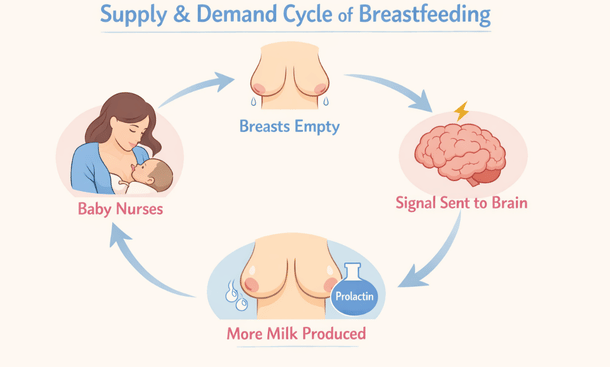
Every time your baby nurses or you pump, your body gets the message to make more milk. The hormone prolactin spikes and tells your milk-making cells to get to work. Meanwhile oxytocin triggers your letdown reflex so the milk actually flows out. This happens multiple times during a single feeding session.
The more frequently milk gets removed, the more your body makes. That’s why newborns nurse constantly and that’s completely normal. They’re literally programming your supply to match their needs.
Why You Probably Think You’re Low When You’re Not
Most moms who think they have low supply actually don’t. I’m serious. Studies show that true insufficient milk supply only affects about 2-5% of women. So why does everyone panic about it?
Because babies are weird and breastfeeding doesn’t look like what we expected.
Your baby wants to nurse every hour? Normal. They just ate 30 minutes ago and they’re rooting again? Also normal. They nurse for 45 minutes, pop off, and then act hungry 20 minutes later? Yep, still normal.
Babies have tiny stomachs and breast milk digests incredibly fast. They also nurse for comfort, not just hunger. They’re regulating their temperature, processing their brand new existence outside the womb, and yeah, building your milk supply to match their growth patterns.
Here are the things that make moms think they’re low when they’re actually fine:
Your breasts feel soft instead of full. Once you’re past those first few weeks, this is normal. It means your supply has regulated. You’re making exactly what your baby needs without overproducing.
You can’t pump much milk. Pumps are machines. Babies are way more efficient at removing milk than any pump on the market. Some women respond great to pumps and some don’t. Pump output doesn’t tell you what your baby is actually getting.
Your baby is fussy at the breast. Could be gas, could be overtired, could be a million things. Fussiness doesn’t automatically mean hunger.
You never feel a letdown. Some women feel that tingly sensation and some don’t. Not feeling it doesn’t mean it’s not happening.

Signs Your Baby IS Getting Enough Milk
Instead of obsessing over how your breasts feel or what you pump, watch your baby. Their body will tell you everything you need to know.
Your baby should have at least six wet diapers in 24 hours after the first week. Those diapers should be heavy with pale yellow pee. They should also have regular dirty diapers, though the frequency changes as they get older.
Weight gain is the gold standard. After the initial newborn weight loss (totally normal, by the way), your baby should gain about 5-7 ounces per week for the first few months. Your pediatrician tracks this at checkups.
Your baby should seem satisfied after most feedings. Not every single time because sometimes they’re cluster feeding or going through a growth spurt, but generally they should relax and seem content.
They should have periods of alert wakefulness and shouldn’t seem constantly lethargic. Their skin should have good color and bounce back when you gently pinch it.
If all those things check out, your supply is fine even if it doesn’t feel that way.
What Actually Causes Low Supply
True low supply does exist and some women genuinely need support. The most common causes are:
Not nursing or pumping frequently enough in those early weeks. If you’re trying to put a newborn on a schedule or going long stretches without emptying your breasts, your body thinks it doesn’t need to make much milk.
Tongue tie or latch issues that prevent your baby from effectively removing milk. If milk isn’t coming out efficiently, your body doesn’t get the signal to make more.
Hormonal conditions like thyroid disorders or PCOS can affect milk production. Previous breast surgery, especially if it involved cutting around the areola, can impact supply too.
Certain medications interfere with prolactin. Birth control with estrogen, pseudoephedrine in cold medicine, and some others can decrease production.
Retained placenta fragments prevent your hormones from shifting properly after birth. This is rare but it happens.
If you suspect you actually have low supply, talk to a lactation consultant before you spiral. They can do a weighted feed to see exactly how much milk your baby is transferring and help you figure out what’s going on.
The Growth Spurt Panic
Here’s something that tricks everyone: growth spurts feel exactly like your supply tanking when actually the opposite is happening.
Around 2-3 weeks, 6 weeks, 3 months, and 6 months your baby hits major growth spurts. Suddenly they want to nurse constantly. Like every 45 minutes constantly. You feel completely drained and convinced you can’t keep up.
What’s really happening is your baby is increasing demand so your supply increases to match. It usually takes 24-48 hours for your production to catch up to their new needs. During that time it feels like you’re running on empty.

The solution is to nurse through it. I know it’s exhausting. I know you feel touched out and desperate for a break. But this is temporary and powering through these days builds your supply to match your growing baby’s needs.
If you supplement with formula during a growth spurt, you’re telling your body the extra demand isn’t real and your supply won’t increase to meet it. Sometimes supplementing is necessary and formula is not the enemy, but understand what you’re doing when you make that call.
Trust the Process
Your body is designed to make milk for your baby. Evolution spent millions of years perfecting this system. The vast majority of supply issues are either misunderstandings about what’s normal or problems with milk removal that can be fixed.
Once you understand how supply and demand actually works, so much of the anxiety disappears. Your baby nurses frequently because that’s what builds and maintains supply. Your breasts feel soft because they’re not meant to be engorged all the time. Pump output varies because pumps aren’t babies.
Watch your baby, not your breasts. Trust the wet diapers and the weight gain. And if you need extra support with techniques to boost production, there are practical strategies you can use that work with your body’s natural system rather than against it.
Give yourself some credit. You’re literally creating food from your body to grow an entire human. That’s pretty incredible even on the days when it feels overwhelming.
When to Get Help
Most supply concerns are just normal breastfeeding patterns, but sometimes you do need professional support. Reach out to a lactation consultant if your baby isn’t gaining weight appropriately, if they’re having fewer than six wet diapers a day after the first week, if nursing is painful, or if your gut is telling you something’s off.
Trust your instincts but also educate yourself on what’s actually normal. The combination of those two things will get you through most of the challenges you’ll face.
And remember, understanding how your body produces milk is just one piece of making breastfeeding work. If you’re looking for ways to manage the stress that can interfere with letdown and milk flow, learning about how stress affects your supply can make a real difference in your breastfeeding experience.
You’ve got this. Really.

As a Felyro.com content author, I develop actionable content on breastfeeding, translating research-backed information into practical advice for mothers. My goal is to help families establish healthy feeding habits, improve maternal confidence, and support infant development.