
Table of Contents
- What travel actually does to your supply
- Packing your pump the right way
- Navigating TSA with breast milk and pump equipment
- Pumping on planes, trains, and in hotels
- Managing time zone shifts without wrecking your schedule
- Storing and transporting milk safely while away
- Keeping your letdown strong when you are far from home
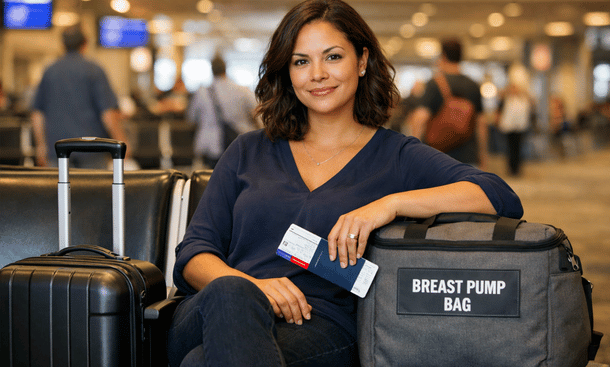
Traveling while breastfeeding sounds like a logistical nightmare, and honestly — it can be, if you go in unprepared. But moms do it every week. They take work trips, attend conferences, visit family across the country, and come home with their supply intact and their milk safely stored.
The difference between a travel experience that works and one that tanks your supply comes down almost entirely to preparation. Not perfection — preparation. Here is what that actually looks like.
What travel actually does to your supply
Your body runs on rhythm. Milk production responds to consistent, predictable emptying — and travel disrupts almost every variable that rhythm depends on. Your schedule shifts. Your sleep takes a hit. You are eating differently, drinking less water than usual, and navigating stress that your body registers whether you feel it consciously or not.
On top of that, the physical distance from your baby removes the most powerful supply trigger you have. The sight, sound, and smell of your baby all stimulate oxytocin, the hormone responsible for milk letdown. When your baby is not with you, your body has to rely entirely on the pump — and for many moms, that shift alone is enough to cause a noticeable dip.
None of this means your supply will tank every time you travel. It means you need to be more intentional while you are away than you are at home.
Packing your pump the right way
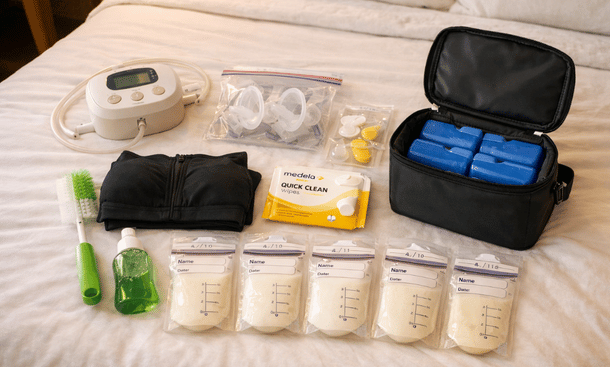
Your pump goes in your carry-on. Always. Not your checked bag, not your partner’s suitcase — your carry-on, where you control it. Checked luggage gets lost, delayed, and thrown around. A pump that arrives two days late or damaged is not a small inconvenience when you are traveling for five days.
Here is what your pump travel kit should include:
Your pump motor and all attachments. A full backup set of valves and membranes — these are the small parts most likely to fail at the worst possible moment. A hands-free pumping bra. A portable cooler with ice packs rated for at least 24 hours. Enough storage bags for every session you plan to pump, plus a few extra. Fragrance-free dish soap in a travel-size bottle and a small cleaning brush. Quick-clean microwave steam bags, which work in most hotel microwaves for fast sterilization between sessions. A car adapter or international outlet adapter if you are going overseas.
If you are using a wearable pump, bring your traditional electric as a backup. Wearables have more components that can malfunction, and having no working pump mid-trip is a supply emergency you do not want to manage from a hotel room.
Navigating TSA with breast milk and pump equipment
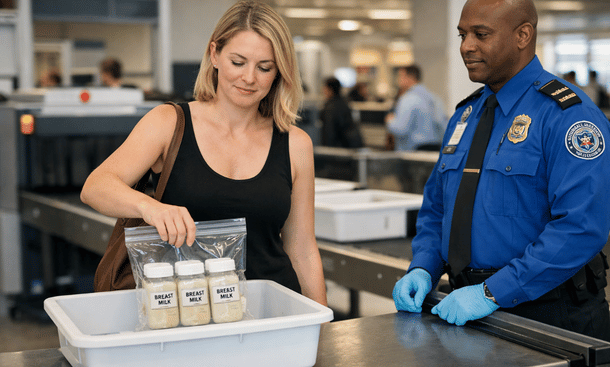
TSA rules in the United States allow breast milk, formula, and juice for infants in quantities greater than 3.4 ounces. You do not need to be traveling with your baby to carry breast milk through security. You are allowed to bring as much milk as you need in your carry-on.
Declare your breast milk and pump at the security checkpoint before your bag goes through the X-ray. You have the right to request that breast milk not be put through the X-ray machine — a TSA officer can test it using alternative screening methods instead. This is your call to make.
Breast pump equipment goes through security exactly like any other medical device. The pump itself is not counted against your carry-on limit in most cases, though airline policies vary slightly — worth checking before you fly.
A few practical notes: pack your milk in a clear, separate bag so it is easy to pull out and declare. Frozen milk is allowed and stays frozen longer, which matters for longer trips. Fully frozen items are generally waved through without issue.
Airport Breast Milk Security
Pumping on planes, trains, and in hotels
On a plane: a wearable pump is your best option here. It is discreet, requires no outlet, and lets you pump in your seat without drawing attention or spending the flight in a tiny bathroom. If you do not have a wearable, most planes have power outlets at seats — check before booking and try to reserve a window seat for a bit more privacy. A nursing cover or scarf works well if you need it.
Plane cabins are dehydrating. Drink water consistently from the moment you board. Dehydration shows up in your output faster than most moms expect, especially combined with the stress of travel.
On trains: Amtrak and most long-distance rail services have accessible bathrooms with outlets — not ideal, but workable for a single session if needed. Many trains also have family cars or quieter sections. A hands-free pump with a good battery makes train travel significantly easier.
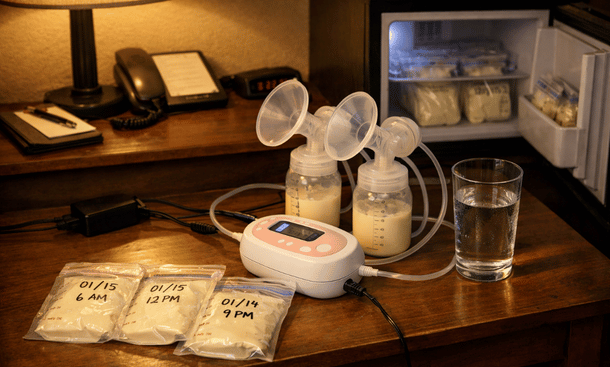
In hotels: request a mini fridge when you book, not when you arrive. Most hotels have them or can bring one to your room — but availability is not guaranteed if you ask last minute. If the fridge is not cold enough, use your cooler with fresh ice from the ice machine. Hotel microwaves work with quick-clean steam bags for sanitizing parts between sessions.
If the hotel has a business center or lounge with a microwave, you can use that too. Most front desk staff are accommodating when you explain what you need.
Managing time zone shifts without wrecking your schedule
Time zone changes are one of the trickier parts of traveling while breastfeeding. Your body has built a supply rhythm around specific times of day, and crossing multiple time zones compresses or stretches that rhythm in ways your system was not expecting.
The most practical approach is to shift gradually rather than all at once. If you are crossing two or three time zones, adjust your pump schedule by thirty to sixty minutes per day rather than jumping immediately to the new time zone’s equivalent of your home schedule. This gives your body time to follow rather than forcing an abrupt reset.
If you are only traveling for two to three days, some moms find it easier to stay on their home time zone entirely for pumping purposes. This means early morning or late night sessions by local time, but it avoids disrupting a well-established rhythm for a short trip.
The non-negotiable is keeping the spacing between sessions consistent. Whether you are in the same time zone or five hours away, going longer than three to four hours between sessions during the day will affect your output.
Storing and transporting milk safely while away
Freshly pumped milk stays safe at room temperature for up to four hours, in a cooler with ice packs for up to twenty-four hours, in a standard refrigerator for up to four days, and in a freezer for up to twelve months — though quality is best within six months.
For travel, the most practical approach depends on trip length. For trips of two to three days, a well-insulated cooler with fresh ice packs is usually sufficient to keep milk refrigerator-cold for the whole trip. For longer trips, look into shipping your milk home. Services like Milk Stork specialize in overnight shipping of breast milk for traveling moms and have become increasingly common for moms on work trips. Your employer may even cover it — worth asking HR.
Label every bag with the date and time pumped. When you are managing multiple sessions across multiple days in an unfamiliar environment, labeling is the thing you will be glad you did not skip.
Keeping your letdown strong when you are far from home
Letdown — the reflex that releases milk into your ducts so the pump can collect it — is where most moms struggle most while traveling. At home, your environment is full of cues that trigger oxytocin. Your baby’s sounds, your nursing chair, your familiar routine. Away from home, those cues disappear.
A few things that genuinely help:
Bring something that smells like your baby. A worn onesie or a small blanket in your pump bag sounds simple, but it works with your biology in a real way. Looking at photos or videos of your baby during a session has the same effect — it is not a trick, it is physiology.
Create a small ritual around your pump sessions. The same order of steps, the same breathing pattern, even the same playlist. Ritual cues your nervous system that it is time to let down, especially in unfamiliar environments.
Stay warm. Cold environments suppress letdown. If your hotel room runs cold, put on a layer before you pump. Warm compresses on your breasts before a session help too.
And give yourself grace. Pumping output while traveling is almost always slightly lower than at home. That is normal. Consistency in your sessions matters more than chasing your best numbers from a Tuesday at home.
Pumping through travel is a skill, and like every skill, it gets easier the more you do it. The logistics become second nature. The letdown comes faster. You stop second-guessing every number on the bottle.
When you are back home and your routine is re-established, the next thing worth your attention is making sure your daily habits are actively supporting your supply — not just maintaining it. The guide on how to increase your milk supply naturally as a working mom gets into the foods, hydration habits, and stress management strategies that make a real difference when life stays busy.
And if you want everything — the scheduling, the pump choices, the travel strategies, all of it in one place — the complete guide to maintaining your milk supply while working and traveling is your full roadmap.
You packed the pump. You made the trip. That already says everything about the kind of mom you are.

As a Felyro.com content author, I develop actionable content on breastfeeding, translating research-backed information into practical advice for mothers. My goal is to help families establish healthy feeding habits, improve maternal confidence, and support infant development.