
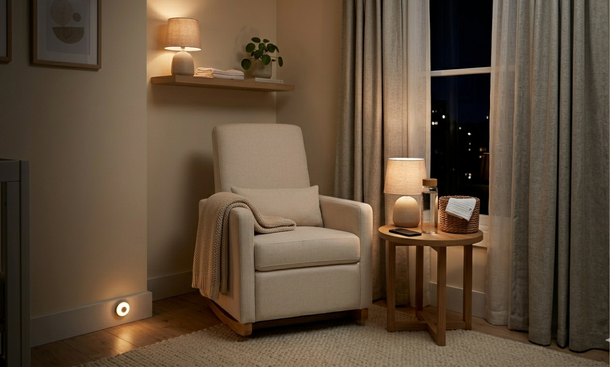
There is a version of breastfeeding that looks serene and effortless. And then there is the real version — where you are up at 2 a.m., the room is pitch dark, you cannot find your phone, you knocked over your water, and the baby is already crying because it took you forty-five seconds longer than expected to get settled.
The chair gets a lot of attention when people talk about setting up for breastfeeding. And the chair matters — a lot. But what surrounds that chair is what actually determines how those night feeds feel. A well-thought-out nursing corner can turn a disorienting, exhausting experience into something that feels almost manageable. And manageable at 2 a.m. is everything.
This is about building that corner intentionally, piece by piece, before the baby arrives — so that when you are running on three hours of sleep, everything you need is exactly where it should be.
Why the setup around your chair matters as much as the chair itself
When you sit down to feed a baby, you are often there for twenty to forty minutes. Sometimes longer during cluster feeding — those periods when a baby feeds frequently and close together, usually in the evenings, to build up your milk supply. During that time, you cannot easily get up. You cannot go to another room. You cannot rummage through a drawer or walk to the kitchen.
Everything you need has to be right there.
When it is, feeding feels calm. When it is not, every missing thing becomes a small frustration that stacks on top of all the other small frustrations of new parenthood. A nursing corner that is genuinely set up well removes those friction points before they happen.
It does not need to be elaborate or expensive. It needs to be functional and within reach.
Start with the chair placement
Before anything else, think about where in the room the chair actually goes — because placement affects everything that comes after it.
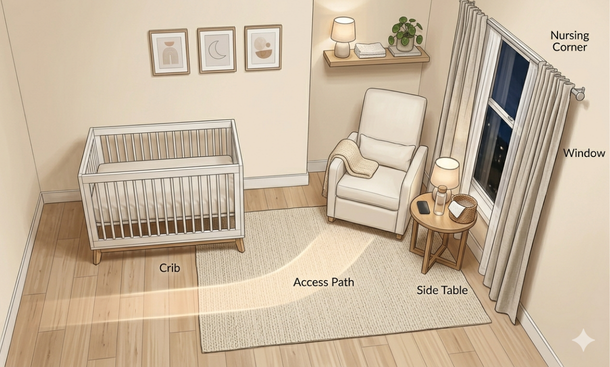
The best position for a nursing chair is one that gives you a clear, unobstructed path to the crib or bassinet. You will be walking that path in the dark, often while holding a sleeping baby. Any furniture in that path — a footstool, a hamper, a toy basket — becomes a hazard.
Corner placement works well for most nurseries. It keeps the center of the room open, gives you two solid walls of context, and creates a natural pocket of calm that feels separate from the rest of the space. It also makes it easier to position a side table within reach on one side without blocking movement on the other.
If the chair is going into a shared bedroom rather than a dedicated nursery, the same logic applies. Place it where you can get to the baby and back to bed with the least number of obstacles in between.
Lighting — the detail that changes everything at night
Lighting is one of the most overlooked parts of a nursing setup, and it is one of the most important ones.
Overhead lighting is too harsh for night feeds. Turning on a bright ceiling light in the middle of the night wakes you up fully, makes it harder to get back to sleep afterward, and can overstimulate a baby who is just beginning to understand the difference between day and night.
What you want instead is layered, controllable light. Here is what actually works.
A warm-toned lamp on the side table, set to its lowest setting, gives you just enough light to see what you are doing without flooding the room. Look for a lamp with a physical dimmer or a smart bulb you can control from your phone — because reaching over to fiddle with a switch while holding a baby is harder than it sounds.
A small plug-in night light near the baseboard is useful for navigating the room without turning anything else on. Position it between the chair and the crib so it marks your walking path.
Color temperature — the warmth or coolness of a light source — matters here. Bulbs with a color temperature of 2700K or below produce a warm amber glow that is much easier on the eyes at night than the cooler white light of standard bulbs. This is worth paying attention to when you buy the lamp bulb, not just the lamp.
Blackout curtains on the window are the other piece of the lighting equation. They keep outside light from disrupting sleep during early morning hours and signal to your baby over time that darkness means sleep. They do not need to be expensive — just effective.
The side table situation
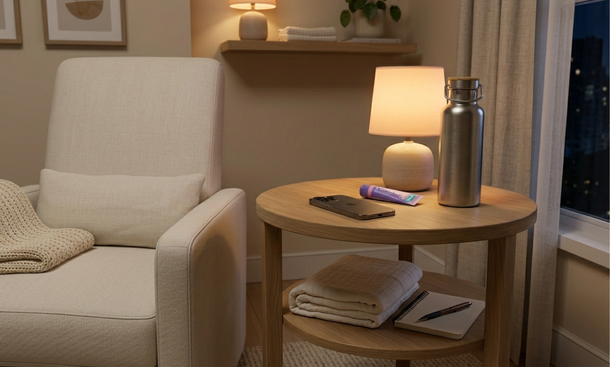
You need a surface next to your nursing chair. This is not optional. A water bottle, a phone, a burp cloth, a nipple cream — these things need somewhere to live that is not your lap or the floor.
The surface should be at a height that lets you reach it without leaning or stretching. For most nursing chair heights — seats that sit 17 to 19 inches from the floor — a side table between 22 and 26 inches tall works well.
The top of the table needs to be large enough to hold a few items without crowding. A surface that is at least 12 inches in diameter if it is round, or 12 by 16 inches if rectangular, gives you workable space. Anything smaller and you are constantly knocking things over.
A table with a small drawer or a lower shelf adds useful storage for items you want close but not always on the surface — an extra hair tie, a spare pacifier, a lip balm.
Avoid tables with fragile or wobbly bases. They will get bumped. They will get leaned on. They need to be stable.
What to keep within arm’s reach
Once the table is in place, here is what should be on or near it every single night.
Water. A large insulated water bottle — at least 24 ounces — that you refill before bed every night. Breastfeeding makes you thirsty in a way that is genuinely surprising, and being unable to reach water during a feed is one of those small miseries that is easy to prevent.
A burp cloth. At least one, ideally two, either on the table or draped over the armrest. Spit-up does not send a calendar invite.
Your phone. Face down so the screen does not disturb you or the baby, but charged and within reach. You will use it for a timer, a feeding tracker app if you use one, or just something to look at during a long feed at 4 a.m.
Nipple cream. If you are using lanolin or any other nipple balm during the early weeks, keep it on the table rather than in the bathroom. The fewer reasons you have to get up between feeds, the better.
A small snack. This one is optional but genuinely useful during the early weeks when your appetite during night feeds can catch you off guard. A granola bar or a small handful of crackers in the basket on the lower shelf costs nothing and has saved more than a few rough nights.
Sound and white noise
A white noise machine — a device that produces a consistent ambient sound to mask background noise — is not strictly part of the nursing corner, but it belongs near it.
White noise helps babies settle by mimicking the sounds of the womb and masking household noise that can interrupt sleep transitions. For night feeds, a machine positioned near the crib does double duty: it helps your baby stay calm during the feed and makes it easier to transfer them back to sleep once they are done.
Keep the volume moderate. The common recommendation is around 65 decibels — roughly the level of a running shower — measured at the baby’s level. You do not need to blast it. Consistent and steady is what matters.
If you have a smart speaker near the chair, you can use it to play white noise without a dedicated machine. The trade-off is that you will need to interact with it to turn it on and off, which adds a step at 3 a.m. that a dedicated machine with a simple on switch does not.
Temperature and comfort layers
Your comfort during feeds matters too. A nursing session where you are cold, stiff, or uncomfortable is harder to relax through — and relaxation actually affects let-down, the reflex that releases milk from the breast to the baby.
Keep a light blanket over the back of the chair or on the lower shelf of the side table. A breathable cotton or muslin throw works well — warm enough to take the edge off a cold room without making you overheated during a feed.
Wear something easy to nurse in at night. A nursing tank or a loose button-front top removes one more obstacle between you and getting the baby latched quickly. The faster you can get settled, the faster the baby calms down — and the faster you both might get back to sleep.
If your nursery or bedroom runs cold, a small space heater on a timer can take the chill off the room before feeds without keeping it warm all night. Check that any heater you use in the nursery has an automatic shut-off and is positioned well away from the chair and any fabric.
The nursing station basket — your secret weapon
A small wicker or fabric basket kept on the lower shelf of your side table or on the floor beside the chair is one of the most practical things you can add to a nursing corner.
Think of it as a portable supply station. Inside it goes the things you do not need on the table surface but want immediately available: an extra burp cloth, a spare pacifier, nipple pads — small absorbent pads worn inside a bra to prevent leaking — a hair tie, your hand cream, and anything else that you keep reaching for and having to get up to find.
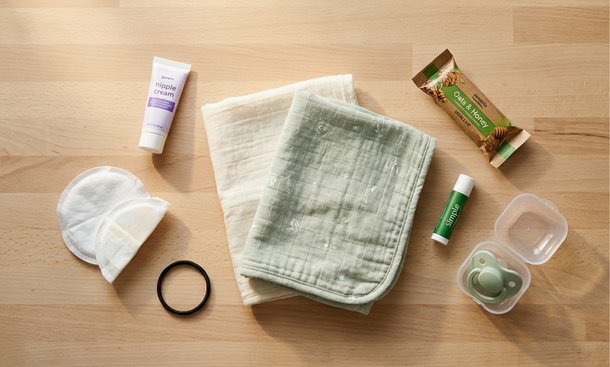
Refill the basket weekly as part of your regular routine. It takes five minutes and prevents the 2 a.m. discovery that you used the last burp cloth two days ago.
Making it work in a shared bedroom
Not everyone has a separate nursery. If your nursing corner is in your bedroom — or in a studio apartment where everything shares the same space — the same principles apply, just compressed into a smaller setup.
A clip-on or small bedside lamp with a warm dimmer setting does the job that a side table lamp does in a nursery. A small basket or caddy hanging from the side of the bed or sitting on your nightstand holds your nursing essentials. A portable white noise machine positioned between you and your partner lets you feed with some ambient cover without waking the whole room.
The key in a shared space is keeping everything self-contained. The more you can reach without getting fully out of bed or turning on overhead light, the less disruptive the whole setup is — for you, for your partner, and eventually for the baby learning to connect darkness with sleep.
A nursing corner does not need to be a design project. It needs to be a functional one. The goal is simple: when you sit down at 2 a.m. with a hungry baby, everything you need is already there. No searching, no getting up, no extra frustration layered on top of an already tiring night.
Start with the chair placement, build the lighting around it, get the right surface next to it, and stock it before the baby comes. Then adjust as you learn what you actually reach for most.
If you are still figuring out the chair itself — what size makes sense, what type of motion works for your space, what features are non-negotiable — the piece on choosing the best nursing chair for small rooms is a useful next step.
And if you want to understand the full picture before you make any decisions, the complete guide to choosing a nursery chair for breastfeeding covers everything from chair type to timing so you can build a setup that actually works for you.

As a Felyro.com content author, I develop actionable content on breastfeeding, translating research-backed information into practical advice for mothers. My goal is to help families establish healthy feeding habits, improve maternal confidence, and support infant development.