

Home pregnancy tests feel simple till you actually need one. Then suddenly every detail matters. What time you took it, how many days past ovulation you are, whether that line is real, whether your app got the date right. It can get messy fast.
I’m Sophia M. Caldwell, I’m 37, and I love writing about pregnancy tracking in a way that feels grounded and human. Pregnancy detection at home can give you real clues about conception timing, but only if you know how to read the result in context. A test is not just a yes or no. It is a marker in a timeline. If you want the whole timeline from intercourse to ovulation to implantation, this guide to figuring out when you conceived lays it out clearly. Right here, we’re keeping it focused on what home testing can actually tell you and what it cannot.
How pregnancy detection at home works
Home pregnancy tests look for hCG in urine. That hormone starts showing up after implantation. That part is key.
Conception usually happens around ovulation, when sperm meets the egg. But a test cannot detect conception right away because your body does not start making detectable hCG the second fertilization happens. First the fertilized egg travels, then implantation happens, and only after that does hCG begin rising enough for a test to catch it.
That means the test result is tied more closely to implantation and hormone buildup than to the exact day you conceived.
A simple sequence looks like this:
- sex happens during the fertile window
- ovulation happens
- fertilization may happen within about 24 hours
- implantation usually happens 6 to 12 days later
- hCG starts rising after implantation
- a home test turns positive when hCG gets high enough
So if you are trying to work backward and estimate conception, the test gives you a clue, but not a direct answer by itself.
Why timing matters more than people think
This is the whole game. A home pregnancy test is only as useful as the timing around it.
If you test too early, you can get a negative even if conception already happened. If you test around the day your period is due, the result becomes more meaningful. If you test several days after a missed period, the result carries even more weight.
A lot of confusion happens because people use a test like a magic truth machine. It is not that. It is a hormone detector. And hormones follow their own schedule.
The question is not just “what did the test say.” The better question is “when did I take it in relation to ovulation, implantation, and my expected period.”
That shift in thinking makes the result way more useful.
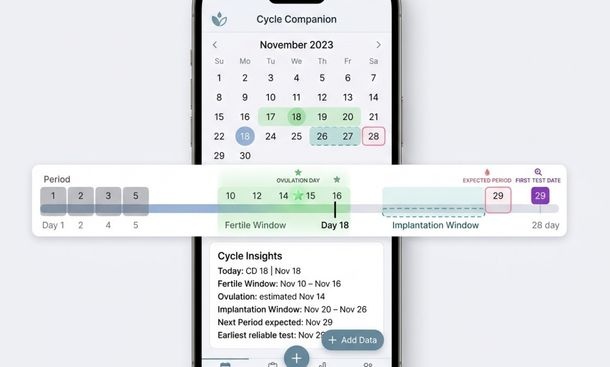
When a home test can first become positive
Some people get a positive before their missed period. Some do not get one till a few days later. Both can happen in normal pregnancies.
Usually, the earliest positive depends on:
- when ovulation really happened
- when implantation happened
- how quickly hCG is rising
- how sensitive the test is
- whether urine is concentrated enough
That is why two people can conceive on roughly the same cycle day and still get different test timing. One may implant earlier. One may test with first morning urine. One may just have a slower hCG rise.
In general, testing on the day your period is due or after gives you a more reliable result. Testing much earlier puts you in the danger zone for false negatives.
What a positive home test can tell you about conception
A positive home test means hCG is present. That tells you implantation likely already happened. Since implantation usually happens several days after conception, you can work backward from the test to estimate the likely conception window.
That estimate is not exact, but it can be useful.
For example, if you get a positive test on august 20, conception probably did not happen on august 20. It likely happened around ovulation, usually about 6 to 12 days before implantation and then a little time before the test turned positive. So your likely conception window may be around early to mid august depending on your cycle.
The best estimate comes from combining:
- first day of your last period
- likely ovulation date
- intercourse during the fertile window
- first positive test date
- any implantation spotting or mild cramps if they lined up
That combo gives you a real working timeline instead of a guess based on one line.
What a negative home test can tell you
A negative test does not always mean no pregnancy. It may simply mean not enough hCG yet.
That is especially true if:
- you tested before your period was due
- you are not sure when you ovulated
- implantation may have happened later
- you drank a lot of water before testing
- you tested later in the day when urine was diluted
A negative result becomes more meaningful the farther you get past your expected period. A negative at 8 days past ovulation means very little. A negative 4 or 5 days after a missed period tells you a lot more.
So even a negative test can help with conception clues. It can tell you whether the timeline still leaves room for pregnancy or whether conception is becoming less likely for that cycle.
The difference between home detection and exact dating
This is where people get frustrated. A home test can tell you pregnancy hormone is there. It cannot tell you the exact day conception happened.
Why not. Because there is variation at every stage.
- sperm can survive up to 5 days before ovulation
- ovulation may not happen on the app’s predicted day
- implantation can happen earlier or later
- hCG can rise at different speeds
So the result gives you a range, not a timestamp. That is still useful. You just have to respect what the test can do and what it cannot do.
If you are looking for an exact date down to the day, home testing alone usually cannot give you that. If you are looking for a realistic conception window, it absolutely can help.
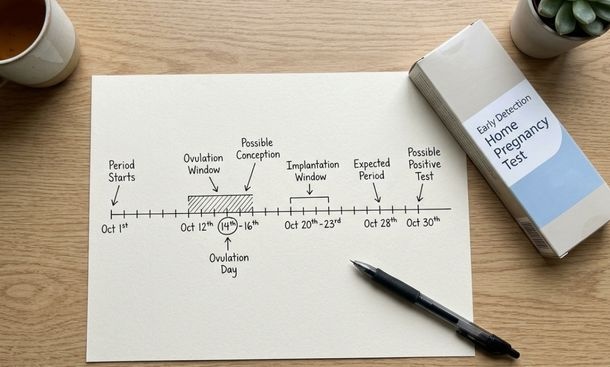
How to use a home test as part of pregnancy tracking
The smartest move is to log the result with context. Not just positive or negative. The details matter.
Write down:
- date and time of the test
- likely days past ovulation
- whether you used first morning urine
- result strength if there was a visible line
- whether your period was due yet
- what happened when you retested
That kind of note helps you later if you are trying to piece together when conception likely happened. It also keeps you from relying on memory when the days start blending together.
A lot of the value in pregnancy tracking comes from small details kept in order.
First morning urine and why people care about it
You hear this advice all the time for a reason. First morning urine is usually more concentrated, especially early on when hCG is still low. That makes it more likely that a test will pick up a faint positive if pregnancy is there.
Now, if you are already several days late, this may matter less. But early in the testing window, it can make a real difference.
So if you got a negative test late in the day after chugging water and now you are spiraling, I would not treat that as the final word. Test again with first morning urine if your period still has not shown.
The stuff that can throw off home pregnancy detection
A few things can make results harder to read.
Ovulation happened later than expected
This is a huge one. If ovulation was late, then implantation and hCG rise will also be later.
The test was used too early
Still the most common issue.
The test was read outside the result window
That can lead to confusion with evaporation lines.
Urine was diluted
Too much fluid before testing can weaken the result.
Your cycle is irregular
Irregular cycles make date estimates less reliable unless you are tracking ovulation closely.
None of this means home tests are unreliable. It just means they work best when the timeline around them is solid.
Can home pregnancy detection help before symptoms start
Yes, sometimes. A positive test may show up before strong symptoms do. That is pretty common.
A lot of people expect their body to announce pregnancy in some dramatic way before a test ever does. Not always. Sometimes the test is the first real sign. That is especially true when symptoms are subtle or feel just like PMS.
So if you are relying on symptoms alone, a home test can add clarity earlier than you expect. It may not date conception exactly, but it can confirm that implantation and hormone production have already started.
When to retest
Retesting makes sense when:
- you got a negative before your period was due
- your period is late and the first test was negative
- the line was so faint you are not sure what you saw
- you want to see whether a positive becomes clearer over time
Waiting 48 hours is usually a smart move because hCG should have more time to rise. Testing again the next hour usually just gives you more stress and not much new information.

When home testing is not enough on its own
Home tests are great, but there are moments when you need more.
Get medical advice if:
- tests are confusing and your period stays absent
- you have strong pain or heavy bleeding
- positive and negative tests seem to alternate
- you have reason to think your dates matter for treatment or care
- your cycles are very irregular and you need clearer dating
A blood test or ultrasound can sometimes give much better clarity than trying to squeeze one more answer out of another strip.
The smartest way to read home pregnancy detection
Treat the test result like a clue placed on your cycle timeline. Not like a random isolated event.
A positive test means hCG is present and implantation likely happened already. A negative test means either hCG is not there or it is too early to detect. The timeline around the test is what tells you which interpretation makes sense.
That means the most useful questions are:
- when did I likely ovulate
- when was my period due
- when did I take the test
- did I retest
- what happened next
Those questions give the result shape. Without them, the test is just a moment of panic in a bathroom.
Pregnancy detection at home can give you strong clues about conception timing, but the result only makes sense when you line it up with ovulation, implantation, and your expected period. A positive test usually means implantation has already happened. A negative test may simply mean the hormone is not detectable yet. The smartest read comes from tracking the result as part of the full cycle story. If you want to circle back to one of the earliest physical clues in that timeline, the next useful read is implantation symptoms: when conception may have happened.

As an author at Felyro.com, I create actionable content on pregnancy tracking, offering practical tools, tips, and insights that empower mothers-to-be to stay informed and confident throughout their pregnancy.