
Okay, so you’ve decided you’re ready to start trying for a baby. Congratulations, that’s huge. Now comes the part where everyone and their mother has an opinion about what you should be doing to prepare.
And one of the biggest questions I see women stressing about is this: when exactly should I start taking prenatal vitamins?
Some sources say one month before. Others say three months. I’ve even seen recommendations for six months or a full year. And then there’s your friend who didn’t start until she was already pregnant and her kid turned out fine, so does any of this even matter?
Yeah, it matters. But not in the scary, you-must-follow-these-exact-rules-or-else kind of way. Let me break down the actual science behind the timing recommendations, what’s happening in your body at different stages, and how to figure out the right timeline for your specific situation.
The Short Answer (Because I Know You’re Impatient)
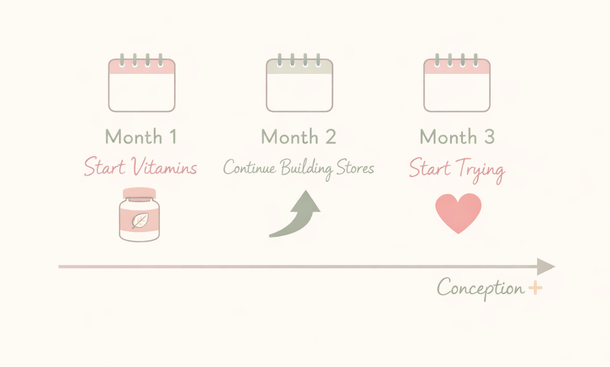
The standard recommendation is to start taking prenatal vitamins at least one month before you start trying to conceive, but three months is better.
That’s the official line from organizations like the American College of Obstetricians and Gynecologists (ACOG) and the Centers for Disease Control and Prevention (CDC).
But let’s dig into why that timeline exists, because understanding the reasoning will help you make better decisions for your own situation.
Why Three Months? The Science Behind the Timeline
Your body doesn’t just flip a switch and suddenly have optimal nutrient levels the day you start taking vitamins. Building up adequate stores of critical nutrients takes time.
Here’s what’s happening during those three months before conception.
Folate stores build up gradually. Red blood cells, which carry folate throughout your body, have a lifespan of about 120 days (that’s roughly four months). It takes consistent supplementation over weeks to months to reach optimal folate levels in your bloodstream and tissues. Since the neural tube forms in the first 28 days after conception—often before you even know you’re pregnant—you want those folate levels already maxed out when conception happens.
Iron stores take even longer to build. If you’re starting with low ferritin (your iron storage protein), it can take three to six months of consistent supplementation to bring your levels into the optimal range. Your body prioritizes iron for essential functions, so building up reserves that will support the massive blood volume increase during pregnancy takes time.
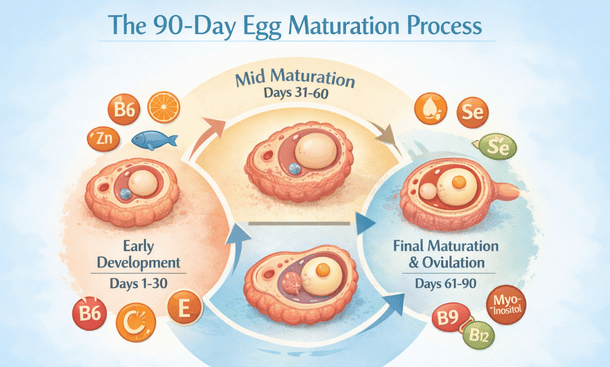
Egg quality improves over 90 days. Here’s something most people don’t know: the eggs that ovulate in any given month actually started their maturation process about three months earlier. The vitamins and nutrients you’re taking today are supporting the eggs that will be ready for fertilization three months from now. So if you want to give those eggs the best possible nutritional environment during their development, you need to start supplementing at least 90 days before you’re trying to conceive them.
Your body needs time to correct deficiencies. If you’re deficient in vitamin D, B12, or other nutrients (and lots of us are without even knowing it), your body needs weeks to months to restore normal levels. A single dose or even a week of supplementation won’t cut it.
This is why three months is the ideal window. It gives your body time to build up stores, correct any deficiencies, and ensure optimal conditions for both conception and those critical first weeks of embryonic development.
The Minimum Timeline: One Month
If three months isn’t realistic for you—maybe you just decided to start trying, or you’ve been trying without success and you’re just now learning about preconception vitamins—one month is the bare minimum.
Here’s what one month of supplementation accomplishes.
You’ll build up some folate stores, though not to the optimal levels you’d reach with three months of supplementation. For most women, one month is enough to reach adequate levels for neural tube defect prevention, which is the most critical concern in those first weeks.
Your body will start correcting nutrient deficiencies, though again, you won’t fully reverse long-standing deficiencies in just 30 days.
You’ll provide nutritional support for the final stages of egg maturation, even though you missed the earlier developmental windows.
Is one month ideal? No. But it’s infinitely better than starting supplementation after you’re already pregnant or not supplementing at all.
Don’t let perfect be the enemy of good here. If you only have one month, use it. Start today.
What If You’re Already Trying?
Look, life doesn’t always follow the perfect timeline. Maybe you’ve been trying for a few months already and you’re just now learning that you should’ve been taking prenatal vitamins all along. Or maybe you got caught up in the moment and weren’t being super careful about prevention, and now you’re not sure if you might already be pregnant.
First, don’t panic. Seriously. Women have been having healthy babies for thousands of years without perfectly timed supplementation protocols.
Second, start taking a quality prenatal vitamin today. Like, right now. Even if you’re already pregnant (though obviously take a pregnancy test to confirm), starting now is still beneficial.
The neural tube closes around day 28 after conception, which is roughly when you’d be getting a positive pregnancy test or slightly after. If you start supplementing the day you get that positive test, you’re probably still within the window where folate supplementation matters for neural tube development.
And even if you’ve passed that specific window, prenatal vitamins support so many other aspects of pregnancy—red blood cell production, bone development, immune function, brain development throughout all three trimesters. It’s never too late to start.
Third, talk to your doctor. If you’ve been trying for several months without supplementation, your doctor might want to check your nutrient levels (especially folate, iron, and vitamin D) and potentially recommend higher doses temporarily to build up your stores faster.
The Longer Timeline: Six Months to a Year
Some fertility specialists and functional medicine practitioners recommend starting prenatal vitamins six months to a year before trying to conceive.
Is this necessary for everyone? No. But there are situations where a longer timeline makes sense.
If you have known nutrient deficiencies—maybe you had bloodwork done and your vitamin D is super low, or your ferritin is bottomed out—you might need six months or more of supplementation to get those levels into optimal ranges.
If you have a history of eating disorders, restrictive diets, or conditions that affect nutrient absorption (like celiac disease or Crohn’s disease), a longer runway gives your body more time to restore depleted reserves.
If you’re over 35, some research suggests that longer supplementation windows may be beneficial for egg quality, though the evidence here is still emerging.
If you’ve had previous pregnancy losses or babies with neural tube defects, your doctor might recommend starting supplementation earlier and potentially at higher doses.
If you’re planning to lose weight before pregnancy, you want to establish healthy habits and nutrient intake patterns well before you start trying, since some weight loss methods can deplete nutrients.
The bottom line? If you’re planning ahead and you have the luxury of time, starting six months to a year out doesn’t hurt. You’re just giving yourself extra insurance that your body is in the best possible shape for conception.
What About Your Partner?
Here’s something that doesn’t get talked about nearly enough: the timeline for men is different, and honestly, it matters just as much.
Sperm take about 74 days (roughly two and a half months) to fully develop from start to finish. That means the sperm that will potentially fertilize an egg three months from now are just beginning their development today.
If your partner wants to optimize his sperm quality—which affects not just conception rates but also early embryo development—he should start taking preconception supplements about three months before you start trying.
This gives his body time to provide optimal nutritional support during the entire sperm development cycle. The nutrients he’s taking today are literally building the sperm that will be ready in 90 days.
For the full breakdown of what your partner should be taking and why male preconception health is just as important as yours, you’ll want to read up on the specific supplements men need before conception. Trust me, this isn’t just a woman’s responsibility.
The Nutrients That Need the Longest Runway
Not all nutrients require the same amount of time to optimize. Some build up quickly, others take months.
Folate reaches adequate levels relatively quickly—you’ll see blood folate levels increase within a few weeks of consistent supplementation. But tissue saturation takes longer, which is why three months is still recommended.
Vitamin D can take two to three months to reach optimal levels if you’re starting from a deficient state. And most of us are deficient without knowing it.
Iron and ferritin are the slowest to build. If you’re low in iron, expect it to take three to six months of consistent supplementation to restore normal stores. This is why iron is one of the best arguments for the longer timeline.
Omega-3 fatty acids (DHA and EPA) incorporate into cell membranes over weeks to months. You want these levels optimized before conception for egg quality and early brain development.
Vitamin B12 stores can last for years, so if you’re not deficient to start with, supplementation has more immediate effects. But if you’re vegan or vegetarian and potentially deficient, you’ll need several months to restore normal levels.
How to Actually Use This Information
Okay, so now you know the timelines. How do you apply this to your actual life?
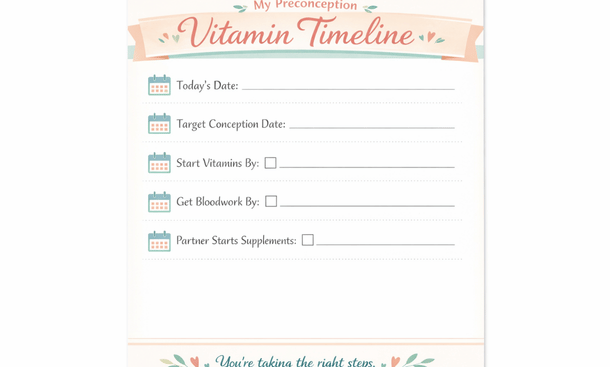
If you’re in the planning stage and pregnancy is at least three to six months away: Start taking a quality prenatal vitamin now. Get baseline bloodwork done (vitamin D, ferritin, B12 at minimum) so you know if you have any deficiencies that need addressing. Use this time to dial in your nutrition, establish healthy habits, and get your body in optimal shape for conception.
If you’re planning to start trying in one to three months: Start your prenatal vitamin today. Focus on consistency—taking it every single day matters more than taking it sporadically. Consider getting your nutrient levels checked if you have time, especially if you have risk factors for deficiencies.
If you’re starting to try this month or next month: Start your prenatal immediately. Don’t wait another day. Accept that you’re not in the ideal three-month window, but know that even a few weeks of supplementation before conception is beneficial.
If you’re already trying or you might already be pregnant: Take a pregnancy test to know where you stand. Start prenatal vitamins today regardless of the result. If you’re pregnant, your doctor might recommend specific doses or additional supplements based on how far along you are.
If you have known health conditions or nutrient deficiencies: Talk to your doctor about your specific timeline. You might need longer than three months, or you might need therapeutic doses of certain nutrients to correct deficiencies faster.
What If You’ve Been Taking Birth Control?
This is a super common question, and the answer depends on what type of birth control you’ve been using.
Hormonal birth control (pills, patches, rings) can deplete certain nutrients, particularly folate, B vitamins, magnesium, and zinc. If you’ve been on hormonal birth control for years, you might benefit from a longer supplementation window—three to six months—to restore optimal nutrient levels.
That said, you don’t need to wait three months after stopping birth control to start trying. You can start trying immediately after stopping (your cycles might be irregular at first, but you can still conceive). Just make sure you’re already taking prenatal vitamins before you stop the birth control.
If you’ve been using non-hormonal methods (condoms, fertility awareness, copper IUD), there’s no nutrient depletion issue. The standard three-month timeline applies.
The Consistency Factor (This Matters More Than You Think)
Here’s something nobody tells you: taking prenatal vitamins sporadically for six months is less effective than taking them consistently for two months.
Your body needs steady, consistent nutrient intake to build and maintain optimal levels. Taking vitamins three times this week, then forgetting for four days, then taking them again is better than nothing, but it’s not giving your body the sustained support it needs.
This is why finding a prenatal vitamin you can actually tolerate and remember to take is so important. The best prenatal vitamin in the world doesn’t do anything if it’s sitting in your cabinet because it makes you nauseous or you keep forgetting to take it.
Set a daily reminder on your phone. Keep the bottle somewhere you’ll see it every morning. Pair it with an existing habit like brushing your teeth or making coffee. Do whatever you need to do to make it automatic.
Consistency beats perfection every single time.
What About Preconception Blood Tests?
If you’re planning ahead and you have time, getting baseline nutrient testing before you start trying is incredibly valuable information.
At minimum, ask your doctor to check vitamin D (25-hydroxyvitamin D), ferritin (iron stores), and complete blood count (to check for anemia). If you’re vegetarian or vegan, add B12 to that list.
These tests will tell you if you’re starting from a deficient state, which would argue for a longer supplementation timeline or higher therapeutic doses.
Many doctors won’t automatically offer these tests for preconception unless you ask, so you might need to specifically request them. If your doctor pushes back, explain that you want to optimize your nutrient status before conception and you’re willing to pay out of pocket if insurance won’t cover it.
Knowing your starting point takes the guesswork out of the equation.
The Real-World Timeline
Look, in an ideal world, every pregnancy would be perfectly planned with six months of advance preparation, optimal nutrient levels, and clockwork supplement schedules.
We don’t live in that world.
About half of all pregnancies in the United States are unplanned. Millions of women don’t start taking prenatal vitamins until they get that positive test. And you know what? Most of those pregnancies turn out absolutely fine.
The recommendations for preconception vitamin timing are about optimizing outcomes and reducing risks, not about creating a pass-fail scenario where anything less than perfect timing dooms your pregnancy.
If you can give yourself three months, great. That’s the sweet spot. If you can’t, do what you can with the time you have. One month is better than nothing. Two weeks is better than starting after conception.
The goal here isn’t to stress you out about one more thing on your preconception to-do list. It’s to give you actionable information so you can make the best decision for your situation.
The timeline for when to start prenatal vitamins isn’t one-size-fits-all, but three months before you start trying gives your body the best shot at building optimal nutrient stores for conception and early pregnancy. That said, one month is the bare minimum, and starting at any point is better than not starting at all.
If you’re feeling overwhelmed about all the preconception prep—and honestly, who isn’t—just remember that taking vitamins is just one piece of the puzzle. But it’s an important piece that gives both you and your partner the nutritional foundation for a healthy pregnancy.
Speaking of your partner, don’t let him off the hook here. Male preconception health is just as critical as yours, and the supplements men should be taking are different from what you need. Make sure you both read up on preconception supplements for men so you’re tackling this as a team.
And when you’re ready to zoom out and see how all of this fits together—the timing, the nutrients, the testing, the whole nine yards—head back to our complete guide to preconception vitamins to make sure you’re not missing anything important.
You’ve got this. Start where you are, use what you have, and give yourself credit for taking this seriously.
