

Look, I get it. You just had your ultrasound and the tech handed you this report that looks like it was written in some secret medical code. Between the alphabet soup of abbreviations and numbers that mean absolutely nothing to you, it’s enough to make your head spin.
I remember my first ultrasound with my daughter. The sonographer was rattling off measurements like she was reading a grocery list while I’m sitting there nodding like I understood a single word. CRL this, BPD that, and I’m thinking “lady, just tell me if my baby’s okay.” But here’s the thing – once you actually understand what these measurements mean, those appointments become so much more meaningful.
So let me break it down for you, New York style. No fluff, no complicated medical jargon, just straight talk about what your doctor’s actually measuring and why it matters.
Why doctors measure everything in the first place
Before we dive into the specific measurements, let’s talk about why your OB is so obsessed with numbers. These measurements aren’t just busywork for the sonographer. They’re actually tracking your baby’s growth patterns to make sure everything’s developing the way it should be.
Think of it like this – if you were building a house, you’d want to make sure the foundation was the right size before you started on the walls, right? Same deal with your baby. Each measurement corresponds to a specific developmental milestone, and comparing them to standardized growth charts helps your doctor spot any potential issues early on.
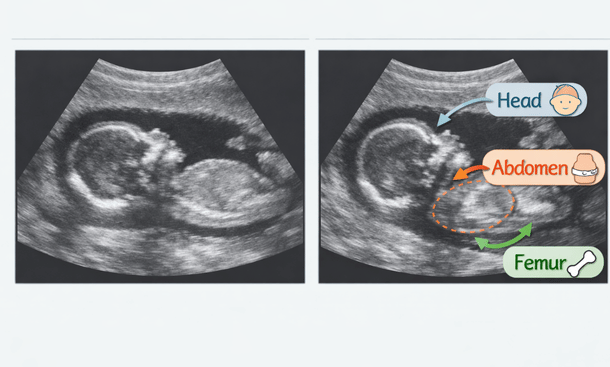
The big measurements you’ll see on every report
Crown-rump length (CRL)
This one’s pretty straightforward once you know what it means. CRL measures your baby from the top of their head (the crown) down to their little tush (the rump). Your doc uses this measurement primarily in the first trimester, usually between weeks 7 and 13.
Why does it matter? Well, CRL is actually the most accurate way to date your pregnancy early on. Way more accurate than trying to remember the first day of your last period, especially if your cycles are irregular like mine were. The measurement can pin down your due date within just a few days.
By around 14 weeks though, babies start curling up and stretching out at different times, which makes CRL less reliable. That’s when your doctor switches to other measurements.
Biparietal diameter (BPD)
Fancy name for a simple concept – this measures the width of your baby’s head from one side to the other. Specifically, it’s measuring the widest part of the skull, right across the parietal bones.
Your sonographer will use BPD throughout your entire pregnancy, but it becomes especially important in the second and third trimesters. This measurement helps estimate your baby’s weight and confirms that their head is growing proportionally with the rest of their body. It’s also one of the key numbers doctors use when they’re trying to figure out if you can deliver vaginally or if you might need a C-section.
Normal BPD measurements vary by gestational age, but generally speaking, at 20 weeks it’s around 4.7 cm and by 40 weeks it’s closer to 9.5 cm. Your doctor’s looking for steady growth rather than one perfect number.
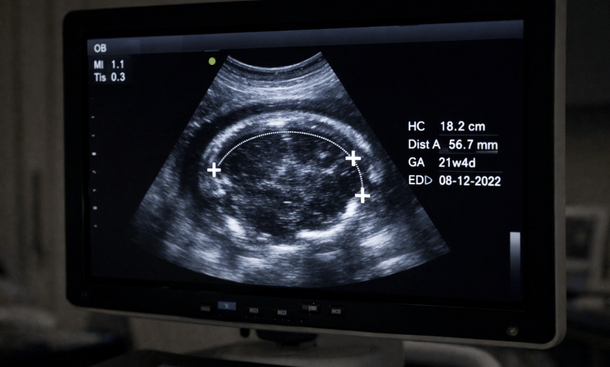
Head circumference (HC)
While BPD measures across the head, HC goes all the way around it. Think of it like measuring your waist versus measuring your width from side to side – both tell you something different.
HC helps your doctor assess brain growth and development. If this measurement is tracking smaller or larger than expected, it doesn’t automatically mean something’s wrong. Some babies just have bigger or smaller heads, just like some adults do. But significant deviations from the normal range might prompt your doctor to take a closer look.
Abdominal circumference (AC)
This one measures around your baby’s belly at the widest point. The sonographer’s looking at the area where the stomach and liver are located, which gives them good insight into your baby’s overall nutrition and growth.
AC is super important because it’s one of the main indicators of your baby’s weight. If the AC is measuring small, your doctor might want to monitor more closely to make sure your baby’s getting enough nutrients through the placenta. If it’s measuring large, they might check for gestational diabetes.
Here’s something that freaked me out the first time – AC measurements can vary quite a bit from one ultrasound to the next, even just a week or two apart. That’s because it depends partly on whether your baby just ate (well, swallowed amniotic fluid) or if they’re in a curled up position versus stretched out. So don’t panic if the number jumps around a little.
Femur length (FL)
This measures the longest bone in your baby’s body – the thigh bone or femur. It’s one of the easiest bones to measure clearly on an ultrasound because it shows up nice and bright on the screen.
FL helps estimate gestational age and predicted birth weight. It’s also used to make sure your baby’s limbs are growing proportionally with their body. Like all measurements, there’s a normal range, and some variation is totally expected. My daughter’s FL was consistently on the shorter side throughout my pregnancy, and guess what? She came out perfectly healthy, just with my husband’s shorter legs instead of mine.
By 20 weeks, average FL is around 3.4 cm, and by full term it’s typically between 7 and 8 cm.
What those percentiles actually mean
Okay, so now you know what’s being measured, but what about those percentile rankings your doctor mentions? This part confused the heck outta me initially.
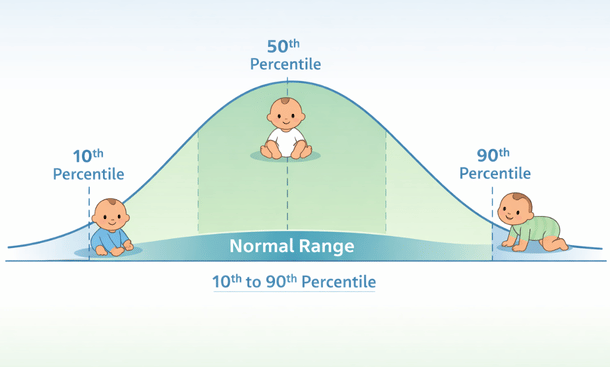
When your doctor says your baby’s head is in the 60th percentile, they’re saying that if you lined up 100 babies at the same gestational age, your baby’s head would be bigger than 60 of them and smaller than 40 of them. That’s it. Nothing more complicated than that.
Anything between the 10th and 90th percentile is considered totally normal. Most of the time, all your baby’s measurements will hover around the same percentile range. If your baby’s consistently measuring in the 30th percentile for everything, that just means you’re probably having a smaller baby. Not a problem as long as everything’s proportional and growing steadily.
Growth Chart Infographic
When measurements don’t match up
Sometimes one measurement will be way different from the others. Maybe your baby’s head is measuring in the 75th percentile but their femur length is in the 25th percentile. Before you spiral, take a breath.
First off, measurement errors happen. The sonographer might not have caught your baby at the perfect angle, or your little one was moving around too much to get a precise reading. This is why doctors never make big decisions based on one ultrasound alone.
Second, genetic variation is real. Maybe you’ve got a tall family and your partner’s family is shorter. Your baby might end up with a longer torso and shorter legs, and that’s gonna show up in the measurements.
That said, significant discrepancies do sometimes warrant further investigation. Your doctor might order additional ultrasounds or tests if they see something that concerns them. The key word here is “significant” – we’re talking major differences, not a few millimeters here or there.
Estimated fetal weight isn’t an exact science
Using all these measurements together, the ultrasound machine calculates an estimated fetal weight (EFW). I’m gonna be real with you – this number can be off by quite a bit, sometimes by a pound or more in either direction.
The formula used to calculate EFW combines several measurements, but it’s still just an estimate based on averages. Your baby’s actual body composition, the amount of amniotic fluid, your body type – all these things can affect the accuracy.
I’ve heard so many stories of women being told they’re having a huge baby, only to deliver a totally average-sized kid. Or being told their baby’s small and then out comes this chunky little thing. So take the EFW with a grain of salt, especially toward the end of pregnancy when babies are packing on weight fast.
Questions you should actually ask your doctor
Instead of just nodding along when your doctor reviews the measurements, here’s what you should be asking about. Is my baby growing consistently along their own curve? Are all the measurements proportional to each other? How do this ultrasound’s numbers compare to the previous ones?
These questions give you way more useful information than fixating on whether your baby’s in the 45th percentile versus the 55th percentile. Growth trends matter more than single snapshots.
The bottom line on all these numbers
Look, I know it’s tempting to Google every measurement and compare your baby to the charts online. I did it too. But here’s what actually matters – consistent growth over time, measurements that are roughly proportional to each other, and a doctor who’s not concerned.
Your baby doesn’t need to be average in every single measurement. They just need to be growing steadily and healthily in their own unique way. Those measurements are tools to help your medical team monitor development, not grades on a report card.
Understanding what CRL, BPD, FL, and all those other abbreviations mean helps you feel more involved in your prenatal care. But remember, your doctor’s looking at the whole picture, not just individual numbers. If they’re happy with how things are progressing, you can be too. For a complete overview of everything from measurements to images and normal findings, For a complete overview of everything from measurements to images and normal findings, check out our complete guide to understanding pregnancy ultrasound results.
And if you want to dive deeper into interpreting all aspects of your ultrasound appointments, including what those grainy images actually show and what questions to ask during your scan, check out our guide on types of ultrasounds during pregnancy to understand what happens at each scan and why certain approaches are used at different stages.

Expectant Parents’ Joy
Trust the process, trust your doctor, and try not to drive yourself crazy with the numbers. Your body knows what it’s doing, and modern medicine is just there to back it up.

As an author at Felyro.com, I create actionable content on pregnancy tracking, offering practical tools, tips, and insights that empower mothers-to-be to stay informed and confident throughout their pregnancy.