
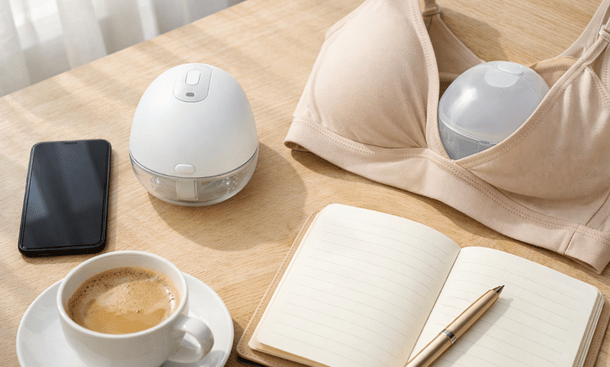
Wearable pumps sound like a dream, right? Pump while you’re makin’ breakfast, chasin’ your toddler, or ridin’ the subway to work. And yeah, for some moms they’re absolute lifesavers—but for others, they’re leaky, frustrating expensive gadgets that end up collectin’ dust. I’ve tested the big names and the newer budget options, and I’m gonna give ya the real scoop on who these hands-free pumps actually work for. Spoiler: it’s not everybody, and that’s okay. If you’re tryna figure out whether a wearable fits your pumping style or if you’d be better off with somethin’ more traditional, my full guide comparing every pump category will help you nail down the right choice.
Elvie Pump: The Pioneer That Set the Standard
Elvie basically invented the wearable pump category as we know it, and they’re still one of the top players. The Elvie Pump is a completely wireless, all-in-one unit that fits inside your bra with no external tubes or wires.
Each pump is about the size of a large computer mouse and sits directly against your breast inside your bra. The whole thing—motor, collection container, rechargeable battery—is contained in that single unit. You control it through an app on your phone via Bluetooth.
The app is actually pretty slick. It tracks how much you’re pumpin’ in real time, shows you which letdown mode you’re in, lets you adjust suction and speed, and keeps a history of all your sessions. Some moms love havin’ all that data. Others think it’s overkill and just another thing to fuss with.
The pumps are genuinely discrete under clothes. You can wear a normal shirt or even a slightly fitted top and nobody’s gonna know you’re pumpin’. The quiet motor helps with that too. It’s not totally silent but it’s way quieter than traditional pumps.
Suction strength is where Elvie gets mixed reviews. It’s gentler than most electric pumps, which some moms find comfortable and others find ineffective. If you’ve got a strong letdown and produce easily, Elvie usually works fine. If you need more aggressive suction to get a good output, you might be disappointed.
The collection containers hold about five ounces per side, which sounds like enough until you realize that’s the absolute max and you don’t wanna risk overflowin’. If you regularly pump four or more ounces per breast, you’re gonna be watchin’ the app nervously and maybe needin’ to dump mid-session.
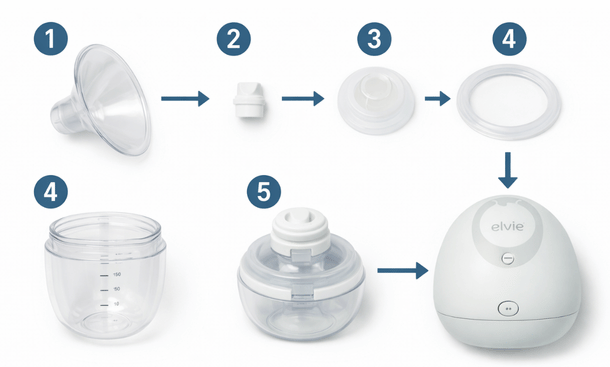
Cleaning is more involved than a basic pump. Each unit has multiple small parts that need to be disassembled, washed, and dried after every use. The silicone valve is particularly finicky and easy to put back wrong, which kills your suction.
Battery life is decent for one or two sessions per charge. If you’re pumpin’ four or five times a day, you’re gonna be chargin’ these things constantly.
Price is rough. Around five hundred dollars for a double set, and insurance coverage is spotty. Some plans cover part of it, many don’t cover it at all. That’s a big investment for somethin’ that might not work for your body.
Willow Go and Willow 360: Two Different Approaches
Willow makes two distinct wearable pumps and it’s important to understand the difference because they work pretty differently.
The Willow 360 is their original model and it’s got a unique design. You can pump directly into reusable containers that attach to the pump, or you can pump directly into disposable milk bags that fit inside the pump. The bag option is brilliant for moms who are buildin’ a freezer stash or pumpin’ at work—no need to transfer milk from bottles to bags later.
The pump itself is larger than Elvie, more egg-shaped, and it sits at kind of an angle in your bra. Some moms find this comfortable, others say it’s bulky and obvious under clothes. You gotta lean forward when you start pumpin’ to get the angle right for the milk to flow into the bag or container properly, which feels awkward at first.
The Willow Go is their newer, simpler version. It’s smaller than the 360, doesn’t use bags, and you pump into a reusable container only. It’s also cheaper—around three hundred dollars versus five hundred for the 360.
Both models use an app for control, though the Go also has physical buttons on the pump itself which some moms prefer. Both are pretty quiet and genuinely hands-free once you get ’em positioned right.
Suction on Willow pumps tends to be a bit stronger than Elvie, which is good for output but can be uncomfortable for sensitive moms. You’ve got seven suction levels to work with.
The bag system on the 360 is either a game-changer or a hassle dependin’ on your perspective. The bags are proprietary and expensive—about a dollar each. If you’re pumpin’ six times a day, that’s six bags a day, forty-two bags a week, almost two hundred bags a month. The cost adds up insanely fast.
Cleaning is similar to Elvie—lots of small parts, regular disassembly. The 360 is particularly annoying because you’ve gotta clean everything after every session, even when usin’ bags.
Battery life is better than Elvie. The 360 can usually handle a full day of pumpin’ on one charge.
Insurance sometimes covers Willow pumps, sometimes doesn’t. It varies wildly by plan.
Momcozy and Other Budget Wearables
The budget wearable category has exploded in the last couple years. Brands like Momcozy, Tsrete, Bellababy, and others are makin’ wearables that cost under two hundred dollars for a double set.
Momcozy is probably the most popular budget option. Their pumps look similar to Elvie—compact, all-in-one units that sit in your bra. They’ve got app control, adjustable suction, and rechargeable batteries.
Here’s the honest truth about budget wearables. They work for some moms. They’re way more affordable than premium brands, which makes ’em accessible to people who can’t drop five hundred bucks on a pump. And for light use—occasional pumpin’, short sessions, buildin’ a small stash—they can be totally fine.
But the quality control is inconsistent. Some moms get a Momcozy that works great for months. Others get one that loses suction after two weeks or where the battery dies after a dozen uses. Customer service for these brands is hit or miss, and warranty claims can be a headache.
Suction strength on budget wearables is usually the weakest point, literally. Even on the highest settings, they often don’t empty as thoroughly as premium wearables or traditional pumps. If you’re exclusively pumpin’ or dealin’ with supply issues, that incomplete emptying can be a real problem.
The parts are cheaper quality—thinner plastic, valves that wear out faster, seals that don’t fit quite right. You’ll probably need to replace parts more often.
That said, if you just need somethin’ for occasional use and your budget is tight, a Momcozy or similar might be worth tryin’. Just go in with realistic expectations and keep your receipt.

Who Wearable Pumps Actually Work For
Let’s get real about who benefits most from wearable pumps because this is where a lotta moms get disappointed.
Wearable pumps are fantastic for moms who produce moderate amounts per session—somewhere in the two to four ounce per breast range. If you’re regularly pumpin’ six or seven ounces per side, you’re gonna overflow these things or spend half your time watchin’ the app nervously.
They’re great for moms with strong letdowns who empty easily. If you typically get a good output in ten or twelve minutes with a regular pump, wearables will probably work fine. If you need twenty-five minutes and really strong suction to empty well, wearables are gonna frustrate you.
Work-from-home moms often love wearables because you can pump durin’ Zoom meetings, while you’re prepping lunch, or while you’re foldin’ laundry. The multitasking ability is real.
Moms who pump once or twice a day for a bottle or small freezer stash are perfect candidates. You’re not askin’ these pumps to handle heavy-duty exclusive pumpin’ schedules.
Wearables are also good for moms who struggle with pumpin’ because they hate bein’ tied down. If you’ve avoided pumpin’ or cut sessions short because you can’t stand sittin’ still for twenty minutes, the freedom of a wearable might actually help you pump more consistently.
They’re less ideal for exclusive pumpers who need maximum efficiency and output. The slightly weaker suction and incomplete emptying can add up over time and impact supply.
They’re not great for moms with oversupply who produce a lot per session. You’ll max out the capacity too quick.
And they’re definitely not worth it for moms on a tight budget unless you can get insurance coverage. Spendin’ three to five hundred dollars on a pump that might not work for your body is a big risk.
The Leaking Issue Nobody Talks About Enough
Here’s somethin’ that doesn’t make it into the marketing materials. Wearable pumps leak. Not all the time for all people, but enough that it’s a real consideration.
Because the pump sits horizontally in your bra instead of hangin’ down like traditional pumps, milk has to defy gravity a little bit. If you move the wrong way, lean forward, or your pump shifts position, milk can leak out around the seal or spill from the collection area.
This is especially true with pumps like the Willow 360 where you have to maintain a specific angle. Bend over to pick up a toy off the floor? You might get milk runnin’ down your stomach.
Some moms never have leaking issues. Others end up pumpin’ in their bathroom anyway because they can’t risk spillin’ milk all over their shirt at work.
The silicone breast shields need to form a perfect seal against your breast for the pump to work and to prevent leaks. If the fit isn’t quite right for your breast shape, you’re gonna have problems. Unlike traditional flanges where you’ve got tons of size options, wearable pumps usually come with limited sizing.
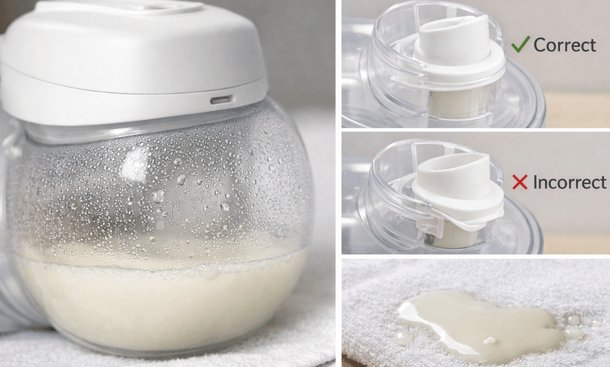
Wearable Pump Issues Illustrated
Battery Life and Practical Limitations
Let’s talk about what it’s actually like to use these things every day over weeks and months.
Battery life sounds good on paper—most wearables claim they’ll last for several sessions. In reality, battery degradation happens fast with frequent charging. After a few months of daily use, you might find your pumps that used to last for three sessions now barely make it through two.
You’re also chargin’ two separate units, which means two charging cables to keep track of. Forget to charge overnight and you’re scrambling in the morning.
The Bluetooth connection can be finicky. Sometimes the app won’t connect. Sometimes one pump connects but the other doesn’t. Sometimes they disconnect mid-session for no apparent reason. It’s not constant but it’s annoying when it happens.
Multitasking while pumpin’ has limits. Yeah, you can walk around and do stuff, but anything too active and you risk the pumps shiftin’ or losing suction. You’re not gonna go for a jog or do yoga while pumpin’. Light household tasks, sittin’ at a desk, drivin’—that stuff works. Anythin’ more vigorous doesn’t.
The learning curve is real. Figurin’ out how to position the pumps correctly, get a good seal, adjust settings through the app, and prevent leaks takes practice. Your first few sessions probably won’t go great. Give yourself some time to get the hang of it.
Cleaning and Maintenance Reality Check
Wearable pumps have more parts than traditional pumps and they’re smaller and more delicate.
After every session you’re disassemblin’ each pump into five or six pieces, washin’ everything, and layin’ it out to dry. Then you gotta reassemble it correctly before the next use. Do this wrong and your suction suffers or you get leaks.
The silicone valves and duck bills wear out faster than traditional pump valves in my experience. You’re supposed to replace them monthly but honestly, some wear out in a couple weeks with heavy use.
The suction is entirely dependent on havin’ every single part clean, dry, and assembled correctly. One tiny bit of moisture or one valve that’s slightly off and your pump won’t work right. With traditional pumps, there’s more margin for error.
Sterilizing is trickier too. Some parts can go in the dishwasher, others can’t. Some can be boiled, others will warp. You gotta read the instructions carefully and follow them exactly.
All that said, some moms don’t mind the cleaning routine and think it’s worth it for the hands-free benefit. Others find it exhausting, especially when you’re pumpin’ six or eight times a day.
Insurance Coverage and Cost Considerations
This is where things get complicated. Insurance coverage for wearable pumps is all over the place.
Some insurance plans explicitly cover wearable pumps as long as they meet certain criteria. Others only cover traditional electric pumps. Some will cover part of a wearable if you pay the difference out of pocket.
You gotta call your insurance company or work with a breast pump supplier who can check coverage for you. Don’t just assume they’ll cover it.
Even with partial coverage, you’re often payin’ a couple hundred dollars out of pocket. Without coverage, you’re lookin’ at three hundred to five hundred dollars for a double set.
Compare that to zero dollars for a traditional electric pump through insurance, and you can see why this is a tough decision.
If the wearable works perfectly for you and you use it successfully for months, it’s worth every penny. If it doesn’t work for your body and you end up buyin’ a traditional pump anyway, that’s a very expensive mistake.
My advice? If you can swing it financially and you think a wearable would significantly improve your quality of life, go for it. But if money’s tight or you’re not sure, start with a traditional pump covered by insurance and see how pumpin’ goes. You can always add a wearable later if you decide you need it.
Should You Take the Wearable Plunge?
After all this, how do you decide?
If you’ve got the budget, produce moderate amounts, have a strong letdown, and value mobility highly, wearables are worth tryin’. Start with one of the established brands like Elvie or Willow rather than the cheapest option so you’ve got decent customer service if things go wrong.
If you’re exclusively pumpin’ or need maximum output and efficiency, stick with traditional electric pumps. You’ll get better results with less frustration.
If you’re on a tight budget, don’t stretch yourself financially for a wearable. A good traditional pump works great and costs way less.
Consider your work environment too. If you’ve got a dedicated private pump room, traditional pumps are fine. If you’re pumpin’ in weird places or can’t always step away, wearables might be worth the investment.
And remember, you can have both. Some moms use a traditional pump at home for overnight and morning sessions when they’ve got time to sit, then use a wearable for daytime sessions at work. Mix and match based on what works.
Your Next Steps
Now you’ve got the real story on wearable pumps—the good, the bad, and the leaky. They’re incredible tools for the right person in the right situation, but they’re definitely not a one-size-fits-all solution. If you decide wearable isn’t for you, or if you want somethin’ to pair alongside a wearable for different situations, that’s totally valid.
The key is knowin’ what factors actually matter when you’re makin’ this decision in the first place. That’s where havin’ a solid framework for how to choose a breast pump that fits your specific lifestyle comes in super handy—it walks you through exactly what to consider based on your work schedule, baby’s needs, and what you can realistically spend. And if you’re lookin’ at the complete landscape of what’s available this year, from wearables to traditional electrics to manual backups, my full comparison of the best breast pumps on the market breaks down every option so you can see how wearables stack up against everything else.

As a Felyro.com content author, I develop actionable content on breastfeeding, translating research-backed information into practical advice for mothers. My goal is to help families establish healthy feeding habits, improve maternal confidence, and support infant development.