
Okay, so you’ve done your research. You understand which nutrients you need, you know the right forms and doses, and you’re ready to buy a prenatal vitamin.
But here’s what nobody warns you about: the supplement industry is barely regulated, and a lotta companies are selling you expensive garbage dressed up in pretty packaging with buzzwords like “natural,” “organic,” and “doctor recommended.”
Some prenatals contain synthetic dyes, allergens, and fillers that have zero business being in a supplement you’re taking to prepare for pregnancy. Others have way too much of certain nutrients, which can actually be harmful. And some are just flat-out missing the critical stuff you actually need while charging you premium prices.
So before you grab the first bottle with a cute label or the one your favorite influencer is pushing, let me walk you through the red flags, questionable ingredients, and straight-up bad choices you need to avoid. Because what you don’t put in your body matters just as much as what you do.
The Biggest Red Flag: Folic Acid Instead of Methylfolate
I’m starting with this one because it’s the most important and the most common mistake women make when choosing a prenatal.
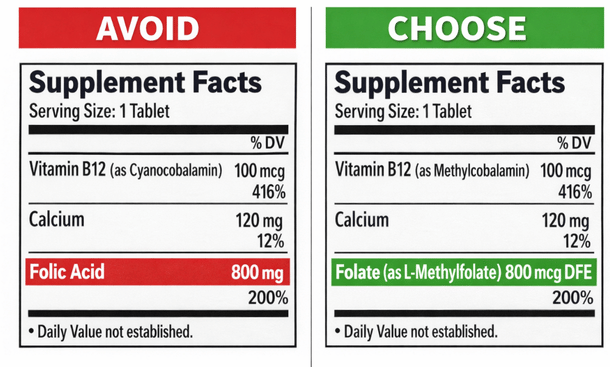
If your prenatal contains folic acid instead of methylfolate (also called L-methylfolate, 5-MTHF, or Metafolin), that’s a significant issue for a huge portion of women.
Here’s why. About 40 to 60 percent of people have a genetic variation called MTHFR that makes it difficult for their bodies to convert synthetic folic acid into the active form of folate their cells actually use. If you’re one of those people and you’re taking folic acid, you might not be getting adequate active folate to your developing baby during those critical first weeks when the neural tube is forming.
Methylfolate, on the other hand, is already in the active form. It works for everyone, regardless of genetics. There’s literally no downside to choosing methylfolate over folic acid—it’s just universally better.
So if you pick up a prenatal bottle and the label says “folic acid” or “folate as folic acid,” put it back. This is non-negotiable. You want to see “folate as L-methylfolate,” “folate as 5-MTHF,” or brand names like Quatrefolic or Metafolin.
Yeah, methylfolate-based prenatals cost more. But this is one area where the extra money is absolutely worth it.
Artificial Colors and Dyes: Completely Unnecessary
This one drives me crazy. Why on earth would a prenatal vitamin—something you’re taking to support a healthy pregnancy—contain artificial food dyes?
And yet, tons of them do. Look for ingredients like FD&C Red No. 40, Yellow No. 5 (tartrazine), Yellow No. 6, Blue No. 1, or any other numbered color additives.
These synthetic dyes serve zero nutritional purpose. They’re purely cosmetic—they make the pills look pretty or colorful. That’s it.
The problem? Some artificial colors have been linked to hyperactivity in children, allergic reactions, and potential carcinogenic effects in animal studies. The research isn’t definitive enough to say they’re definitively dangerous in the small amounts found in vitamins, but here’s my take: why take the risk when there’s absolutely no benefit?
If a company is putting artificial dyes in a prenatal vitamin, it tells me they care more about marketing and appearance than actual quality and safety. Hard pass.
Quality prenatals use natural colorings if they color their capsules at all, or they just leave them plain. That’s what you want.
Synthetic Vitamin E: The Wrong Form
Not all forms of vitamin E are created equal, and this is one area where a lot of prenatals cut corners.
Synthetic vitamin E is listed as “dl-alpha-tocopherol” on ingredient labels. Natural vitamin E is listed as “d-alpha-tocopherol” (notice the “dl” versus just “d”).
Your body absorbs and uses natural vitamin E about twice as effectively as synthetic. Studies show that natural vitamin E has significantly higher bioavailability—meaning more of it actually gets into your system and does its job.
If you’re paying for a prenatal vitamin, you want the form your body can actually use efficiently. Synthetic vitamin E is cheaper to manufacture, which is why budget brands use it, but it’s an inferior form.
Check your label. If it says “dl-alpha-tocopherol,” that’s synthetic. You want “d-alpha-tocopherol” or mixed tocopherols, which are natural forms.
Cyanocobalamin vs. Methylcobalamin: The B12 Issue
Similar to the folate situation, there are different forms of vitamin B12, and one is significantly better than the other.
Cyanocobalamin is the synthetic form of B12. It’s cheap, stable, and widely used. Your body has to convert it into methylcobalamin or adenosylcobalamin (the active forms) before it can use it.
Methylcobalamin is already in an active form your body uses directly. No conversion necessary.
For most people, cyanocobalamin works fine—their bodies convert it without issue. But some people, particularly those with certain genetic variations or absorption issues, don’t convert it efficiently.
Since methylcobalamin works for everyone and cyanocobalamin doesn’t, why not just choose the form that’s universally effective?
Quality prenatals use methylcobalamin. Budget brands use cyanocobalamin to save money. Check your label.
Excessive Vitamin A from Retinol: A Real Concern
Vitamin A is essential for fetal development, but too much of the wrong form can cause serious birth defects, particularly in the first trimester.
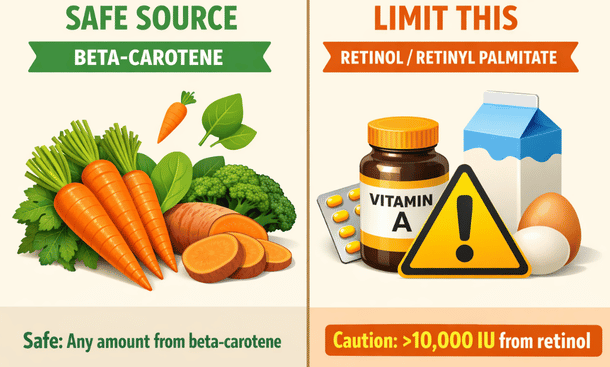
There are two forms of vitamin A: preformed vitamin A (retinol, retinyl palmitate, retinyl acetate) and provitamin A carotenoids (beta-carotene).
Preformed vitamin A is the concern. Doses above 10,000 IU (3,000 micrograms) daily during early pregnancy have been associated with birth defects affecting the heart, skull, and central nervous system.
Beta-carotene, on the other hand, is converted to vitamin A in your body only as needed. You can’t overdose on it—your body just stops converting it when it has enough. It’s completely safe.
Check your prenatal label. If it contains more than 5,000 to 10,000 IU of vitamin A from retinol or retinyl forms, that’s potentially too much. The safest prenatals use beta-carotene as the vitamin A source, or a combination with most coming from beta-carotene.
Some prenatals contain no preformed vitamin A at all and rely entirely on beta-carotene. That’s perfectly fine—your body will make what it needs.
Herbal Ingredients: Proceed with Extreme Caution
Some prenatal vitamins include herbal ingredients like ginger for nausea, red raspberry leaf, or various “women’s health” herb blends.
Here’s the problem: most herbs haven’t been adequately studied for safety during preconception and pregnancy. Some herbs that seem harmless or even beneficial can affect hormone levels, uterine tone, or other aspects of reproductive health in ways we don’t fully understand.
Red raspberry leaf, for example, is sometimes recommended during the third trimester to prepare for labor, but there’s debate about whether it’s safe earlier in pregnancy or during preconception.
Ginger is generally considered safe and can help with nausea, but high doses (more than 1 gram daily) might have blood-thinning effects.
My take? Stick with vitamins and minerals that have clear, established benefits and safety profiles. If you want to use herbs for specific symptoms, do that separately under the guidance of a healthcare provider who specializes in reproductive health—don’t get them randomly mixed into your prenatal where you don’t control the dose.
The safest prenatals stick to vitamins, minerals, and omega-3s. If a prenatal has a long list of proprietary herbal blends, I’d be cautious.
Fillers, Binders, and Flow Agents: The Necessary Evils
Here’s where things get a bit nuanced. Pretty much every supplement contains some fillers, binders, or flow agents—these are ingredients that hold the pill together, prevent ingredients from clumping, or help the manufacturing process.
Common ones include magnesium stearate, stearic acid, silica, cellulose, and various starches.
Are these harmful? Generally, no. They’re used in tiny amounts, and there’s no solid evidence that the quantities in supplements cause problems.
That said, some people prefer to minimize these additives, and some companies use cleaner options than others.
Magnesium stearate, for example, is super common and generally recognized as safe, but some people worry about it because it’s often derived from hydrogenated oils (though the amount is so small it’s unlikely to matter).
Titanium dioxide is used as a whitening agent in some supplements, and there’s been some controversy about its safety. The EU banned it in food products in 2022, though it’s still allowed in supplements in the US. If you want to be extra cautious, you can avoid supplements that list titanium dioxide.
My advice? Don’t stress too much about seeing a few standard excipients on the label—they’re pretty much unavoidable in tablet and capsule manufacturing. But if the inactive ingredients list is longer than the active ingredients list, that’s a red flag that the company is using excessive fillers.
Sugar and Sweeteners in Gummy Vitamins
Gummy vitamins are popular because they’re easy to take and taste good, but they come with significant downsides.
First, gummies can’t contain iron because it destroys the gummy texture. So right away, you’re missing a critical nutrient.
Second, gummies typically contain added sugars or sugar alcohols to make them palatable. Some contain 3 to 5 grams of sugar per serving (and a serving is often multiple gummies). That might not sound like a lot, but when you’re taking them daily, it adds up.
Sugar alcohols like maltitol or sorbitol can cause digestive upset—bloating, gas, diarrhea—especially if you’re taking multiple gummies.
Third, gummy formulations typically have lower doses of nutrients because the gummy format doesn’t allow for as much active ingredient as a capsule or tablet.
Are gummies better than nothing? Sure. If the choice is between taking a gummy prenatal and not taking anything at all because you can’t stomach pills, take the gummy. Just make sure you’re adding a separate iron supplement and checking that the doses of key nutrients are adequate.
But if you can tolerate capsules or tablets, that’s a better option.
Proprietary Blends: Hiding Behind Vague Labels
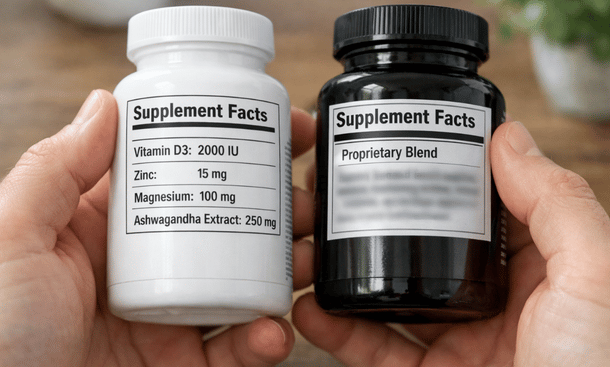
A proprietary blend is when a supplement lists multiple ingredients under one umbrella term without disclosing how much of each ingredient is included.
For example, a label might say “Women’s Herbal Blend – 500mg” and then list five or six herbs underneath. You have no idea if you’re getting 400mg of one herb and 20mg each of the others, or if they’re evenly distributed.
This is a red flag for several reasons. First, you can’t know if you’re getting therapeutic doses of anything. Second, if you have a reaction, you don’t know which ingredient caused it. Third, it allows companies to hide the fact that they’re using tiny, ineffective amounts of expensive ingredients while still listing them on the label for marketing purposes.
Quality supplement companies are transparent. They list exactly how much of each ingredient is in their product. If you see “proprietary blend” on a prenatal vitamin label, I’d keep shopping.
Mega-Doses: More Isn’t Always Better
Some prenatals brag about having “extra strength” formulas or mega-doses of certain nutrients. This sounds impressive, but it’s often unnecessary and occasionally harmful.
Your body can only absorb so much of certain nutrients at once. Taking massive doses doesn’t mean you’re getting more benefit—it often just means you’re producing expensive urine as your body excretes the excess.
Worse, some nutrients can actually be harmful in excessive amounts. We already talked about vitamin A from retinol. But high doses of certain B vitamins, particularly B6, can cause nerve damage over time. Excessive zinc can interfere with copper absorption. Too much iron can cause digestive issues and oxidative stress.
The goal is adequate amounts of nutrients in the right forms, not massive amounts for the sake of marketing.
Check the doses on your prenatal label against established recommendations. For most nutrients, you want to be at or slightly above the RDA (recommended dietary allowance), but not at 500 percent of the RDA unless there’s a specific therapeutic reason.
Missing Key Nutrients: What Should Be There But Isn’t
Just as important as avoiding bad ingredients is making sure your prenatal actually contains what you need.
A shocking number of prenatals are missing iodine. You need 150 micrograms daily before conception, and many women are deficient. If your prenatal doesn’t contain iodine, that’s a deal-breaker.
Many prenatals also skimp on vitamin D. You want at least 800 to 1,000 IU, and preferably 2,000 IU. If your prenatal only has 400 IU, that’s not enough for most women.
Choline is another nutrient that’s often missing entirely. You need 450 milligrams daily during pregnancy, and most women don’t get nearly enough from food. Very few prenatals contain adequate choline—it’s bulky and expensive. But if you can find one that includes at least some choline, that’s a plus.
DHA is missing from most pill-based prenatals. You need 200 to 300 milligrams daily. If your prenatal doesn’t include it, you’ll need a separate omega-3 supplement.
Calcium is rarely included in adequate amounts because it’s so bulky it would make the pills enormous. Most prenatals have 200 to 300 milligrams at most, whereas you need 1,000 milligrams daily. This is normal—you’re expected to get most of your calcium from food or a separate supplement.
Allergens and Sensitivities
If you have food allergies or sensitivities, you need to read prenatal labels carefully.
Common allergens that might be lurking in prenatals include soy (often used as a filler or as a source of vitamin E), dairy (lactose is sometimes used as a filler), gluten (from wheat-derived ingredients), fish (if the prenatal contains omega-3s from fish oil), and tree nuts (sometimes used as sources of vitamin E or other nutrients).
Most quality prenatals will clearly state on the label if they’re free from major allergens. Look for statements like “gluten-free,” “dairy-free,” “soy-free,” etc.
If you have celiac disease or severe gluten sensitivity, make sure your prenatal is certified gluten-free, not just “made in a gluten-free facility.” Cross-contamination can be an issue.
If you’re vegan, watch out for gelatin capsules (from animal sources), vitamin D3 from lanolin (sheep’s wool), and omega-3s from fish oil. Vegan prenatals use vegetable capsules, vitamin D2 or lichen-derived D3, and algae-based omega-3s.
Quality and Testing Red Flags
Beyond specific ingredients, there are broader quality issues to watch for.
If a prenatal doesn’t have any third-party testing or certification (like NSF, USP, or ConsumerLab), that’s not automatically disqualifying, but it means you’re taking the company’s word that what’s on the label is actually in the bottle and that it’s free from contaminants.
If the company has a history of FDA warning letters or recalls, that’s a major red flag. You can search for this information on the FDA’s website.
If the prenatal is significantly cheaper than comparable products, ask yourself why. Quality ingredients cost money. If a company is selling a comprehensive prenatal for 10 bucks a month when similar formulas cost 30 to 40 dollars, they’re cutting corners somewhere—either with ingredient quality, forms, doses, or manufacturing standards.
If the company makes outrageous claims like “guaranteed to help you conceive” or “clinically proven to prevent miscarriage,” run. No prenatal vitamin can make those promises, and any company willing to make them is either misleading you or outright lying.
How to Actually Read a Supplement Label
Here’s a quick guide to decoding prenatal labels so you can spot the red flags yourself.
Start with the supplement facts panel. Check the serving size—is it one pill, two pills, six pills? Make sure you’re comfortable with taking that many daily.
Look at the folate line. Does it say “folic acid” or “folate as L-methylfolate”? You know which one you want.
Check the vitamin B12 line. Cyanocobalamin or methylcobalamin?
Look at vitamin E. Is it “dl-alpha-tocopherol” (synthetic) or “d-alpha-tocopherol” (natural)?
Check vitamin A. How much is from beta-carotene versus retinol? If there’s more than 10,000 IU from retinol, be cautious.
Look for iodine. Is it there? How much?
Check vitamin D. At least 800 to 1,000 IU?
Is there DHA? How much?
Then scroll down to the “other ingredients” section. This is where you’ll see fillers, binders, and potential allergens. Look for artificial colors (FD&C anything), excessive fillers, or ingredients you’re sensitive to.
If anything raises a red flag, keep shopping.
Brands I’d Personally Skip
Based on everything we’ve covered, here are some brands and types of prenatals I wouldn’t recommend.
Most store-brand generic prenatals from drugstores use folic acid instead of methylfolate, cyanocobalamin instead of methylcobalamin, and synthetic vitamin E. They’re cheap, but you’re not getting optimal forms of nutrients.
One A Day Prenatal uses folic acid, has low doses of several key nutrients, and uses inferior forms. There are better options at the same price point.
Vitafusion Prenatal Gummies are missing iron entirely, contain added sugars, and have lower doses of most nutrients compared to pill-based prenatals.
Any prenatal that contains artificial colors, flavors, or sweeteners. There’s no reason for these to be in a supplement you’re taking for your health.
Any prenatal with proprietary blends that don’t disclose individual ingredient amounts.
Any prenatal making unrealistic promises or claims that sound too good to be true.
What You Should Be Looking For Instead
So if you’re avoiding all these red flags, what should you actually be choosing?
Look for methylfolate, not folic acid. Methylcobalamin for B12. Natural vitamin E (d-alpha-tocopherol). Beta-carotene as the vitamin A source, or at least limited retinol (under 10,000 IU). Adequate doses of vitamin D (1,000 to 2,000 IU), iodine (150 micrograms), iron in an absorbable form like ferrous bisglycinate, and zinc.
DHA is a bonus if it’s included, but you can take it separately if needed.
Third-party testing certification is a strong indicator of quality.
Minimal fillers and no artificial colors, flavors, or sweeteners.
Transparency about ingredient sources and forms.
A company with a good reputation and track record in the supplement industry.
And honestly, all of this information comes together when you’re comparing actual products and trying to figure out which one checks all the boxes. If you want specific brand recommendations and detailed comparisons of what’s actually worth your money, check out our guide to the best prenatal vitamins to take before pregnancy—we break down exactly which brands deliver on quality and which ones are just expensive marketing.
The supplement industry banks on the fact that most people don’t read labels carefully and don’t know what to look for. Companies can get away with using cheap, inferior ingredients because they know consumers are overwhelmed by choices and often just grab whatever has the prettiest package or the best Instagram presence.
But you’re not most people. You’re doing your research, asking the right questions, and refusing to settle for a prenatal that’s full of junk or missing critical nutrients. That level of intentionality matters, and your future baby benefits from it.
Now that you know what to avoid, you’re equipped to read labels like a pro and spot the red flags that signal a low-quality product. The goal isn’t perfection—it’s choosing a prenatal that contains what you actually need in forms your body can use, without unnecessary additives or potential risks.
And remember, choosing the right prenatal is just one piece of preparing your body for pregnancy. All of these details—the nutrient forms, the doses, the timing, what to avoid—fit together into a comprehensive preconception strategy. Head back to our complete guide to preconception vitamins to see the full picture and make sure you’re covering all your bases.
You’ve done the hard work of educating yourself. Now use that knowledge to make smart choices that support your health and your baby’s best possible start.
